
What if the most sophisticated R&D department on earth has already spent 3.8 billion years perfecting the very systems your business is currently struggling to reinvent? Many leaders across London and Sydney are waking up to the reality that our current industrial models are failing both our people and our planet. You likely feel the heavy pull of corporate burnout and a deep seated guilt over practices that take more than they give. To heal this, we must first ask: what is biomimicry and how can it help us start listening to the voice of nature?
In this guide, we’ll explore how this ancient wisdom serves as a bridge between the boardroom and the living world. You’ll discover how to transform your organisation from a rigid machine into a flourishing ecosystem that regenerates itself and its community. We’ll examine the practical steps to begin this transition, starting with the essential foundation of private leadership mentoring to help you finally take your seat in natures boardroom.
Key Takeaways
- Discover what is biomimicry by shifting your perspective from observing the natural world to learning from its three billion years of regenerative wisdom.
- Learn how to invite the voice of nature into your strategy to replace extractive habits with circular models that ensure long term resilience and diversity.
- Embrace the wayfinder path by grounding your transformation in private leadership coaching or mentoring to align your organisational culture with biological life principles.
- Explore how leaders from London to Sydney are redesigning their boardrooms to act as flourishing ecosystems that nurture both profit and the planet.
- Master the art of nature aligned leadership to move beyond mere sustainability and create an enduring legacy that allows your business and community to truly flourish.
Understanding the Essence: What is Biomimicry in a Regenerative Context?
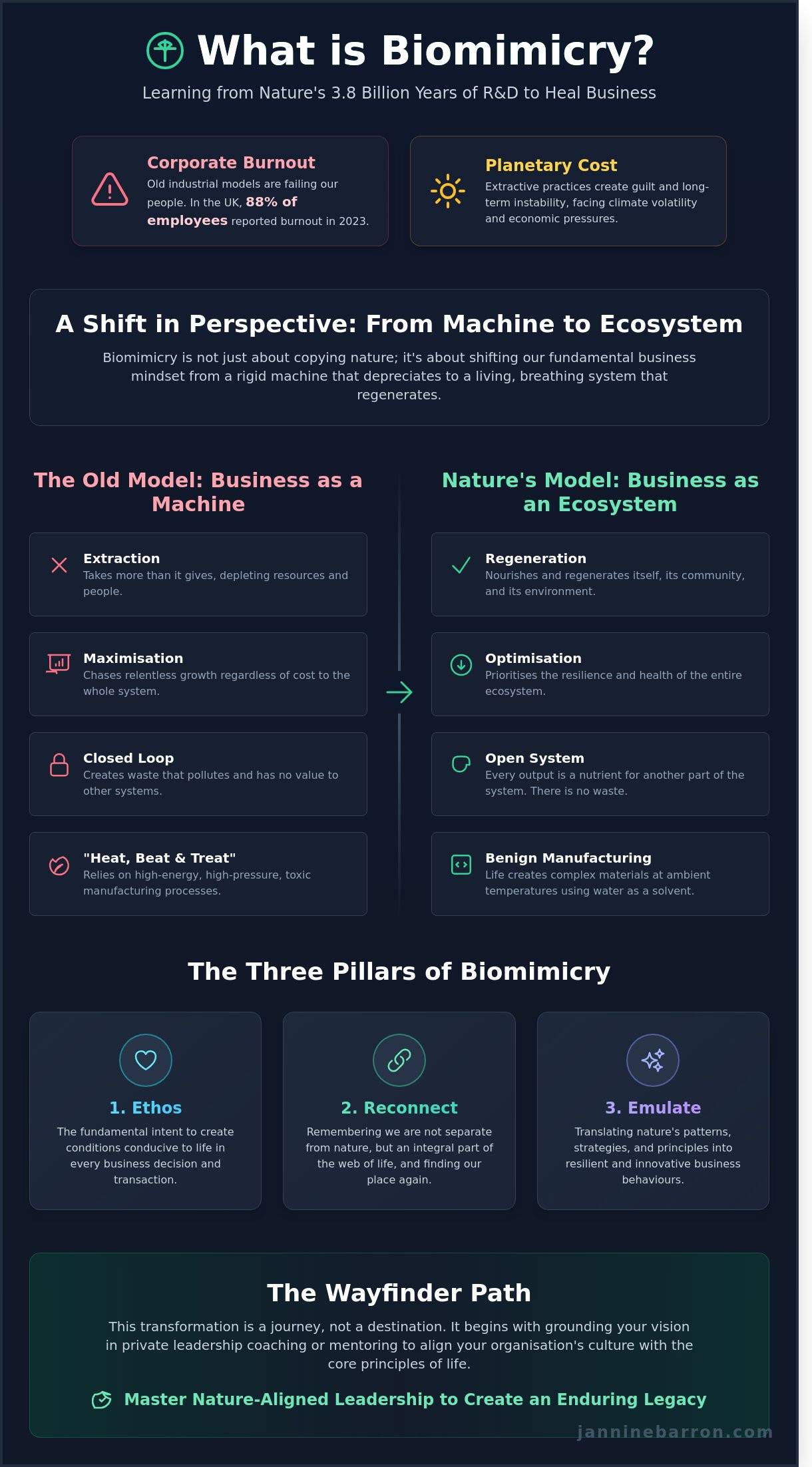
We stand at a threshold where the old mechanics of industry no longer serve the heartbeat of our planet. For decades, we viewed our companies as cold engines; we measured success by how much we could extract and how fast we could grow. Now, a profound shift is occurring in the way we perceive our roles as leaders. We are asking a deeper question: what is biomimicry in the context of a world that needs to heal? It’s the conscious emulation of life’s 3.8 billion years of wisdom to solve our modern human challenges. This isn’t just about looking at a leaf and making a better solar panel. It’s about inviting the Voice of Nature into our boardrooms as a silent yet powerful strategic partner. We are moving away from learning about nature as a resource and moving toward learning from nature as a mentor.
To truly embrace this, we must frame the business as a living system rather than a machine. A machine is a closed loop that depreciates; a living system is an open, breathing entity that can regenerate its surroundings. When we ask what is biomimicry, we’re really asking how we can return home to the biological laws that govern all successful systems. This transition requires a wayfinder who understands that leadership is not about control, but about tending to the conditions that allow an entire ecosystem to flourish. We are birthed from the earth, and our commerce should reflect that sacred origin.
The Three Pillars of Biomimicry
The foundation of this work rests upon three essential pillars that guide our transformation. First, there’s Ethos. This is the fundamental intent to create conditions conducive to life within every transaction and supply chain decision. Second, we must Reconnect. We aren’t separate from the woods or the oceans; we’re part of the web of life. We must find our place again. Finally, we Emulate. We translate biological patterns into resilient business behaviours. Biomimetics or biomimicry offers a rigorous framework for this translation, ensuring our innovations respect the limits and logic of the natural world. It’s a bridge between the forest floor and the executive suite.
Why UK and Australian Leaders are Turning to Nature
Leaders in the glass towers of London and the sun drenched expanses of the Australian bush are feeling the same exhaustion. In the UK, corporate burnout reached record levels in 2023, with 88 percent of employees reporting some form of burnout according to Mental Health UK. Meanwhile, Australian founders face the brutal reality of climate volatility and a 4.1 percent interest rate environment that demands new ways of thinking about resilience. They’re seeking a sanctuary from the frantic pace of traditional capitalism.
This is where the regenerative business mentor steps in. I act as an executive doula, helping leaders give birth to ideas that nourish rather than deplete. Aligning with nature offers a path out of the burnout cycle. By listening to the Voice of Nature, we find strategies that are both poetic and pragmatic. Whether you’re navigating the complex regulations of the London Stock Exchange or the unique ecological challenges of New South Wales, the principles remains the same. We must bide our time, observe the cycles, and build organisations that act like ancient forests; diverse, interconnected, and eternally renewing. This is the first step in our journey together through natures boardroom.
The Mechanisms of Life: How Nature Solves Complex Problems
Nature doesn’t have a waste management department because waste simply doesn’t exist in the wild. Every output of one system becomes the nutrient for another. In natures boardroom, success isn’t measured by quarterly extraction but by the ability to sustain life over 3.8 billion years of evolution. To understand what is biomimicry, we must look at it as a bridge between biology and business. It’s the practice of asking how a forest would manage a budget or how a reef would handle a merger.
Life operates on a model of optimisation rather than maximisation. Modern corporate structures often chase 15% annual growth regardless of the cost to the surrounding environment. In contrast, a healthy ecosystem prioritises the resilience of the whole. This resilience is rooted in diversity. An ancient woodland with 1,000 species is far more stable than a monoculture plantation. When we apply this to business, we see that diverse teams and varied revenue streams aren’t just ethical choices; they’re survival strategies that protect us from market volatility.
Nature builds using benign manufacturing. While human industry often relies on “heat, beat, and treat” methods involving toxic chemicals and high pressure, life creates complex materials at ambient temperatures. We see this reflected in Biomimicry in architecture and design, where structures are now being built to sequester carbon or regulate heat using the same principles as a termite mound. By using local materials and life-friendly chemistry, we can reduce our overheads and our ecological footprint simultaneously.
Learning from the Forest Floor in Wiltshire
In the ancient woodlands of Savernake Forest, the “wood wide web” operates without a single CEO. Mycelial networks, comprising over 10,000 species of fungi in the UK, distribute nutrients from nutrient-rich areas to saplings struggling in the shade. This isn’t charity; it’s a strategic investment in the forest’s future health. You can apply this to your supply chain by moving away from predatory procurement toward collaborative partnerships. When your suppliers thrive, your entire business ecosystem becomes more robust against global shocks.
Resilience Lessons from the Australian Outback
The Australian landscape offers a masterclass in adaptation. Flora like the Eucalyptus have evolved over 60 million years to thrive amidst the cycles of fire and flood. Some species only release their seeds after the intense heat of a bushfire, a lesson in finding the “growth spark” within a crisis. Indigenous perspectives on kincentric leadership remind us that we are not separate from nature; we are nature. This deep time wisdom suggests that resource management should be viewed through the lens of seven generations. A kangaroo doesn’t overgraze its territory to the point of collapse; it moves in rhythm with the land’s capacity. As a wayfinder in your industry, you can learn to listen to the voice of nature to determine when to push for growth and when to rest.
If you feel called to bring this wisdom into your own work, my leadership coaching offers a path to align your business with these ancient, regenerative rhythms. We don’t need to reinvent the wheel; we just need to remember how the world actually works.
Biomimicry for Business: Moving Beyond Extraction
Most UK businesses still operate on an extractive pulse. They pull resources from the earth and energy from their people without a plan for replenishment. This linear “take make waste” model is reaching its biological limit. When we ask what is biomimicry in a corporate context, we aren’t just talking about copying the shape of a leaf for a better solar panel. We’re talking about a profound shift in how we lead. It’s an invitation to move toward The Growth Experience where profit becomes a natural byproduct of a healthy, flourishing ecosystem rather than the result of exhaustion.
Sustainability is no longer enough. To sustain is simply to maintain a state of “less bad,” which won’t heal our fractured landscapes or our burnt out workforces. Regeneration is the goal. It’s the difference between a plastic plant that stays the same and a living oak that drops acorns to feed the soil and the squirrels. By understanding The Biomimicry Institute’s definition of this practice, we see that nature doesn’t have a waste department. Every output is an input for something else. Your business can mirror this by designing circular supply chains and organisational cultures that leave every stakeholder, from the soil to the shareholder, better off than they were before.
Redesigning the Boardroom
The traditional boardroom is often a sterile cage of glass and steel that disconnects us from the very life we’re trying to protect. I invite leaders into natures boardroom; a space for strategic immersion where the trees become our mentors. When we stand among ancient woodlands, the frequency of leadership shifts. We move away from the frantic, fear based decision making of the city and into a state of calm, rooted love. In this space, we don’t just solve problems; we listen to the wisdom of the forest. This immersion allows us to see that true power isn’t about control; it’s about the ability to nourish the whole system. Decisions made in the presence of trees carry a different weight and a longer legacy.
The Voice of Nature in Your Strategy
How do we practically invite the more than human world into our meetings? We start by giving it a seat at the table. Using the “Council of All Beings” framework, we ask how a proposed strategy affects the local watershed, the soil microbes, or the birds that migrate through our lands. This isn’t a poetic exercise; it’s a rigorous ethical filter for the 21st century. We can look to the resilience of the Australian bush, where certain seeds only germinate after the heat of a fire, to understand how our own businesses can find life in the midst of crisis.
Birthing ideas that serve the whole ecosystem requires us to stop acting like owners and start acting like stewards. When the voice of nature is heard, our strategies become more than just financial targets. They become life affirming blueprints. We stop focusing on short term extraction and start tending to the long term health of our community. This is how we move beyond the clinical or aggressive styles of traditional coaching and into the role of a wayfinder, guiding our organisations toward a future where every living thing has the chance to thrive.
The Wayfinder Path: Practical Steps to Nature Aligned Leadership
Leadership is not a set of mechanical tasks; it is the stewardship of a living system. To lead in a way that honours the planet, we must first unlearn the extractive habits that have defined the last 150 years of industrial growth. This transformation begins with a shift in perspective. Instead of viewing your organisation as a machine to be optimised, you start to see it as an organism that needs to thrive. This is where the journey of a Wayfinder begins. It is a path that requires both the courage to dismantle old paradigms and the softness to listen to the voice of nature.
This principle of nurturing a living system extends beyond the boardroom to our own bodies. Just as a business ecosystem requires balance to thrive, so too does our personal health. For those interested in how natural harmony applies to wellness, you can learn more about Nutrahara.
Starting Your Mentoring Journey
The foundational first step for any leader ready for this shift is engaging in private leadership coaching or deep mentoring. This isn’t your standard corporate training. It is a space for unlearning the “growth at all costs” mindset that has led to the 19 percent decline in UK biodiversity since 1970. Finding a mentor who acts as a business doula is essential. A doula doesn’t do the work for you; they hold the space while you birth a new way of being. They help you bring the soul of your brand into the light. You can begin this transformation by exploring The Process, which serves as a map for leaders ready to step into natures boardroom.
When we ask what is biomimicry in a leadership context, we find it is the practice of looking to biological life principles to solve human problems. Nature doesn’t have a waste department. It operates in closed loops where the output of one process becomes the nutrient for another; to see a practical application of this in modern cultivation, you can learn more. By observing your business through this lens, you can identify where energy is being leaked or where resources are being exploited rather than cycled. In Australia, Indigenous Wayfinders have used these observational skills for over 65,000 years to maintain a balance that Western business is only just beginning to understand. We can learn much from the way they read the land as a living textbook of strategy.
- Mapping Business Cycles: Align your quarterly goals with the seasons of the earth. Use the winter months for fallow reflection and the spring for rapid prototyping and planting.
- Tending the Team: View your staff as a flourishing garden. A gardener doesn’t force a rose to bloom; they ensure the soil is nutrient dense and the environment is supportive.
- Kincentric Leadership: Recognise that your brand is part of a wider web of life. Every decision should consider the impact on the “kin” in your supply chain; from the soil in Somerset to the workers in New South Wales.
Nature Immersion in London and Somerset
Clarity rarely arrives behind a desk. To truly understand what is biomimicry and how it applies to your vision, you must reset your nervous system in the wild. Even in London, pockets of wildness like Richmond Park or the ancient woodlands of Highgate offer the quiet needed for forest therapy. Research shows that just 120 minutes a week in nature significantly lowers cortisol levels and boosts creative problem solving. For those seeking a deeper reset, a retreat to the ley lines of Glastonbury or the vast horizons of Salisbury provides the silence required to hear the voice of nature. These landscapes hold a frequency that helps leaders ground their loftiest visions in practical, regenerative action. For leaders ready to embrace nature based problem solving for regenerative leaders in the UK and Australia, these immersive experiences become the foundation for transforming complex business challenges into opportunities for regenerative growth.
Are you ready to stop managing and start wayfinding? Connect with me to begin your regenerative business mentoring today.
Embodying the Change: Your Invitation to Flourish
The time for incremental change has passed. We stand at a threshold where the 2023 climate reports demand a radical shift in how we conceive of commerce. Choosing to become a regenerative leader isn’t just a career move; it’s a commitment to the web of life. When you ask what is biomimicry, you’re looking for a blueprint to build an organisation that functions like a healthy forest. This approach ensures your business creates more value than it consumes, leaving a legacy that future generations will thank you for. In the UK, where 80% of the population now lives in urban areas, reconnecting with these biological truths is vital for our collective success.
We’ve been conditioned by a hustle culture that mirrors an invasive species, spreading rapidly but ultimately depleting the soil. This model is unsustainable. Nature doesn’t bloom all year round. It respects seasons, cycles, and rest. By aligning with these natural rhythms, you protect your energy and the wellbeing of your team. This transition involves moving from a mindset of extraction to one of stewardship. It’s about birthing ideas that have the resilience of the Australian banksia, which requires the heat of fire to release its seeds. In the 2020 bushfire recovery, we witnessed how these species don’t just survive; they use the crisis to regenerate. Your business challenges are often the very catalysts needed for your greatest growth.
True leadership today requires a deep listening to the voice of nature. This isn’t a clinical exercise. It’s a soulful reclamation of our place within the ecosystem. When we apply the principles of what is biomimicry to our supply chains and internal structures, we move beyond being “less bad” to being “actively good.” We become the wayfinders who show that profit and planetary health are not mutually exclusive but are, in fact, deeply interdependent. This is the path to a life affirming economy. For leaders ready to embrace this transformation, understanding the comprehensive framework of regenerative business in the UK and Australia provides the practical roadmap for implementing these principles across your entire organisation.
The Growth Experience Incubator
Scaling a brand often feels like losing its essence. My nine month incubator for ethical brands changes that narrative. We use biological models to ensure your impact grows while your soul remains intact. This journey focuses on regenerative systems that allow for expansion without exhaustion. You can explore how this process works by visiting The Programmes to see which path aligns with your current season of growth and helps you scale your impact with grace.
Step into Natures Boardroom
Sometimes the answers aren’t found in a spreadsheet but in the dappled light of a Wiltshire woodland or a quiet London park. During a nature immersion day, we leave the digital noise behind to enter natures boardroom. Here, we consult the original experts. These sessions are designed to help you hear the voice of nature clearly, providing clarity on complex strategic hurdles. If you’re ready to lead with a different rhythm, please Contact me to book a discovery call and begin your transformation into a regenerative leader.
Cultivate Your Legacy as a Regenerative Wayfinder
The transition from an extractive mindset to a life aligned one requires more than just a shift in strategy; it demands a transformation of the heart. We’ve explored how 3.8 billion years of biological wisdom provides the ultimate blueprint for solving complex human challenges. Understanding what is biomimicry serves as your portal into this intelligence, allowing you to move beyond sustainability into true regeneration. Whether you lead a team in the heart of London or navigate the unique coastal markets of Sydney, the voice of nature offers a steady rhythm for your growth. Since 1994, I’ve dedicated my career to ethical business, helping leaders bridge the gap between the boardroom and the forest floor.
Through the Growth Experience incubator and immersive sessions in Natures Boardroom, we strip away the clinical layers of traditional coaching to reveal a more soulful, effective path. You don’t have to carry the weight of the climate crisis alone when the solutions are already etched into the ecosystem around you. It’s time to nurture an organisation that doesn’t just survive but flourishes alongside the planet.
Begin your journey into nature aligned leadership with private mentoring
Your leadership is a seed that, when planted with intention, can grow into a forest of impact. Let’s start sowing those seeds today.
Frequently Asked Questions
How is biomimicry different from traditional sustainable business?
Traditional sustainability often focuses on damage limitation and reducing carbon footprints to zero, whereas biomimicry seeks to create conditions conducive to life. When we explore what is biomimicry, we move beyond just being less bad to becoming actively regenerative by mimicking the 3.8 billion years of wisdom found in the natural world. Data from the 2023 State of Green Business report indicates that while 92 percent of UK firms have sustainability targets, only 2 percent currently employ regenerative design principles that restore ecosystems.
Do I need a science background to use biomimicry in my leadership?
You don’t need a PhD in biology to invite the voice of nature into your decision making process. Leadership coaching is the essential first step because it shifts your perspective from a commander to a gardener. My role as a wayfinder is to help you sit in natures boardroom and translate biological strategies into organisational flow. We use the 10 elements of the Biomimicry Design Lens to guide your strategy without requiring you to step into a laboratory.
Can biomimicry help with employee engagement and team culture?
Biomimicry transforms toxic cultures into thriving ecosystems by mirroring the mutualism found in mycelium networks. Gallup 2023 report on the global workplace shows that only 10 percent of UK employees feel engaged, yet companies that adopt nature aligned structures see a 21 percent increase in productivity. I often look to the resilience of Australian Eucalyptus forests after fire as a metaphor for team recovery. These trees don’t just survive; they use the heat to release seeds and foster new growth for the entire canopy.
What are some examples of biomimicry in UK businesses?
UK based Exploration Architecture, founded in 2007, leads the way by designing buildings that function like closed loop ecosystems. Another example is the carpet manufacturer Interface, which uses random diversity inspired by forest floors to reduce waste by 50 percent during installation. These organisations prove that nature inspired innovation isn’t a distant dream but a practical reality for British industry. By following these biological blueprints, businesses in London and beyond are cutting material costs by up to 30 percent while enhancing aesthetic value.
How does a regenerative business mentor help with nature alignment?
As your regenerative business mentor, I act as a business doula to help you birth ideas that are inherently life affirming. This journey begins with private leadership coaching where we quiet the human ego and listen to the voice of nature. We move away from the clinical extraction of traditional consulting and instead focus on nurturing your legacy. By aligning your business with the rhythms of the seasons, we ensure your growth is sustainable and your impact is deeply rooted in the soil of your community.
What is kincentric leadership and why does it matter now?
Kincentric leadership is the practice of viewing the natural world not as a resource but as a relative with a seat at the table. This approach is vital because our current economic models have failed to account for the 1,000,000 species currently facing extinction. I draw heavily on Australian First Nations wisdom where the land is kin, ensuring every boardroom decision considers the next seven generations. Recent 2022 studies from the University of Exeter suggest that kincentric models improve long term organisational resilience by 40 percent compared to traditional hierarchies.
Is biomimicry applicable to service based businesses or just products?
Biomimicry is deeply relevant to service based models because it provides a framework for understanding complex human systems and information flow. When we define what is biomimicry in a service context, we look at how a coral reef manages energy or how a hive organises communication without a central manager. Research from the Biomimicry Institute in 2021 shows that service firms applying these biological principles can reduce operational friction by 25 percent. It’s about birthing a culture that breathes and adapts just as a living organism does. If you’re feeling trapped in systems that drain rather than nourish, understanding what is an extractive business model can help you identify the patterns that need to shift before you can fully embrace regenerative practices.