
What if the blueprint for your next boardroom breakthrough was not hidden in a spreadsheet but written in the mycelial networks beneath a 400 year old oak in the Cotswolds? For many leaders in the UK and Australia, the relentless pursuit of 10 percent quarterly growth has led to a spiritual and physical exhaustion that no standard holiday can cure. You likely feel that current sustainability efforts are little more than thin greenwashing, leaving you disconnected from the natural world you wish to protect. I understand this deep fatigue because I see it in every leader who enters Natures Boardroom seeking a different way to lead. Nature based problem solving offers a pathway out of this extractive cycle by inviting the Voice of Nature back into your strategic planning. It is time to listen.
By starting with private business mentoring, you can begin to align your personal values with your professional output. This article promises to show you how nature based problem solving transforms extractive business models into regenerative systems that flourish in both the UK and Australia. We will explore a practical framework to apply biological efficiency to your operations and introduce you to a community of wayfinders who embrace Kincentrism as the foundation of a life affirming economy.
Key Takeaways
- Learn to transform extractive business models into flourishing systems through nature based problem solving that mimics the resilience and efficiency of natural ecosystems.
- Master the principles of Kincentrism and biomimicry to align your business strategy with the deep wisdom and interconnectedness of the living world.
- Discover how to bring the voice of nature into your strategy sessions by establishing natures boardroom as a sanctuary for visionary thinking.
- Recognise why private mentoring is the essential first step for any leader seeking to unlearn extractive behaviours and embrace a wayfinder role.
- Explore why regenerative models are the most pragmatic choice for business survival and founder wellbeing within the UK and Australian markets.
What is nature based problem solving for modern leaders?
Modern leadership often feels like a relentless battle against a closing window of time. Nature based problem solving offers a different rhythm. It is a way of thinking that mimics the resilience and efficiency of ecosystems rather than the cold, linear output of a factory. This methodology invites us to stop treating our organisations as machines and start tending to them as living forests. By observing how an ancient woodland manages waste or how a reef adapts to rising temperatures, we find blueprints for business logic that sustains rather than depletes.
This approach moves us toward a sophisticated understanding of interconnectedness. What are Nature-Based Solutions? This foundational concept serves as a guide for leaders who wish to move beyond simple sustainability into a space where every decision feeds the whole. To truly lead, we must listen to the voice of nature and allow it to inform our strategic direction.
To better understand this concept, watch this helpful video:
The shift is urgent. By 2026, the UK Sustainability Disclosure Requirements will demand a level of transparency and long term planning that many current business models cannot survive. We are no longer in a season where we can prioritise short term gain over the health of the planet. This is why private business mentoring is the essential first step in leadership coaching. We must first heal the perspective of the individual leader before we can birth a regenerative organisation. Nature based problem solving requires us to look at the root causes of our systemic failures rather than just trimming the leaves of the problem.
From extractive to regenerative thinking
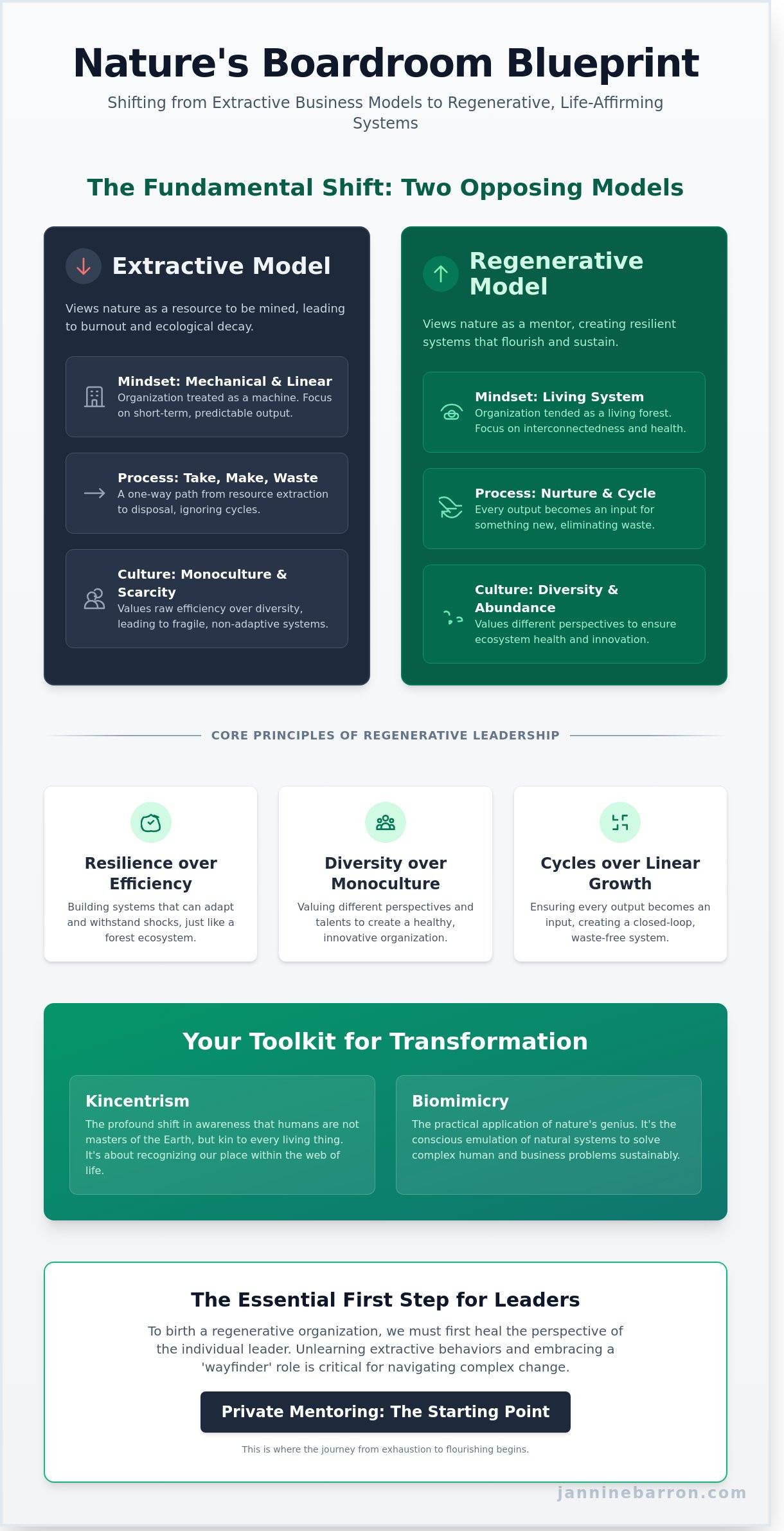
For decades, the corporate world viewed the earth as a mere resource to be mined. We took, we made, and we wasted. Regenerative thinking asks us to see nature as a mentor instead. This profound shift impacts every supply chain decision and the very marrow of team culture. When we embrace regeneration, we move away from extractive habits that lead to burnout and ecological decay. We start to birth ideas that have the stamina to last for generations. It is about moving from a mindset of scarcity to one of Kincentrism, where we recognise our place within the web of life. Consider these shifts:
- Resilience over raw efficiency: Building systems that can withstand shocks.
- Diversity over monoculture: Valuing different perspectives to ensure ecosystem health.
- Cycles over linear growth: Ensuring every output becomes an input for something new.
The wayfinder approach in the UK and Australia
A wayfinder does not use a fixed map; they read the stars, the winds, and the currents. In the boardrooms of London or the creative hubs of Sydney, this approach is vital for navigating complex system change. Whether we are drawing inspiration from the ancient chalk streams of Wiltshire or the resilient, fire adapted eucalyptus of the Australian bush, the local landscape informs our strategic perspective. Each environment teaches us something unique about survival and flourishing.
Traditional business coaching often fails because it treats the symptoms of stress rather than the root cause of disconnection. It ignores the wisdom found in natures boardroom. To lead through a transition, a leader needs emotional depth and a quiet confidence that solutions already exist in the natural world. This is not just about profit; it is about the legacy we leave. We must learn to walk with the land to find our way home to a life affirming economy.
The mechanics of Kincentrism and biomimicry in business
Nature does not operate in silos; it breathes through interconnected networks where every element serves a purpose. When we embrace Kincentrism, we acknowledge that humans are not masters of the Earth but kin to every leaf, river, and species. This is a profound shift in awareness that transforms how we lead. Biomimicry then provides the practical toolkit for this awareness. It is the conscious emulation of nature’s genius to solve human problems. By observing how a forest manages resources without waste, we find the blueprints for a more resilient business model. This is the heart of nature based problem solving. We stop forcing growth and start nurturing the conditions for it to happen naturally. Before we can apply these patterns to a global supply chain, we must first look inward. I often find that private business mentoring is the essential first step in leadership coaching, as it allows a leader to realign their internal compass with these biological truths.
Applying Kincentrism to your team and stakeholders
Think of your team not as a machine with replaceable parts but as a thriving woodland. Your employees and customers are vital organisms within a shared habitat, each contributing to the collective health of the organisation. Moving away from rigid command and control structures allows for mutualistic relationships where every voice contributes to the whole. In this space, we value the voice of nature alongside the balance sheet. Kincentrism is a foundational pillar for life affirming leadership. It requires us to listen deeply to the needs of the collective. When we treat stakeholders as kin, loyalty grows from a place of shared purpose rather than transactional obligation. This shift creates a fluid environment where teams self organise, much like a flock of birds or a school of fish, responding to challenges with collective intelligence rather than waiting for a top down directive.
Biomimicry as a tool for systemic innovation
In the UK, the move toward a circular economy is gaining momentum as businesses seek to eliminate waste. We can look at how natural systems manage resources; in nature, waste is simply food for something else. Businesses can mirror this by designing out waste in supply chains and creating closed loop systems. We can also use biological patterns to design communication networks that are as resilient as mycelial webs. For those seeking deeper technical insight into these applications, you might explore this biomimicry problem solving guide. Grounding these shifts in academic data is essential for credibility in the boardroom. The University of Oxford’s Nature based Solutions Initiative provides extensive evidence on how these ecological strategies support long term stability and climate resilience. This approach to nature based problem solving ensures our innovations are life aligned and durable. When we bring these principles into natures boardroom, we begin to see solutions that were previously hidden by traditional corporate logic. If you feel called to explore how these systems can transform your specific organisation, you can learn more about the process of regenerative transition.
Comparing extractive versus regenerative problem solving models
The traditional business model operates like a mine; it extracts value until the resource is exhausted. This logic dictates that we must squeeze every drop of productivity from our teams and the earth to satisfy the hunger for quarterly growth. In London, this pressure contributes to a culture where mental ill health costs employers approximately £56 billion annually. When we treat our organisations as machines rather than living systems, we create a brittle environment. The traditional boardroom, with its glass walls and sterile air, often silences the very intuition needed to survive a crisis. It stifles the nature based problem solving that allows a leader to see beyond the immediate spreadsheet.
The high price of the extractive habit
Extractive decision making carries a heavy, often invisible tax. In Sydney, the drive for urban expansion without regard for natural watersheds has led to systemic fragility during the 2022 flood events. Business leaders who prioritise short term gain over ecosystem health find themselves trapped in a cycle of burnout. They are constantly reacting to fires instead of planting forests. This exhaustion is a signal that the extractive habit has reached its limit. We see this in the way supply chains are managed; a relentless pursuit of the lowest price often destroys the local communities that provide the raw materials, ultimately leaving the business with nothing but a broken promise and a depleted brand.
Why regenerative systems are more resilient
Nature does not seek infinite growth; it seeks a state of thriving balance. Regenerative models are the pragmatic choice for those who intend to be here in fifty years. Evidence from ancient woodland shows that diversity is not just a moral goal but a survival strategy. By mimicking these natural systems, businesses in Australia are beginning to adapt to extreme weather by building redundancy and cooperation into their core logic. They recognise that transformative business leadership for nature requires us to listen to the land as a stakeholder.
To move from a model of depletion to one of life, we must first look inward. I always advocate that private business mentoring is the essential first step for any leader ready to make this shift. It is within the quiet space of the process that we begin to unlearn the extractive habits that have kept us small. Consider two companies facing a 30% spike in logistics costs. The extractive firm cuts its staff and demands lower prices from its suppliers, which leads to a strike and a total collapse of service. The regenerative firm, using nature based problem solving, gathers its partners to co-create a local distribution hub. They share the risk and the reward; they ensure that the community in which they operate remains vibrant. One choice leads to a temporary fix; the other ensures a legacy of resilience.
Regenerative leadership is not less efficient than traditional methods. It is simply operating on a different timeline. While the extractive model is fast and fragile, the regenerative model is rhythmic and robust. It understands that a business is a living entity that requires tending, not just managing. When we bring the voice of nature into our strategic planning, we stop fighting against the cycles of life and start flowing with them.
Bringing the voice of nature into your boardroom
The boardroom is often a sterile space where logic dominates and the pulse of life is excluded. We must change this. Natures Boardroom is a sanctuary where strategy breathes. It is both a physical destination in the wild and a mental state for the visionary leader. Here, we invite the voice of nature to sit at the head of the table. This is where nature based problem solving begins. We stop treating the planet as a resource and start treating it as a mentor. I always remind my clients that private business mentoring is the essential first step in leadership coaching. We must first nurture the leader’s inner landscape before they can lead a complex ecosystem.
Place based leadership requires us to listen to the specific soil beneath our feet. Whether you gather in the mystical energy of Glastonbury or the vast silence of the Australian outback, the land speaks. It offers a blueprint for systems change that no textbook can replicate. By grounding our decisions in the reality of the earth, we move from extractive models to regenerative ones that birth true legacy.
Practical steps for your next strategy session
Begin by stepping outside. If you gather in locations like Salisbury or Glastonbury, the ancient landscape holds answers. Start with ten minutes of silence. This is not empty time; it is fertile ground. Observe how a tree balances its growth or how water finds its path. These patterns offer solutions that logic alone misses. For teams seeking a guided transition, a Natures Boardroom immersion provides the structure to hear what the wind and soil are saying. We use forest therapy which has been shown to reduce salivary cortisol levels by 12.4 percent according to a 2019 study in Frontiers in Psychology. This physiological shift allows for deeper creativity and biomimicry applications.
Local wisdom from the UK and Australian landscapes
In the UK, the ancient oak teaches us about slow, enduring strength and the vast fungal networks that support a whole forest. In contrast, the fire adapted eucalyptus of Australia shows us the necessity of destruction for renewal. These ecosystems offer distinct lessons in resilience and recovery after a crisis. Integrating this local ecological knowledge into your corporate social responsibility is an act of Kincentrism. It moves beyond box ticking. The UK has seen a 41 percent decrease in species abundance since 1970; your business can be the force that reverses this trend. Using nature based problem solving ensures your strategy is not just profitable but life affirming.
If you are ready to midwife a new era of leadership that honours the earth, let us begin the journey together. Explore our regenerative leadership programmes to find your path.
Private mentoring as the essential first step for leaders
Systemic change begins at the root. If we want to transform the way our organisations interact with the planet, we must first transform the internal landscape of the person at the helm. Private mentoring is the essential first step because it creates a container of radical safety. Within this space, a leader can finally unlearn the extractive habits that have been rewarded for decades. You cannot lead a regenerative revolution if you are still operating from a mindset of scarcity and competition. This individual work serves as the bedrock for every other initiative. Whether you are looking at supply chain transparency or circular product design, the efficacy of those projects depends on your ability to hold the vision of a wayfinder.
Private mentoring allows you to sit in what I call natures boardroom; a place where we listen to the wisdom of the living world to guide commercial decisions. By adopting nature based problem solving, you move away from the clinical and often aggressive tactics of traditional business coaching. Instead, you enter a process of deep inquiry. This foundation ensures that when you eventually enter larger incubator programmes or leadership circles, you do so with a clear sense of purpose and a grounded regenerative identity.
Why you cannot do this work alone
The path toward Kincentrism is rarely a straight line. It is a messy, beautiful process of shedding old identities. A mentor acts as a midwife for these new ideas, helping you birth a business model that prioritises life. You will face emotional complexity as you dismantle systems you once helped build. This is not work you can do in a crowded seminar or through a self paced course. It requires the intimacy of mentoring programmes designed for those who feel the weight of our current ecological crisis. In these private sessions, we navigate the grief of the old world while planting seeds for the new one.
Your journey from burnout to flourishing
Many founders in the UK arrive at my door on the edge of burnout. They have spent years pushing against the grain of natural cycles, trying to maintain infinite growth on a finite planet. We work together to move you from that state of exhaustion toward true flourishing. By integrating nature based problem solving into your daily leadership, you stop fighting the tide and start flowing with it. Your legacy should not be a pile of profit at the expense of the earth; it should be a thriving ecosystem that sustains future generations.
If you are ready to transition from a stressed founder to a regenerative wayfinder, I invite you to visit my contact page to book a discovery call. Let us begin the work of nurturing your business as a living, breathing force for good. The future of business is being written in the language of the forest.
Step Into Your Role as a Wayfinder for the Living Economy
Transitioning from extractive models to regenerative systems is the most vital work of our time. By embracing Kincentrism and inviting the voice of nature into your boardroom, you shift from being a manager of resources to a guardian of life. Since the 1990s, I’ve guided ethical brands through this transformation. We move beyond clinical business coaching to a space where your supply chains and leadership structures actually mirror the resilience of an ancient forest.
True nature based problem solving requires more than a shift in logic; it demands a shift in being. Whether we’re walking through the Wiltshire or London woods during one of my Natures Boardroom immersion days or refining your brand through The Growth Experience incubator, the goal remains the same. You’re learning to birth ideas that nourish the world. These methods ensure your organisation thrives within the limits of our shared ecosystem.
Transformation never happens in a vacuum. Private mentoring is the essential first step to ground these visionary concepts into your daily leadership. It’s the foundation upon which you build a legacy that honours the earth. It’s time to align your professional success with the health of our planet.
Book your private mentoring session to begin your regenerative journey
The world is waiting for your leadership to bloom.
Frequently Asked Questions
How can nature based problem solving help with my specific business challenges?
Nature based problem solving addresses complex business hurdles by applying the 3.8 billion years of wisdom found in biological systems to your specific organisational friction. Whether you face supply chain disruptions or cultural stagnation, we look to the forest to see how it manages resources without waste. Private business mentoring is the essential first step here, allowing us to audit your current structures before we invite the voice of nature to guide your strategic evolution.
Is biomimicry actually practical for small businesses in the UK and Australia?
Biomimicry is exceptionally practical for small businesses in the UK and Australia because it focuses on efficiency and local resilience rather than massive capital expenditure. A small design firm might mimic the cooling properties of a termite mound to reduce energy costs by 30 percent, or a local retailer might adopt the cooperative networks of mycelium to strengthen community ties. These strategies dont require huge budgets; they require a shift in perspective that starts with private business mentoring.
What is the difference between sustainability and regenerative business strategy?
Sustainability aims for a net zero impact to keep things as they are, whereas regenerative business strategy seeks to actively restore and heal the ecosystems we touch. While sustainability is about doing less harm, regeneration focuses on doing more good by creating conditions where life can flourish. In natures boardroom, we dont just sustain; we evolve and contribute to the whole system, ensuring your business leaves a legacy of vitality rather than just a neutral footprint.
Do I need to be an expert in biology to use nature based problem solving?
You dont need a degree in biology to practice nature based problem solving because the principles of life are already intuitive to us as living beings. My role as a mentor is to act as a bridge, translating complex ecological patterns into actionable business frameworks you can use immediately. We focus on Kincentrism, recognising our place within the web of life, which is a mindset shift that any dedicated leader can achieve through consistent practice and reflection.
How do I bring the voice of nature into a traditional corporate environment?
Bringing the voice of nature into a traditional corporate environment begins with creating a dedicated space for natures boardroom within your meeting structures. You might start by leaving an empty chair to represent the local ecosystem or by beginning sessions with a moment of silence to ground the team in their physical surroundings. This isnt just symbolic; its a pragmatic tool that shifts the frequency of the room from frantic extraction to calm, systemic awareness.
Can nature based solutions help prevent executive burnout?
Nature based solutions prevent executive burnout by aligning your work rhythms with natural cycles rather than the relentless demands of a constant growth economy. When leaders adopt the seasonal pace of the earth, they find that periods of rest are as productive as periods of growth. By integrating these biological realities, you protect your personal energy and ensure your leadership remains a sustainable source of inspiration for your entire organisation.
What are the first steps to move away from an extractive business model?
The first steps to move away from an extractive model involve a deep audit of your value chain and a commitment to private business mentoring to unlearn old habits. You must identify where your business is taking more than it gives and then look for ways to close those loops. By 2025, many UK firms will need to report on biodiversity impacts, so starting this transition now ensures your business remains resilient and ethically sound.
How does the Australian context differ from the UK when applying these principles?
Applying these principles in the Australian context requires a deep respect for the ancient wisdom of the land held for over 60,000 years, whereas the UK context often focuses on restoring depleted temperate landscapes. In Australia, you might deal with extreme fire and drought cycles that demand radical resilience, while in the UK, the focus is often on rewilding and hedgerow connectivity. Both regions require a unique application of nature based problem solving that honours local soil and spirit.