
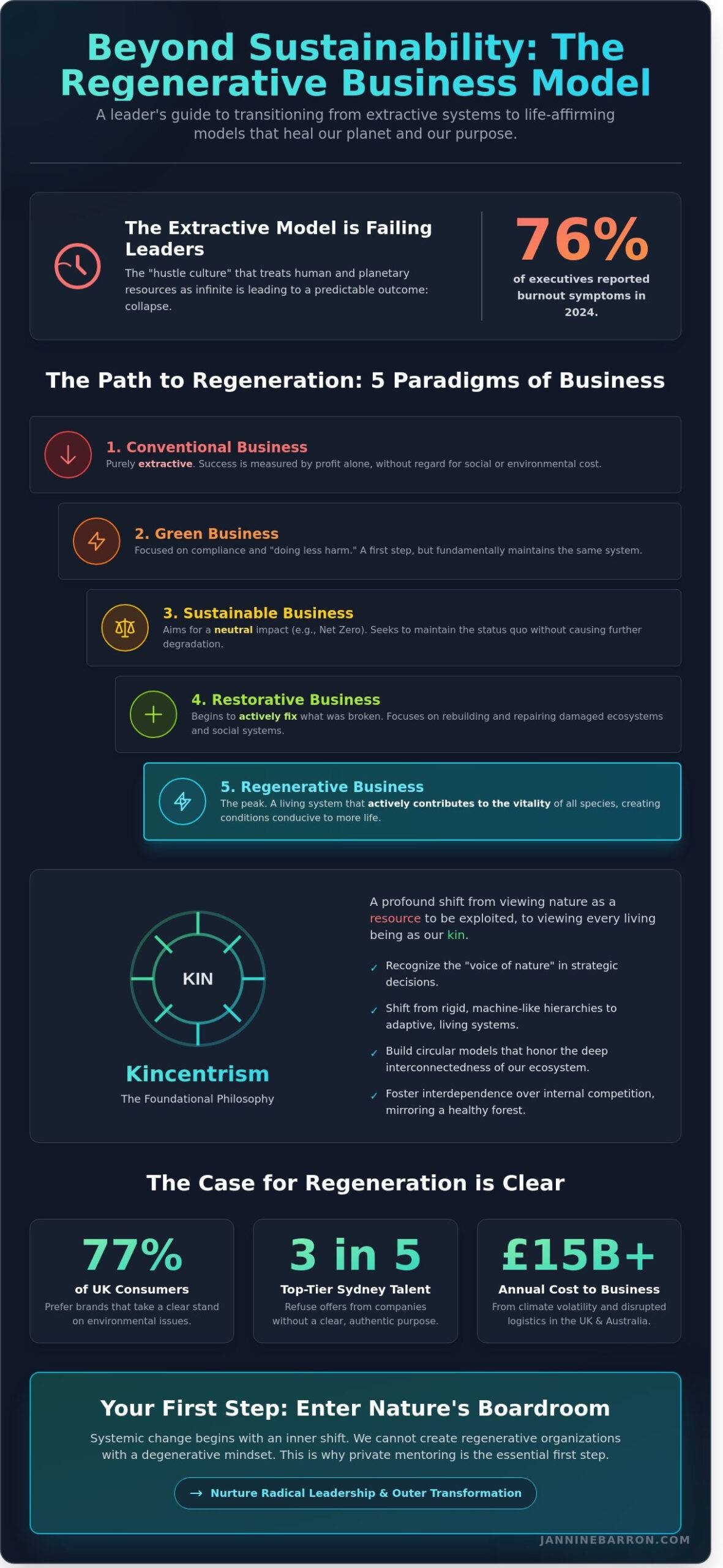
What if the persistent exhaustion you feel in the boardrooms of London or Sydney is not a personal failing but a biological signal that your extractive model of success is dying? You are likely one of the 76 percent of executives who reported burnout symptoms in 2024; a direct result of a hustle culture that treats human energy and planetary resources as infinite. You know deep down that your supply chains carry a heavy weight of guilt and your disconnection from the natural world is no longer sustainable.
By embracing a regenerative business model, you can move beyond mere sustainability into a state of true Kincentrism where your leadership and our planet flourish together. I promise that this guide will show you how to transition from extractive systems to life affirming ones that respect the voice of nature. We will explore a clear framework for nature aligned leadership, practical steps to transform your supply chains, and why private business mentoring is the essential first step to entering natures boardroom and securing your legacy for 2026.
Key Takeaways
- Understand why traditional sustainability is no longer enough and how to transition towards a life affirming regenerative business model that allows your leadership to flourish.
- Embrace Kincentrism as a foundational philosophy to recognise the voice of nature within your strategic decision making and nature’s boardroom.
- Identify extractive behaviours within your current supply chain to build circular systems that honour the deep interconnectedness of our global ecosystem.
- Discover why private business mentoring is the essential first step to nurture the inner shifts required for radical leadership and outer transformation.
- Explore practical implementation pathways for organisations in the UK and Australia that ensure a steady transition without disrupting essential operations.
What is a Regenerative Business and why is it vital in 2026?
By 2026, the global economy has reached a profound crossroads where the old ways of taking without giving are no longer viable. A What is a Regenerative Business is more than a company with a green logo; it’s a living system that seeks to heal the soil, the soul, and the supply chain. It’s a fundamental shift from being a predator to being a partner with the planet. We are moving away from extractive models that deplete resources toward life affirming systems that actively contribute to the vitality of all species. This transition requires us to embrace Kincentrism, recognizing that our enterprises are part of a larger web of life.
This journey begins with private business mentoring as the essential first step in leadership coaching. We cannot change the world without first changing how we see ourselves in relation to it. As a wayfinder, I help you listen to the voice of nature and bring those insights into your daily operations. Traditional sustainability, which focused on doing less harm or reaching net zero, is no longer enough to address the polycrisis of 2026. We need a more radical approach that restores and renews.
To better understand this concept, watch this helpful video:
The five paradigms of business evolution
Understanding where your organisation sits on the spectrum is vital for growth. We see a clear evolution from conventional business, which is purely extractive, to green business that does a little less harm. Sustainable business tries to reach a neutral point, while restorative business starts to fix what was broken. The peak of this pyramid is the truly regenerative business. In natures boardroom, we learn that growth isn’t about endless expansion but about cyclical health. You can explore the process of identifying your current paradigm to begin your transformation today.
The economic case for regeneration in London and Sydney
In major hubs like London and Sydney, the shift is palpable and profitable. A 2024 study showed that 77 percent of UK consumers prefer brands that take a stand on environmental issues. In Sydney, the demand for ethical work has seen 3 in 5 top tier candidates refuse offers from companies without a clear purpose. By 2026, climate volatility is no longer a future threat; it’s a daily reality costing businesses £15 billion annually in disrupted logistics. Investing in regeneration builds long term resilience against resource scarcity while attracting talent that seeks work aligned with nature. This is how businesses in the UK and Australia are leading a global shift toward a wellness economy that serves the many, not just the few.
The Principles of Kincentrism and Nature Aligned Leadership
Kincentrism is the heartbeat of a truly regenerative business. It is a profound shift in perception that invites us to view every living being as our kin rather than a resource to be exploited. In the United Kingdom, where the 2023 State of Nature report revealed that 16 percent of species are at risk of extinction, this philosophy is no longer a choice; it is a necessity for survival. We must move beyond the cold, human centric hierarchies that have defined the industrial age. These structures are built on the illusion of separation, yet we know that no business exists in a vacuum. Every decision you make ripples through the local soil, the water tables, and the social fabric of your community.
The wisdom of the forest offers a blueprint for this transition. In a woodland, the oldest trees share nutrients with the struggling saplings through a complex fungal network. They do not compete for dominance at the cost of the whole; they ensure the health of the entire ecosystem. Modern corporate structures can mirror this by fostering interdependence rather than internal competition. When we recognise the voice of nature in our strategic planning, we begin to act as stewards of a living system. This is the path to creating an organisation that breathes with the world rather than suffocating it.
Applying biomimicry to organisational design
To build a resilient team, we must stop treating the company as a machine with replaceable cogs. A machine is rigid; it breaks under pressure. A living organism adapts. In the UK, ethical startups like Notpla are leading this change by using seaweed to create packaging that vanishes just like a fruit peel. They are not just making products; they are mimicking the circular cycles of the earth. When you view your business as a living entity, your leadership style shifts from control to cultivation. You start to nurture the conditions for growth rather than forcing outcomes. This approach allows for a natural flow of ideas and energy, ensuring that your team remains vibrant even during economic shifts.
Leading with the voice of nature
Giving nature a seat at the boardroom table is a radical act of visionary leadership. In 2022, the UK company Faith in Nature became the first in the world to appoint a legal representative for nature to its board. This ensures that the needs of the environment are heard before any major strategic move is finalised. It requires us to listen to the specific ecological needs of our location, whether that is the chalk streams of southern England or the rugged coastlines of the north. This deep listening is where the transformation begins. To begin this journey of listening, many leaders find solace and strategy within natures boardroom where the forest becomes the mentor. Private business mentoring is the essential first step in this process, helping you to shed old paradigms and embrace a brand identity that is rooted in genuine environmental stewardship. It is about birthing a legacy that nourishes life for generations to come.
Transforming Systems from Supply Chains to Circular Models
Regeneration is not a vague aspiration; it is a rigorous technical redesign of how we exist within the web of life. While many start with the heart, the pragmatic side of regenerative business requires us to look at the plumbing of our organisations. We must move beyond the superficial metrics of sustainability to address the structural reality of systems change. This transformation begins with private business mentoring as the essential first step in leadership coaching. Before we can heal a global network, we must first align the internal compass of the leader to ensure every decision flows from a place of integrity and Kincentrism.
Auditing your current supply chain for extractive behaviours is a profound act of truth telling. It involves looking past the invoice to see where we are still taking more than we give. Are we depleting the soil where our ingredients grow? Are we exhausting the spirits of the people who stitch our garments? A regenerative audit identifies these leaks in the system. By 2026, the UK circular economy is projected to offer opportunities worth over £4.4 billion, yet this value only manifests when we stop treating resources as disposable commodities. We are invited to build value networks that nourish every participant from soil to soul, ensuring that profit is a byproduct of planetary health rather than a cost of its destruction. Understanding which regenerative business metrics to track is essential to ensuring your audit reflects the true flourishing of your entire ecosystem rather than just your financial bottom line.
Redesigning the regenerative supply chain
The transition from efficiency to holistic health in logistics marks the end of the industrial era mindset. In natures boardroom, we learn that resilience comes from diversity and local loops, not just speed. UK brands are already moving beyond sustainability by embracing radical transparency. For example, Riverford Organic Farmers achieved a 65 percent reduction in packaging weight by 2023 by questioning the very necessity of plastic in their network. They don’t just deliver food; they steward a relationship between the farm and the kitchen table.
Australian businesses face unique resource challenges that require a different kind of creative grit. With water scarcity and extreme weather becoming the norm, companies in the Southern Hemisphere are pioneering decentralised production models. They are learning to listen to the voice of nature to understand when to pause and when to produce. This adaptation is not about surviving the climate crisis; it is about thriving within the limits of a living landscape by using technology to mimic natural cycles rather than override them.
Systems change and the life affirming economy
Every business decision creates a ripple that touches the edges of our world. A life affirming economy recognises that products are merely temporary embodiments of energy and matter. We must design goods that are destined to return to the earth as nutrients, not as toxic legacy. This requires a shift in how we perceive ownership and waste. When we treat our outputs as the beginning of a new cycle, we close the loop on extraction and open the door to true abundance. For those ready to dive into the technicalities of these nature aligned networks, the regenerative supply chain guide provides the deeper insights needed to navigate this transition. We are no longer just managers; we are wayfinders birthing a future where business is a force for healing the planet.
Why Private Mentoring is the Essential First Step for Leaders
The transition toward a regenerative business model is not a spreadsheet exercise; it is a profound act of rebirth. You cannot birth a living system from a mechanistic mind. Many founders in the UK and Australia currently feel the crushing weight of global shifts and ecological grief. A 2024 report on leadership wellbeing indicated that 60 percent of purpose driven leaders suffer from chronic exhaustion. This isn’t just simple fatigue. It’s a soul level misalignment. Traditional coaching often misses this mark because it stays on the surface of performance metrics. It treats you like a machine to be optimised rather than an ecosystem to be tended. Private mentoring provides the sanctuary needed for radical shifts. It allows you to dismantle old paradigms in a safe space away from the prying eyes of stakeholders.
The role of the regenerative business mentor
A mentor acts as a wayfinder through the dense thicket of systems change. My role as a business doula is to hold the space where your poetic vision meets the hard reality of supply chains and profit margins. We work to prevent burnout by aligning your personal rhythm with the cycles of the natural world. Mentoring helps you navigate the complexity of Kincentrism; ensuring your organisation respects all life forms while remaining commercially viable. It’s about midwifing your ideas into a reality that nourishes you as much as it nourishes the planet. We move beyond the clinical to the deeply human, focusing on the inner landscape before we attempt to terraform the outer business world.
Natures boardroom: Strategy in the wild
Strategic planning shouldn’t happen under fluorescent lights or within the grey walls of a city office. We move the conversation to the ancient woodlands of Somerset or the rugged, sun drenched Australian bush. These landscapes aren’t just backdrops; they’re active participants in the dialogue. Immersing yourself in these spaces helps you hear the voice of nature and recalibrate your nervous system. You can discover the process of nature based strategic planning during our immersion days. This shift in environment allows for a deeper level of clarity that is impossible to find in a traditional boardroom. By 2026, the ability to lead from a place of ecological connection will be the primary differentiator for successful brands. We use these wild spaces to anchor your strategy in the resilience of the earth itself.
If you feel called to lead with more depth and soul, let’s begin the journey together. Connect with me to discuss your private mentoring path.
Pathways for Implementation in the UK and Australia
The transition to a regenerative business begins with a quiet, internal shift rather than a loud corporate overhaul. It’s an evolution that requires leaders to step away from the noise of Sydney or London and into a space of deep reflection. Private business mentoring acts as the essential first step in this leadership coaching process. It’s here, within the stillness of Natures Boardroom, that we begin to listen to the voice of nature and align your commercial goals with planetary health. This process isn’t about ticking boxes; it’s about shifting your entire perspective on what a company is meant to be.
Whether you’re operating out of a tech hub in London or a rural estate in Wiltshire, the pathway involves three core movements. First, we assess your existing systems to identify where extraction can be replaced by contribution. Second, we integrate Kincentrism into your supply chain decisions. Third, we ensure these changes happen gradually. You don’t need to disrupt essential operations to begin. You simply need to start tending to your business like a living ecosystem rather than a machine. This long term commitment ensures that by 2026, your brand isn’t just surviving; it’s thriving within the life affirming economy.
Local networks and support for ethical brands
Finding your community is vital for sustaining momentum. Founders in Somerset and the South West of England are currently leading the way, creating clusters of innovation that prioritise soil health and social equity. In Australia, hubs in Sydney, Byron Bay, and Melbourne offer similar sanctuary for those seeking a different way of working. You can look at various regenerative business examples UK for inspiration, seeing how others have successfully bridged the gap between profit and purpose. These connections provide the emotional and strategic nourishment needed to stay the course during the 2026 transition.
The Growth Experience: A nine month journey
True transformation cannot be rushed. It follows the natural cycles of gestation. The Growth Experience provides a structured, nine month journey designed for leaders who are ready to birth a new legacy. This high ticket incubator program moves beyond surface level sustainability. It’s a deep dive into systems change, legacy building, and the practical application of regenerative principles. You’ll gain the clarity needed to lead with Kincentrism at your core while consulting the voice of nature for every major decision. If you feel the call to evolve, I invite you to contact Jannine for a discovery call. Let’s explore how your business can become a force for healing.
Stepping Into the Life Centric Future
The transition to a regenerative business model is no longer a distant ideal; it’s the necessary evolution for leaders in the UK and Australia by 2026. We’ve explored how Kincentrism reshapes our perspective and why circular supply chains are vital for systemic health. True transformation doesn’t begin in a corporate office. It starts with the inner work of the leader. This is why private mentoring is the essential first step to align your leadership with the voice of nature.
Since the 1990s, I’ve guided founders through the complexities of ethical commerce. Whether we are walking through Natures Boardroom or scaling through The Growth Experience incubator, my role is to help you midwife a legacy that serves all life. You don’t have to navigate this shift alone. Together, we can ensure your organisation becomes a force for restoration and collective joy.
Begin your journey with private regenerative mentoring
The path is ready for those brave enough to walk it. Your leadership is the seed from which a thriving world will grow.
Frequently Asked Questions
What is the difference between sustainable and regenerative business?
Sustainable business aims for zero impact, while a regenerative business actively restores and heals the ecosystems it touches. While sustainable models seek to maintain the status quo, 2026 standards require us to be net positive. We aren’t just sustaining a dying system; we’re birthing a living one that thrives alongside nature. It’s the difference between doing less harm and doing more good for our planet and people.
How do I start a regenerative business in the UK or Australia?
You begin by mapping your local ecosystem and identifying where your supply chain can move from extraction to contribution. In the UK, look towards the 2025 Green Claims Code for guidance on transparency. In Australia, the 2026 Nature Positive laws provide a framework for biodiversity reporting. It starts with a commitment to listen to the voice of nature before making any strategic moves for your regenerative business.
Is Kincentrism applicable to large corporate structures?
Kincentrism is entirely applicable to large structures because it reframes stakeholders as a family of living beings rather than just line items. By 2026, forward thinking firms like Patagonia or the Australian brand Koala have integrated these principles into their governance. It requires shifting from a hierarchy of power to a web of relationship where every decision considers our non human kin. We move from management to stewardship.
Why is private mentoring considered the first step in this journey?
Private business mentoring is the essential first step because leadership transformation must happen within the individual before it can manifest in the organisation. You cannot lead a regenerative shift if your own internal landscape is depleted. This intimate partnership provides the safe soil where a leader’s visionary seeds can take root and grow into a resilient strategy. It’s about birthing a new way of being through dedicated support.
Can a regenerative business model be profitable in the long term?
This model is often more profitable in the long term because it builds true resilience against climate shocks and resource scarcity. Data from the 2025 Circular Economy Report shows that companies using these principles saw a 12 percent increase in margins over five years. By investing in the health of your community and environment, you ensure the longevity of your financial returns. Profit becomes a byproduct of health.
What are the best examples of regenerative businesses in 2026?
In 2026, Riverford Organic Farmers in the UK and Bindi Maps in Australia stand out as beacons of this movement. Riverford transitioned to a total employee ownership model that prioritises soil health as much as profit. Bindi Maps uses inclusive technology to harmonise human navigation with the built environment. These companies prove that business can be a force for healing while maintaining a strong presence in the modern market.
How does natures boardroom differ from a standard corporate retreat?
Natures boardroom differs from a standard retreat by moving the strategic process into the wild to let the landscape lead the conversation. Unlike a hotel conference room, this space uses the rhythm of the forest or the coast to break down rigid corporate thinking. We don’t just talk about the environment; we allow the voice of nature to dictate the solutions we birth. It’s a sacred space for deep, quiet reflection.
What role does biomimicry play in regenerative strategy?
Biomimicry provides the technical blueprint for a regenerative strategy by imitating the time tested patterns of the natural world. Instead of forcing growth, we look at how an old growth forest manages its resources or how a coral reef supports diverse life. It’s a pragmatic tool that turns 3.8 billion years of biological wisdom into a competitive advantage. We learn to design our systems exactly as nature would design them.