
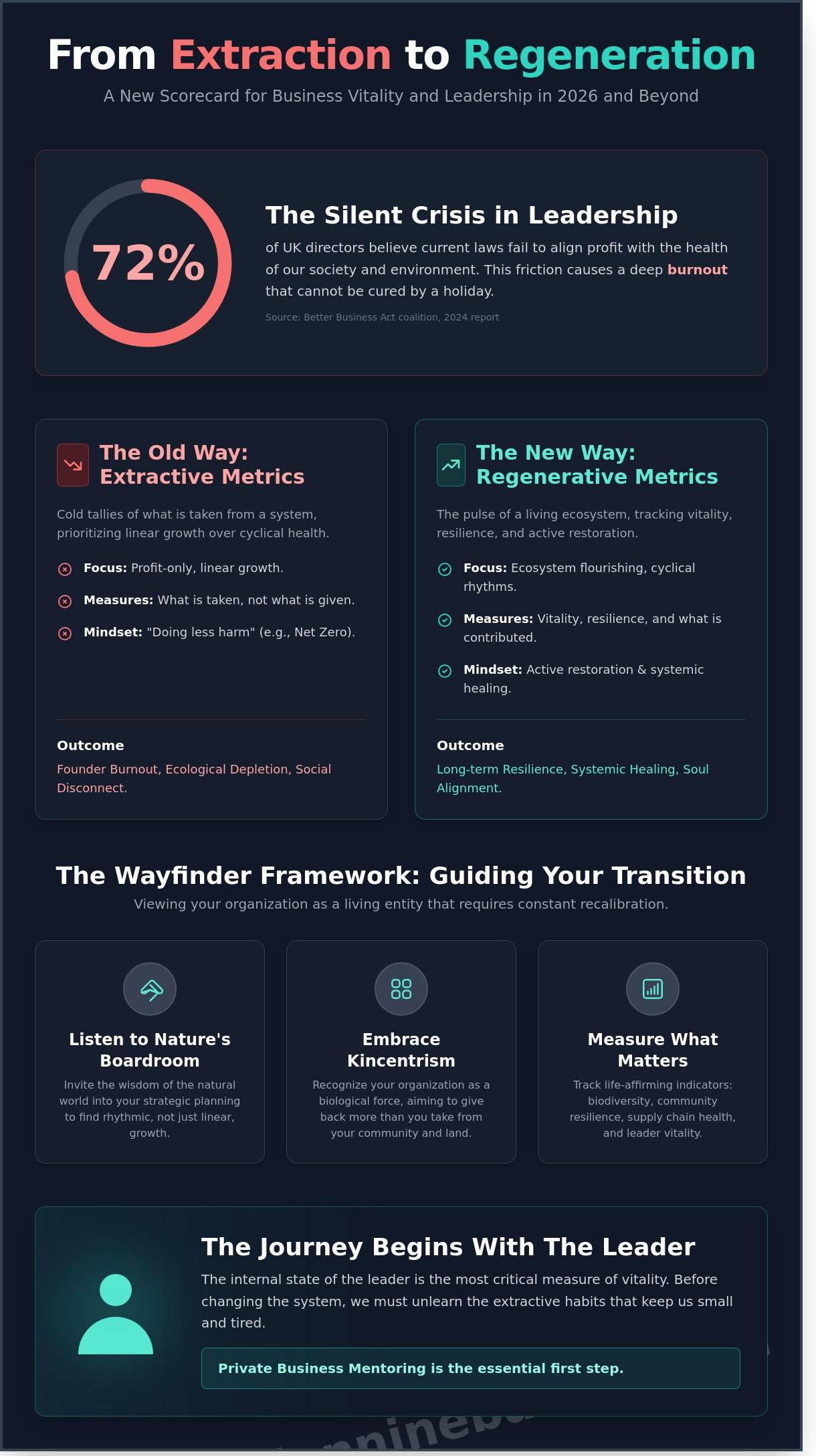
What if the very numbers you use to measure success are actually the silent thieves of your organisations vitality? You likely feel the constriction of traditional financial reporting, where your heart yearns to protect the planet but your spreadsheets only demand more extraction. A 2024 report by the Better Business Act coalition found that 72 percent of UK directors believe current laws fail to align profit with the health of our society and environment. This friction causes a deep burnout that cannot be cured by a holiday. It requires a fundamental shift toward regenerative business metrics that track the flourishing of your entire ecosystem.
I believe you deserve a way of leading that feels as natural and rhythmic as the seasons. By beginning with private business mentoring, we can anchor your leadership in the wisdom of natures boardroom and ensure the voice of nature has a seat at your table. This guide offers a clear framework for nature aligned success, helping you move away from extractive habits and toward Kincentrism. You will learn to measure what truly matters, creating better alignment between your daily operations and your soul while building long term resilience for 2026 and beyond.
Key Takeaways
- Learn why traditional extractive metrics lead to founder burnout and how to replace them with data that tracks the flourishing of your entire organisational ecosystem.
- Discover how to listen to the voice of nature within natures boardroom to design scorecards rooted in Kincentrism that reflect the rhythm of a living world.
- Explore a list of regenerative business metrics that prioritise biodiversity and community resilience over simple financial gain.
- Recognise that the internal state of the leader is the most critical measure of vitality and why private business mentoring is the essential first step.
- Access a pragmatic roadmap for leaders in London and Sydney to begin the transition by starting small and experimenting with life affirming indicators.
Beyond the Balance Sheet: Why Traditional Metrics Fail UK and Australian Leaders
For decades, our measure of success has been defined by what we can extract. These extractive metrics are cold tallies of what is taken from a system; whether that is the minerals from the earth or the life force of a weary employee. In the frantic pace of 2026, the cracks in this old foundation are impossible to ignore. Traditional KPIs lead directly to founder burnout and ecological depletion because they ignore the fundamental truth that a business is a living entity. When we prioritise linear growth over the cyclical rhythms of natural living systems, we create a debt that the future cannot pay. We are birthing a crisis of meaning alongside a crisis of climate.
To better understand this concept, watch this helpful video:
Life affirming success is the new gold standard for leaders who wish to leave a legacy that breathes. This shift requires us to listen to the voice of nature and invite the wisdom of natures boardroom into our strategic planning. It begins with the leader. I always suggest that private business mentoring is the essential first step in leadership coaching; it allows us to unlearn the extractive habits that have kept us small and tired. By adopting regenerative business metrics, we move away from the exhaustion of the machine and toward the vitality of the forest. We begin to see that profit is not the goal but the result of a healthy ecosystem.
The Problem with Net Zero and Pure Sustainability
Doing less harm is no longer sufficient for our current climate reality. Net zero is a noble intention but it often becomes a mathematical game of offsets that lacks soul. Carbon counting is a limited lens that fails to capture the complexity of a thriving ecosystem. We must move toward metrics that measure active restoration and systemic healing. Our goal is not just to sustain a dying system; it is to bring it back to life through regenerative economic principles that value life above all else. True health is measured by the resilience we build within our supply chains and our communities.
The Extractive Mindset in London and Sydney Corporate Culture
In the high pressure boardrooms of London and Sydney, the social cost of growth is often hidden behind glossy quarterly reports. There is a deep disconnect between the financial health of a company and the health of the local community or the soil beneath our feet. Acknowledging the flaws in our current measuring sticks is the first step toward a Kincentrism approach to commerce. We must ask ourselves if our profit is built on the depletion of our neighbours or our land. In 2026, the most successful leaders will be those who recognise that their organisation is a biological force. They will use regenerative business metrics to ensure they are giving back more than they take, honouring the delicate balance of the world they inhabit.
The Wayfinder Framework: Measuring Vitality through the Voice of Nature
True leadership in 2026 requires more than a compass; it demands the intuition of a wayfinder. Traditional business models often treat growth as a straight line on a graph, yet life never moves in such a rigid fashion. By adopting a wayfinder approach, we view our organisations as living entities that require constant recalibration. This journey begins with the recognition that regenerative business metrics are not just numbers on a screen; they are the pulse of a thriving ecosystem. This philosophy is deeply embedded in The Growth Experience, where we explore how to align your commercial ambitions with the rhythms of the natural world. Before we can change the system, we must change the leader, which is why private business mentoring is always the essential first step in this transformation.
Natures Boardroom as a Strategic Filter
We cannot solve systemic problems using the same sterile environments that created them. When we move our strategy sessions away from the fluorescent lights and into the wild, the metrics we value begin to shift. Within Natures Boardroom immersion days, leaders learn to use silence and observation as diagnostic tools. Instead of rushing to fill the air with jargon, we listen to the voice of nature to identify where energy is stagnant. A forest does not measure its success by the height of a single tree but by the health of the soil and the diversity of the canopy. We use biomimicry to design scorecards that mirror these healthy ecosystems; focusing on nutrient flow and resilience rather than just quarterly extraction. In the UK, where biodiversity loss is a critical concern, these immersion days provide the clarity needed to rebuild what has been lost.
Kincentrism as a Foundation for Measurement
To measure what truly matters, we must adopt the lens of Kincentrism. This is the profound recognition that our businesses are deeply connected to all living beings. When we view our suppliers, local communities, and even the local watershed as kin, our definition of impact transforms. We stop measuring transactions and start measuring reciprocal relationships. Leaders are now looking for guidance on regenerative metrics to ensure their supply chains nourish the earth rather than deplete it. This shift is essential because a business cannot be healthy if the community and environment it relies upon are in decay. If you feel called to lead this transition, you might consider how private business mentoring can help you ground these concepts in your daily operations. Measuring the vitality of these connections ensures your legacy is one of life, not just profit.
Nature Aligned Metrics for Environmental and Social Flourishing
To move beyond the exhaustion of the old economy, we must first address the internal landscape of the leader. I always begin with private business mentoring as the essential first step because a business cannot heal the world if the person at the helm is still operating from a place of scarcity. When we step into natures boardroom together, we stop asking how much we can take and start asking how much life we can support. This shift in perspective requires a new set of regenerative business metrics that value the vitality of the whole over the profit of the part.
Ecosystem Vitality Metrics
True stewardship means measuring the health of the land your business occupies, whether that is a high rise in London or a creative hub in Sydney. By 2026, leading organisations are tracking their Biodiversity Presence Index to ensure they are active participants in their local ecology. This includes:
- Urban Biodiversity: Tracking a 15 percent annual increase in local pollinator species through rooftop gardens or green walls in urban centres.
- Stormwater Wisdom: Measuring the volume of water retained by permeable surfaces, aiming for a 30 percent reduction in runoff to protect local river systems like the Thames or the Parramatta.
- Soil Health: For businesses with physical footprints, monitoring the increase in soil organic matter and microbial activity as a direct result of regenerative landscaping.
- Circular Flow: Moving beyond simple recycling to track the total elimination of waste streams and the percentage of materials kept in a continuous loop of use.
Social and Cultural Regeneration
The health of your organisation depends entirely on the health of the human soil it is built upon. We must measure the creative flourishing of our teams by looking at psychological safety as a tangible asset. In 2026, we track how many new ideas are birthed in an environment free from the fear of failure. This is Kincentrism in action; recognising that our employees and our communities are part of our extended family of life.
We also measure the ripple effect your business has on local UK and Australian communities. This involves tracking the percentage of profits or resources redirected into community resilience projects, such as local food security or skill sharing workshops. A regenerative business does not just exist in a community; it nourishes it. We look for a 20 percent increase in local social cohesion metrics, ensuring that the business acts as a catalyst for collective wellbeing.
Transparency is the light that allows these relationships to grow. By maintaining a Regenerative Supply Chain guide, you ensure that every node in your network is aligned with these life affirming values. When we listen to the voice of nature, we understand that regenerative business metrics are not just numbers; they are the heartbeat of a living economy that honours the legacy we leave for future generations.
Measuring Leadership Transformation: The Role of Private Business Mentoring
Success is often measured by what we can see from a distance. We track carbon footprints or calculate biodiversity net gain. Yet the most vital regenerative business metrics begin within the quiet landscape of a leader’s internal state. If the founder is depleted, the organisation will eventually mirror that exhaustion. Private business mentoring is the essential first step in any regenerative transition because it addresses the root system before the branches can flourish. It’s the sacred work of soil preparation before any seeds are sown. Without this internal alignment, even the most sophisticated sustainability plan remains a surface level exercise.
Tracking personal resilience is a structural necessity in a volatile world. In 2024, data from the Mental Health Foundation showed that 74 percent of adults in the UK felt so stressed they were unable to cope. For a leader in 2026, avoiding burnout is a strategic act of stewardship. It ensures you have the capacity to hear the voice of nature and lead with clarity. Through a focused mentoring process, we measure the shift from reactive survival to intentional presence. We look for the moment you stop extracting from your own spirit and start nourishing your energy reserves. This is where true leadership begins.
The Internal Compass: Personal Metrics for Founders
The transition to a regenerative model requires a profound move from a scarcity mindset to one of abundance. We track this by observing how you respond to market shifts. Do you contract in fear or do you see an invitation for Kincentrism? Leading with empathy and soul requires immense structural integrity. It’s about being soft enough to listen and strong enough to hold the vision. Regular reflection sessions held in the ancient centres of Glastonbury or Wiltshire provide the stillness needed to calibrate this inner compass. These landscapes offer a connection to deep time that helps anchor your leadership in something more permanent than quarterly reports. Whether you are walking the ancient tracks of the Australian bush or the rolling hills of the West Country, the goal is the same: to align your well being with the rhythm of the earth.
Mentoring as a Feedback Loop for Systems Change
A mentor acts as a mirror for the lagging metrics of your growth. These are the subtle changes in behaviour that only become visible months after a shift in perspective. We use these sessions to align your personal legacy with the daily operations of your business. This ensures that your company is not a separate machine but a living extension of your values. By stepping into natures boardroom, you begin to see your organisation as an ecosystem. This clarity is the foundation for all system wide change. It allows you to birth ideas that are life affirming and resilient. When you measure your growth by the depth of your connection to the whole, your business begins to thrive in ways that traditional spreadsheets cannot capture.
If you’re ready to begin your own transformation, I invite you to explore private mentoring options to support your path as a wayfinder.
Implementing Regenerative Metrics in London Sydney and Beyond
The transition from extractive KPIs to regenerative business metrics isn’t a simple swap of spreadsheets. It’s a profound shift in how we perceive value and success. Moving away from the clinical pursuit of infinite growth requires us to embrace a roadmap that mirrors the cycles of a living forest. You don’t need to overhaul your entire reporting system overnight. Instead, start small. Choose one or two indicators that truly pulse with the life of your organisation. This might be the biodiversity density of your primary supply site or the percentage of profit reinvested into local community wealth building. By experimenting with these focused pulses of data, you allow your team to adjust to a new rhythm of accountability.
Building trust with investors and customers in 2026 requires radical transparency. Today’s stakeholders are weary of greenwashing; they seek proof of life. When you report these metrics, tell the story of the journey. Explain why a specific metric was chosen and how it serves the long term health of the whole system. This honesty builds a bridge of integrity that traditional marketing can’t replicate. It shows you’re not just managing a company; you’re stewarding an ecosystem.
Local Implementation in the UK and Australia
In London, the regulatory landscape is shifting rapidly. With the UK government aiming for mandatory nature related financial disclosures by 2026, the move toward B Corp standards has become a baseline for survival. Leaders here must look beyond carbon and integrate social equity into their core reporting. Meanwhile, in Australia, climate resilience is the primary driver. Businesses are increasingly measured by their ability to protect and restore the land they occupy. We must adopt place based metrics that respect the deep history of the Country we stand on. This means acknowledging the wisdom of the land and ensuring our business activities contribute to its ongoing vitality rather than its exhaustion.
Creating Your Regenerative Scorecard
To begin this transformation, gather your team for a workshop. Step away from the fluorescent lights and enter natures boardroom to find clarity. Ask yourselves what it means for your business to be a “good ancestor” to the people and places you touch. Once you’ve defined your unique metrics, integrate them into your existing project management tools. Use software like Monday.com or Asana to track these life affirming goals alongside your daily tasks. This ensures that regeneration isn’t a separate department but the very heartbeat of your operations. If you feel called to lead this change but need a guide to navigate the complexity, contact Jannine for bespoke guidance on your journey. It’s time to become a wayfinder for an economy that loves life as much as you do.
Stepping Into Natures Boardroom for 2026
The transition from extractive profit to life affirming vitality is a fundamental requirement for leaders across London and Sydney. Traditional balance sheets fail because they ignore the ecosystems that sustain our commerce. By adopting regenerative business metrics, you start to listen to the voice of nature and integrate Kincentrism into your supply chains. This transformation requires more than a new spreadsheet; it demands a shift in the leader’s soul. It’s about moving beyond the machine and into the garden to nurture growth that lasts.
I bring over 30 years of experience in ethical business to help you navigate this path. My bespoke mentoring for leaders in the UK and Australia is guided by biomimicry to ensure your organisation flourishes like a healthy forest. We’ll step into natures boardroom together to redefine success through the lens of systems change and deep empathy. This work’s the essential first step toward a legacy that truly matters for our planet and our future.
Begin your journey with private business mentoring
The path is ready for your first step. Let’s grow something beautiful together.
Frequently Asked Questions
What are the most important regenerative business metrics to start with?
The most vital metrics focus on soil health, carbon sequestration, and community vitality. You should begin by measuring the net increase in local biodiversity and the psychological safety of your team. Private business mentoring is the essential first step to help you navigate these complex systems. By 2026, leaders in the UK and Australia are prioritising these life giving indicators over simple extraction. You’ll find that tracking the health of your local watershed or the density of soil organic matter provides a clearer picture of true wealth than a balance sheet alone.
How do regenerative metrics differ from traditional ESG or sustainability reporting?
Traditional ESG metrics focus on reducing harm and managing risk; however, regenerative business metrics aim to actively heal and restore the ecosystems your brand touches. Sustainability often seeks a neutral impact which is no longer enough in our current climate reality. Regenerative reporting looks for evidence of flourishing and abundance within your supply chain. It moves beyond the clinical checklists of 2024 to embrace Kincentrism. This approach ensures your organisation acts as a living system that contributes more to the planet and society than it takes away.
Can a small business in the UK really afford to track biodiversity or social impact?
Yes, small businesses can access affordable tools like the UK Business Climate Hub or local nature recovery audits which often cost around £1,200 for an initial assessment. You don’t need a massive budget to begin observing the voice of nature in your immediate surroundings. Many UK SMEs are already using community interest company structures to track social impact without heavy administrative costs. Starting small allows you to grow your data collection naturally as your revenue increases. It’s about a shift in mindset rather than a massive financial burden.
Is it possible to measure the voice of nature in a corporate environment?
You can measure the voice of nature by appointing a legal guardian for local ecosystems or a nature representative on your board. This practice brings the needs of the physical world into nature’s boardroom where decisions are made. In 2026, forward thinking companies in Australia and the UK are using bioacoustic monitoring to track bird and insect populations as a direct metric of success. This data provides a tangible score for how well your operations support the local web of life. It transforms nature from a silent victim into a vocal stakeholder.
Why is leadership mentoring considered a metric for regenerative business?
Leadership mentoring is a metric because the internal evolution of a leader directly dictates the external health of the organisation. We track the hours dedicated to inner work and self reflection as a baseline for systems change. You can’t midwife a new economy using the same tired paradigms that created the old one. Private business mentoring ensures you’re prepared to handle the emotional and technical weight of Kincentrism. This metric measures your capacity to lead with empathy and foresight; it’s the foundation upon which all other regenerative efforts are built.
How do I explain regenerative metrics to traditional investors or stakeholders?
Explain these metrics as a strategy for long term resilience and risk mitigation in a volatile 2026 market. Recent data shows that 68 percent of institutional investors now prioritise firms with proven restoration pathways over those with simple net zero targets. You’re not just being kind; you’re building a brand that can survive resource scarcity and climate shifts. Speak the language of value creation and legacy. Investors respond well when you demonstrate how life affirming practices lead to more stable supply chains and higher employee retention rates.
What role does biomimicry play in choosing the right metrics for my brand?
Biomimicry provides the blueprints for your metrics by teaching you how nature measures success through efficiency and circularity. Instead of focusing on linear growth, you might track how well your brand mimics a forest floor by recycling every waste stream into a new resource. This approach helps you identify gaps in your supply chain where energy or materials are lost. By observing natural cycles, you can set KPIs that align with the rhythms of the earth. It turns your business into a functioning part of the local eco system.
How often should a regenerative business review its metrics and KPIs?
You should review your metrics quarterly to align with the changing seasons and the natural cycles of the UK and Australian landscapes. An annual deep dive is necessary to assess the long term health of your legacy; however, monthly check ins on team well being keep the pulse of the organisation steady. This rhythm ensures you stay responsive to the voice of nature and the shifting needs of your community. It prevents the stagnation that often occurs with traditional yearly reporting. Regular reviews allow you to pivot quickly as a wayfinder in a rapidly changing world.