
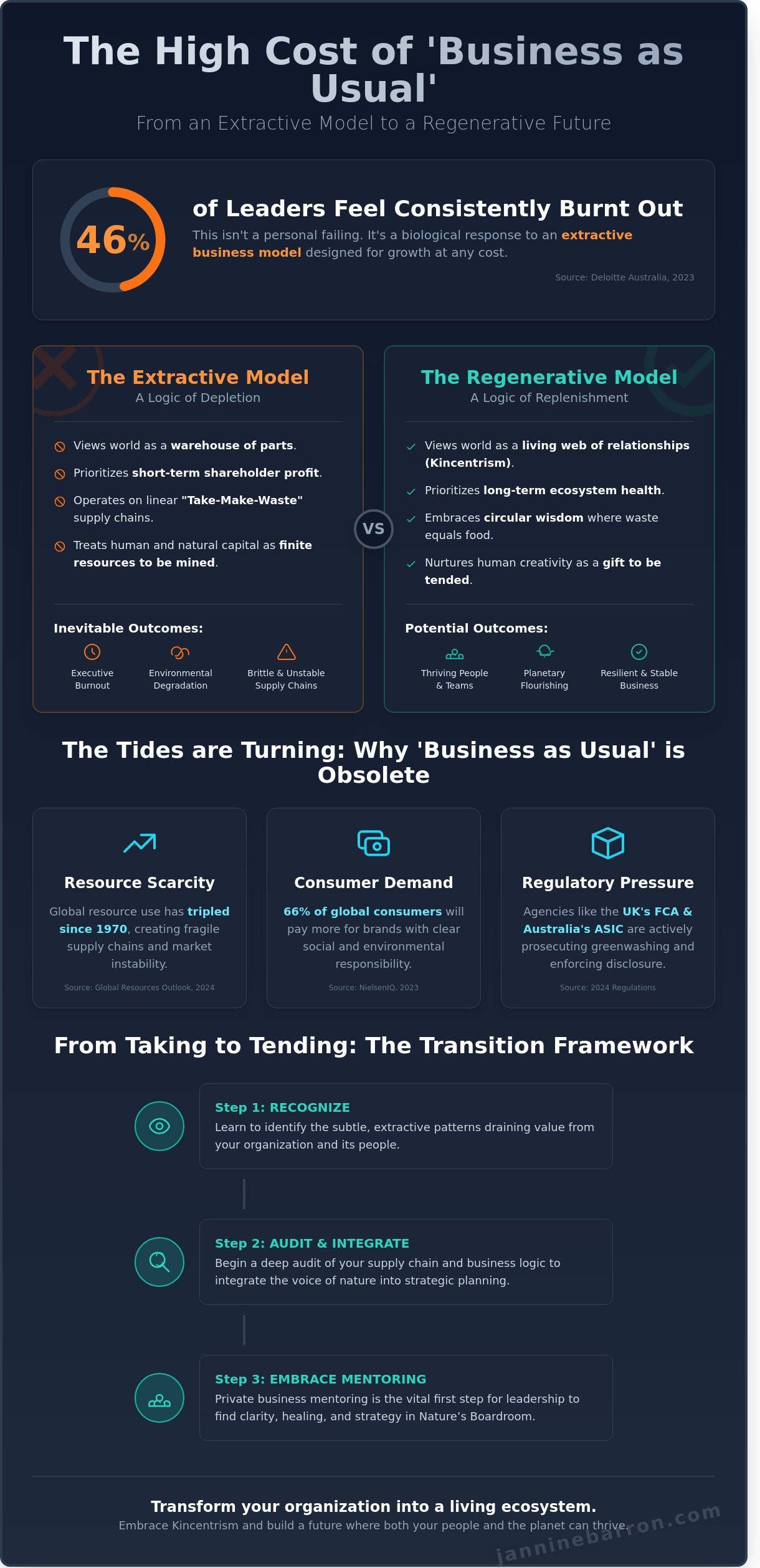
What if the exhaustion you carry home isn’t a sign of weakness but a biological response to an extractive business model that treats your spirit like a finite resource to be mined? In 2023, research from Deloitte Australia found that 46 percent of leaders feel consistently burnt out. This depletion isn’t accidental; it’s the inevitable result of systems designed for growth at any cost. You know deep down that your leadership shouldn’t feel like a battle against the very planet that sustains us.
It’s natural to feel trapped in a cycle where profit demands everything and gives little back to the soul or the soil. You’re ready to stop the bleeding and start the healing. This article illuminates the path to identify these patterns of depletion and begin your journey toward a nature aligned regenerative future. We will examine the mechanics of extraction and see how private business mentoring acts as the vital first step to bring the voice of nature into natures boardroom. By embracing Kincentrism, you can transform your organisation into a living ecosystem where both your people and the planet finally have the space to thrive.
Key Takeaways
- Learn to recognise the extractive business model as a system that drains value without replenishment and see how this traditional paradigm impacts your organisation.
- Identify subtle patterns of depletion within UK and Australian service industries and understand how the resource wave affects the stability of your local business.
- Discover why the relentless pursuit of extraction leads to executive burnout and how to move beyond the myth that depletion is the only path to market survival.
- Begin a deep audit of your supply chain to integrate the voice of nature into your strategic planning and move toward a future of Kincentrism.
- Embrace private business mentoring as the essential first step in your leadership coaching journey to find clarity and healing within Nature’s Boardroom.
Defining the Extractive Business Model in a Changing World
The extractive business model operates on a logic of depletion. It views the world as a warehouse of parts rather than a living web of relationships. In traditional business schools across the UK and Australia, we were taught that success is measured by how much value we can pull from the earth and our people. This is often described through the lens of What is Extractivism? which highlights the historical patterns of removing resources without any intention of replenishment. Leaders are now waking up to the reality that our planetary boundaries are finite. We cannot have infinite growth on a finite planet. Before we can change the system, we must change the leader; this is why private business mentoring is the essential first step in any leadership journey toward true regeneration.
To better understand how these systems affect our global economy, watch this helpful video:
This frontier mentality assumes there’s always more to take. It ignores the externalised costs that fall upon the public purse or future generations. In the UK and Australia, these costs manifest as environmental degradation and social inequality. We must move toward Kincentrism, where we recognise our place within the family of life. By listening to the voice of nature, we begin to see that profit at the expense of life is no longer a viable strategy for the modern era.
The Core Characteristics of Extraction
The primary signal of an extractive business model is the prioritisation of short term shareholder profit over the long term health of the ecosystem. It treats human creativity as a commodity to be bought and sold rather than a gift to be nurtured. These organisations rely on linear supply chains that move from take to make to waste. This process ignores the circular wisdom found in natures boardroom where nothing is wasted and every output becomes an input for another part of the system.
Why Business as Usual is No Longer Fit for Purpose
The regulatory landscape is shifting rapidly. In London, the Financial Conduct Authority introduced the Sustainability Disclosure Requirements in 2024 to curb misleading claims. Similarly, in Sydney, the Australian Securities and Investments Commission is actively prosecuting greenwashing to protect market integrity. Consumer behaviour is also evolving; a 2023 NielsenIQ study found that 66 percent of global consumers are now willing to pay more for brands that demonstrate social and environmental responsibility. Leaders have an ethical imperative to move beyond simple CSR metrics. It’s time to birth ideas that nourish the world rather than just consume it.
The Hidden Patterns of Depletion in UK and Australian Markets
We often view extraction through the lens of open cut mines or oil rigs. Yet, the extractive business model has migrated into our offices and digital clouds. It operates like a silent tide, pulling value away from the source without replenishment. Leaders in London and Sydney are now witnessing a resource wave where the very inputs they rely on are becoming brittle. The 2024 Global Resources Outlook indicates that resource use has tripled since 1970; this creates a fragility that threatens local business stability. When we take more than we give, the supply chain doesn’t just bend; it eventually collapses under the weight of its own exhaustion.
Extraction in the Digital and Service Sectors
Data is the new topsoil. In our digital age, companies harvest personal information as if it were a raw mineral, eroding the privacy that once anchored social trust. We see this manifested in the gig economy where human energy is treated as a disposable battery. Workers are expected to give without receiving the tending required for long term flourishing. Intellectual property too has become a fence. It often locks away wisdom that should be part of a shared ecosystem. This shift mirrors the concerns raised in the UN Policy on Sustainable Extraction which highlights how value flows away from those who provide the labour. It’s a pattern of taking that leaves the digital landscape barren of genuine connection.
Local Impact on Land and Community
The scars are visible if we look closely. In the wheat belts of Rural Australia, extractive farming has led to a 50 percent loss of organic soil matter in some regions over the last century. This isn’t just an agricultural crisis; it’s a loss of our foundational heritage. Similarly, in Wiltshire, the disappearance of ancient hedgerows to satisfy industrial efficiency mirrors the urban extraction seen in London. There, community spaces are being swallowed by high rise developments that offer no soul or sanctuary. This decline in local biodiversity and social cohesion is a direct result of placing profit above the voice of nature.
To change this trajectory, we must look inward. I believe that private business mentoring is the essential first step in any leadership journey. It’s how we begin to unlearn the habits of the extractive business model and start birthing ideas that serve the whole. When we sit in natures boardroom, we begin to see that Kincentrism is the only way forward. It requires us to listen to the land and our people with the same intensity we bring to our balance sheets. We are not separate from the ecosystems we trade in; we are the ecosystem. Tending to it is the only way to ensure our collective future.
Beyond the Bottom Line: The Personal Cost of Extraction on Leadership
I often hear leaders in the boardrooms of London and Sydney argue that an extractive business model is the only shield against a volatile market. They believe that to survive, they must squeeze every drop of value from their people and the planet. This is a profound misunderstanding of how life actually works. When you lead a system designed solely to take, you eventually find yourself empty. You cannot pour from an exhausted well; yet, the traditional corporate structure demands exactly that. This model does more than deplete the soil or the supply chain; it erodes the very essence of the person at the helm.
A Harvard Report on Extractive Economies highlights how these systems focus on short term gain at the expense of social stability. For a leader, this manifests as a crushing weight of responsibility without the nourishment of reciprocity. By 2024, data from various executive health studies indicates that nearly 75 percent of founders report feelings of isolation and severe fatigue. This is not a personal failing; it is a biological response to an inorganic system. An extractive business model cannot sustain an authentic leader because it requires you to silence your heart to meet a spreadsheet.
The Symptom of Entrepreneurial Burnout
Purpose driven founders often experience a painful dissonance as they realise the disconnect between their values and their model. You started your venture to create beauty or solve a problem, yet the daily mechanics of extraction force you into a role of a modern day overseer. This disconnect is the primary driver of the burnout epidemic. When your values say give but your model says take, your nervous system stays in a state of high alert. This physical toll is documented in the 2023 Global Leadership Forecast, which found that leaders who feel their work lacks meaning are twice as likely to leave their roles within two years. To find a different path, we must look toward regeneration as the antidote to the hustle.
The Need for a New Leadership Paradigm
We are being called to step out of the commander role and into the shoes of a wayfinder. In natures boardroom, we see that no single entity thrives by total dominance. Instead, they thrive through intricate webs of support. Listening to the voice of nature teaches us that true growth is cyclical, not linear. Shifting your focus to Kincentrism allows you to view your employees as kin rather than assets to be managed. This creates a culture of psychological safety, which is a vital non extractive resource. When people feel safe, they innovate. When they feel like kin, they care. This transformation begins with private business mentoring, as we must first heal the leader’s relationship with power before we can reshape the organisation.
Moving from Taking to Tending: The Transition Framework
Transitioning away from an extractive business model feels like a slow, rhythmic exhale after years of holding our breath. It’s a journey from the cold logic of depletion toward the warmth of stewardship. This path isn’t about minor adjustments to a spreadsheet; it’s a fundamental rebirth of how you show up as a leader. We must move beyond the idea of the Earth as a warehouse and begin to see it as a living partner. This shift requires us to bring the voice of nature into the heart of our decision making, ensuring that every strategic choice nourishes the soil from which our prosperity grows.
Auditing Your Impact
The first step in this metamorphosis is a rigorous, honest look in the mirror. You cannot heal what you refuse to see. Conduct a deep audit of your supply chain to map exactly where your organisation takes without giving back. This process involves more than carbon counting; it’s about identifying the true cost of your presence. According to the 2019 UN Global Resources Outlook, 90 percent of biodiversity loss is linked to resource extraction and processing. To understand your place in this data, use the regeneration framework to assess your current state. Look at your waste streams, your labour practices, and your energy sources. Are you leaving the land and the community better than you found them, or are you leaving a trail of exhaustion?
Redefining Growth and Success
We’ve been taught that growth is the only metric of health, yet in nature, perpetual growth is the hallmark of a system in crisis. We must replace the obsession with quarterly expansion with the concept of thriving. Thriving is cyclical, patient, and resilient. When you communicate this shift to your investors and team members, frame it as a move toward long term vitality. In natures boardroom, success is measured by the health of the entire ecosystem. Set regenerative KPIs that track community wellbeing, soil health, or the restoration of local waterways alongside your financial goals. In the Australian context, this often means aligning with the ancient wisdom of Kincentrism, recognising our deep interconnectedness with the living world that has sustained life for over 60,000 years.
Navigating this transition alone can feel overwhelming. This is why private business mentoring is the essential first step in leadership coaching. It provides the sacred space needed for deep self reflection and the birthing of new, life affirming strategies. By seeking guidance from a regenerative mentor, you gain a wayfinder who helps you bridge the gap between the boardroom and the forest. You learn to listen to the voice of nature and lead with a heart that is both fierce and tender.
Embracing Regeneration through Private Mentoring and Nature
Transitioning away from an extractive business model requires more than a simple pivot in strategy. It demands a profound shift in the way a leader perceives their role within the wider web of life. This is why private business mentoring is the essential first step in any leadership journey. Before you can redesign an organisation, you must first tend to the soil of your own mindset. A mentor acts as a wayfinder, holding the space as you navigate the discomfort of unlearning old habits of exploitation and control. It’s a process of birthing a new identity, one that values Kincentrism over competition. This deep work ensures your transition is rooted in authenticity rather than mere compliance.
The Power of Nature’s Boardroom
True strategic clarity rarely happens behind a desk. Whether we are walking among the ancient oaks of Wiltshire or sitting in the stillness of the Australian bush, the landscape speaks a language of resilience that we have forgotten. Through forest therapy and deep immersion, leaders can finally clear the fog of the extractive business model that prizes speed over health. In Nature’s Boardroom, we listen to the voice of nature to find solutions that are already proven. This is where healing begins, allowing you to move from a state of depletion to one of creative abundance. The silence of the forest provides the perspective needed to see your business as a living ecosystem rather than a machine. It’s a space where the noise of the market fades, leaving only the truth of what needs to be born.
Your Journey as a Regenerative Leader
The path to regeneration is a structural evolution. We use biomimicry as a blueprint, looking at how natural systems have thrived for billions of years without creating waste. This is the foundation of aligning your business with natural living systems. Your mentor ensures that these concepts are not just abstract ideas but are grounded in your daily operations and supply chains. Consider the legacy you are currently leaving. Are you merely taking, or are you contributing to the flourishing of the planet?
- Identify the hidden leaks in your current supply chain
- Apply biological principles to your organisational structure
- Foster a culture of care that extends to every stakeholder
- Create a roadmap for a business that gives more than it takes
You are birthing a world where business is a force for good. It’s time to step out of the cycle of extraction and embrace a model that is life affirming. The world is waiting for the leadership only you can provide. Your legacy starts with the decision to lead differently today.
Cultivating a Legacy Beyond the Harvest
The extractive business model has dominated global markets for decades, leaving leaders from the UK to Australia feeling as depleted as the landscapes they manage. We’ve explored how this pattern of taking without giving back hollows out the soul of an organisation. True success requires us to move beyond the bottom line and embrace Kincentrism. This path invites you to experience Nature’s Boardroom and listen to the wisdom that has sustained life for millennia. Shifting from a taker to a tender is a profound act of courage that begins with your own inner transformation. It’s about more than profit; it’s about birthing a legacy that flourishes for generations.
The essential first step in this leadership journey is a personal commitment to change. As the creator of The Growth Experience incubator and pioneer of the Nature’s Boardroom immersion method, I’ve spent over 30 years in ethical business guiding this shift. It’s time to honour the voice of nature and hear what it requires of your leadership today. Book your first private mentoring session with Jannine Barron today to begin your transition toward a life affirming future. The world is waiting for your most authentic contribution.
Frequently Asked Questions
What is the simplest definition of an extractive business model?
An extractive business model is a system that takes more from people and the planet than it ever gives back. It prioritises short term financial gain over the long term health of the living ecosystem. In 2023, the Global Footprint Network reported that humanity uses 1.75 Earths worth of resources annually. This model treats nature and humans as mere inputs to be consumed for profit.
How can I tell if my small business is being extractive?
You can identify extraction by looking at the net impact of your operations on human energy and natural resources. If your staff turnover exceeds the UK average of 15 percent or your supply chain relies on non renewable materials, you are likely operating within an extractive cycle. True reflection starts with private business mentoring to uncover these hidden costs within your leadership style and internal structures.
Is it possible for a profitable business to be non extractive?
Yes, a profitable business can absolutely be non extractive by adopting a circular or regenerative approach to value creation. Companies like Patagonia proved this by reaching 1.5 billion dollars in annual revenue while committing all profits to environmental restoration. Profit becomes the fuel for healing rather than the end goal. Success is measured by how much life you support across your entire value chain.
What is the difference between a sustainable model and a regenerative one?
Sustainability aims for zero impact or doing less harm, while a regenerative model actively heals and restores the damage already done. Think of sustainability as staying at 100 percent of current health, whereas regeneration seeks to reach 120 percent through active contribution. In the Australian context, 70 percent of agricultural land requires active regeneration to reverse decades of soil degradation and biodiversity loss.
Why does the extractive business model lead to founder burnout?
The extractive business model demands constant, linear growth that ignores the natural cycles of rest and renewal. A 2022 study found that 42 percent of small business owners feel burnt out because they treat their own energy as a resource to be mined. When you ignore the voice of nature in your own body, you deplete your creative well. Leadership coaching helps you realign with the rhythms found in natures boardroom.
How do I start the transition to a regenerative business model?
The transition begins with a shift in mindset through private business mentoring to evaluate your core values and leadership paradigms. You then audit your supply chain to ensure every touchpoint adds value to the local community and environment. Start by committing 1 percent of your revenue to local restoration projects. This small step shifts your identity from a consumer of resources to a guardian of the ecosystem.
Can a service based business in London really be regenerative?
A London service business becomes regenerative by focusing on social equity and intellectual restoration within the urban landscape. You might implement a 4 day work week to allow staff time for community service or nature connection. If your 20 person agency adopts a Kincentrism approach, you treat your city as a living stakeholder. Your legacy is built on the health of the people and the city you inhabit.
What role does nature play in changing my business strategy?
Nature acts as the ultimate consultant and blueprint for building resilient, adaptive, and thriving systems. By stepping into natures boardroom, you learn that no species in an ecosystem grows forever without contributing back to the whole. Biomimicry principles can reduce operational waste by 30 percent when applied to logistics and resource management. Listening to the voice of nature allows you to build a business that is as durable as an ancient forest.