
What if your procurement department was not a clinical cost centre but a living garden that replenished the very soil your business stands upon? You likely feel the heavy pull of complicity in extractive systems while wondering how to create a regenerative supply chain amidst the dizzying complexity of multi layered global networks. It is natural to fear that restoration is a luxury your organisation cannot afford. I understand the weight of that responsibility. This guide reveals how to transform your procurement from an extractive model into a life giving network by finally listening to the voice of nature.
We begin this journey with private business mentoring; the essential first step to ground your leadership in Kincentrism before entering natures boardroom. You will learn to navigate the new March 2026 Rainforest Alliance standards and the 25 million acres of certified land now thriving globally. This is your wayfinder to move beyond mere sustainability into a future where your business actively heals the earth and secures its own legacy. We will explore practical steps to find restorative partnerships and align your commercial success with the ancient wisdom of the natural world.
Key Takeaways
- Understand that private business mentoring is the essential first step to align your organisational values before you learn how to create a regenerative supply chain.
- Discover how the worldview of Kincentrism allows you to hear the voice of nature and transform extractive procurement into restorative partnerships.
- Identify practical steps to audit your current impact and find the specific intervention points where your business can begin to heal ecosystems.
- Experience the clarity of natures boardroom to move beyond clinical strategy and embrace a visionary path that secures both your legacy and the life of the land.
The Evolution from Extractive Lines to Regenerative Living Webs
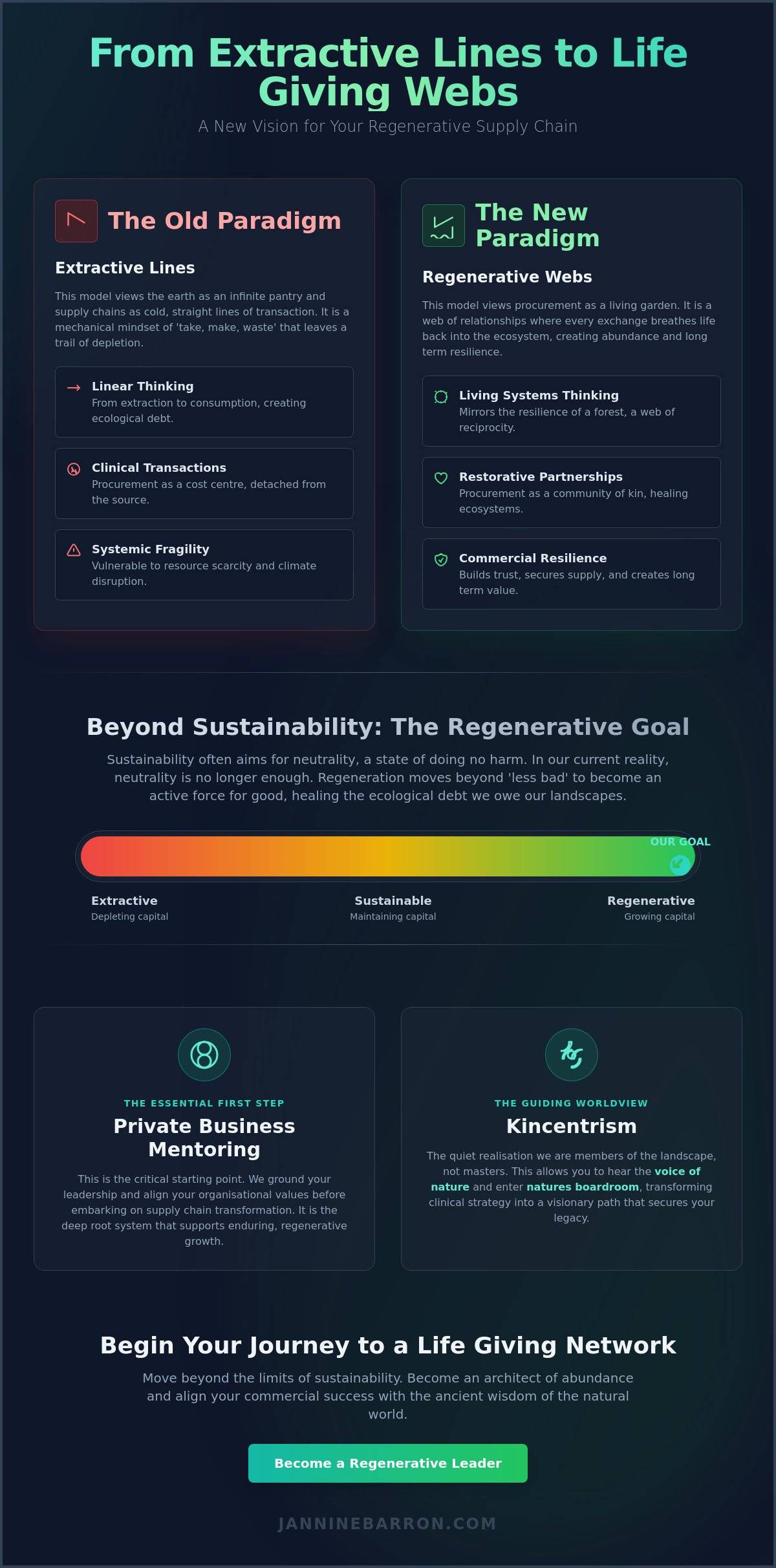
For decades, we have viewed our supply chains as cold, straight lines of transaction. These lines lead from a point of extraction to a point of consumption, leaving behind a trail of depletion and silence in the soil. This extractive business model treats the earth as an infinite pantry rather than a living relative. To truly understand how to create a regenerative supply chain, we must first unlearn this linear thinking. We must begin to see our procurement as a web of relationships where every exchange breathes life back into the ecosystem. A regenerative supply chain is a restorative living system.
The shift toward life giving networks represents the next great evolution of ethical trade. It moves us away from the mechanical “take, make, waste” mentality and toward a model that mirrors the resilience of a forest. In this new paradigm, your business does not just exist on the landscape; it becomes a steward of it. By 2026, the goals of the global community have moved beyond carbon reduction. We are now called to be architects of abundance, ensuring that every raw material we source leaves the earth more vibrant than we found it.
To see how this transformation unfolds in the natural world, watch this exploration of seaweed as a catalyst for change:
The Limitations of Traditional Sustainability
Sustainability was a noble starting point, yet it often aims only for a neutral footprint or a state of doing no harm. In our current climate reality, neutrality is no longer enough to heal the historical ecological debt we owe to our landscapes. Being less bad is not the same as being actively good. While circular economy principles help us keep materials in use, regeneration goes further by restoring the biological vitality of the source. Organisations in the UK and Australia are already seeing a shift toward mandatory restoration reporting, as regulators recognise that survival depends on active repair rather than mere maintenance.
The Business Case for Resilience and Restoration
Creating a life giving network is a pragmatic strategy for commercial survival. When you choose to invest in soil health or biodiversity, you are essentially buying insurance against the crop failures and resource scarcities that plague extractive systems. In the boardrooms of Sydney and London, the conversation has shifted toward long term security. Leaders now realise that trust is the new currency. Conscious consumers can sense the difference between a brand that takes and a brand that nourishes. By following the voice of nature, you build a resilient foundation that can withstand the storms of a changing climate while securing a competitive advantage in an increasingly aware marketplace.
Applying Principles of Kincentrism to Your Supply Network
Kincentrism is the quiet realisation that we are not masters of the landscape but members of it. It is a worldview that invites us to see every river, every patch of soil, and every worker as part of an extended family of life. When we contemplate how to create a regenerative supply chain, we are looking for ways to restore these familial bonds. This shift is profound. It moves us away from viewing a procurement list as a collection of clinical transactions and toward seeing it as a community of kin. Each raw material carries the story of the land it came from, and our role as leaders is to ensure that story is one of health and vitality.
To listen to the voice of nature is to respect the biological limits of the places we touch. It requires us to slow down and observe the unique needs of the biodiversity in the UK countryside and the resilient Australian bush. We must regenerate supply chains by moving beyond the obsolete cycles of corporate transformation and instead adopting a continuous, organic rhythm of growth. This is where the technical meets the spiritual. It is where your procurement strategy becomes an act of love for the world your children will inherit. To prepare for this level of systemic change, private mentoring is the essential first step to align your inner compass with the needs of the earth.
Biomimicry in Procurement and Logistics
Nature is the most efficient logistics manager on earth. Consider the mycelial networks beneath the ancient forests of the UK. They distribute nutrients to where they are most needed, ensuring the health of the whole system without creating a single gram of waste. By understanding what is biomimicry, we can apply these ancient blueprints to our own distribution networks. We can design systems that are as intelligent and responsive as a fungal web, turning our logistics from a source of pollution into a model of elegant resource management.
Restoring the Commons Through Business
A regenerative leader acts as a steward of the commons. This means moving beyond private gain and looking toward the shared ecological health of the regions you source from. Whether it is regenerative farming in Wiltshire that brings birds back to the hedgerows or soil restoration in Australia that captures carbon and retains water, your business has the power to heal. You are no longer just a buyer; you are a partner in the landscape, ensuring that the commons are replenished for all who rely upon them.
Why Private Mentoring is the Essential First Step for Supply Change
Your supply chain is not merely a logistical map; it is a mirror reflecting your deepest internal values. When we look at the complexity of global networks, it is easy to feel lost in the mechanics of spreadsheets and shipping lanes. However, to truly grasp how to create a regenerative supply chain, you must first address the internal landscape that governs your decisions. Private business mentoring serves as the essential first step in this transformation. It provides a quiet sanctuary to clear the extractive mindsets that have been conditioned into us by centuries of industrial tradition. This process is about more than just better management. It is about finding the courage to choose restoration over the hollow lure of short term profit.
A mentor acts as a wayfinder, helping you navigate the fog of ethical dilemmas that arise when you begin to listen to the voice of nature. You cannot heal a supply chain until you heal your relationship with nature. By stepping into this reflective work, you move from being a passive participant in extractive systems to becoming a conscious architect of life giving networks. This shift requires a profound commitment to self awareness and a willingness to question the very foundations of how you define success. Adopting a regenerative business model is as much an emotional journey as it is a commercial one.
Aligning Personal Purpose with Procurement
The journey toward a regenerative business begins with an honest audit of your own soul. It is here that you identify where your personal values of care and love conflict with the extractive habits of your current suppliers. Through deep, one on one reflection, you begin the process of unlearning the “take, make, waste” paradigm. This internal alignment ensures that when you eventually enter natures boardroom, your strategic decisions are anchored in a truth that cannot be shaken by market volatility.
The Emotional Intelligence of Partnership
Regeneration is built on the strength of your relationships. It requires a high degree of emotional intelligence to move from transactional negotiations to a state of collaborative co creation with your partners. Mentoring helps you develop the empathy needed to build partnerships based on mutual flourishing. You will learn to hold the difficult conversations required to shift a vendor toward restorative practices. This isn’t about clinical oversight; it is about nurturing a community of kin where every member is committed to the health of the whole system.
Five Steps to Create Your Regenerative Supply Chain
Creating a living web requires a shift from clinical checklists to soulful observation. If you have already begun your journey with private mentoring, you are ready to map the physical reality of your network with a new set of eyes. This is not a bureaucratic exercise but a rhythmic sequence of alignment. You are moving from a model that simply manages risk to one that actively cultivates life. To understand how to create a regenerative supply chain, you must be willing to look at the points of pain in your network and see them as opportunities for healing. This wayfinder path is about more than logistics; it is about restoring the broken bonds between commerce and the earth.
The first step is to audit your current impact with an honest and empathetic eye. This involves identifying the key points of intervention where restoration is most urgent. You then select partners who are already practicing or deeply committed to regenerative ways. Once these kinships are formed, you invest in the long term health of their ecosystems and communities. Finally, you measure success through life affirming metrics that reflect the vitality of the land. As you move through the process of transformation, you will find that each step brings your organisation closer to the resilience found in natural systems.
Auditing for Life Affirming Impacts
Traditional audits often stop at carbon footprints, yet a regenerative approach looks at the whole living system. You must look beyond the numbers to see the social and ecological health of your supply web. This means questioning the origin of every ingredient with curiosity. Are the workers thriving? Is the water being replenished? By using tools that map the biological richness of your source regions, you can begin to see your business as a participant in a wider cycle of life.
Nurturing Local and Indigenous Partnerships
True regeneration is deeply rooted in place. In the UK, this might mean sourcing from local producers to significantly reduce transport miles and support the revival of the British countryside. In Australia, it involves honouring Indigenous knowledge in land management and sourcing. By creating multi year agreements, you provide the financial security that regenerative farmers need to transition their land. As of January 2026, over 25 million acres are certified under regenerative standards, proving that these partnerships are not just possible but are becoming the new industry benchmark.
Measuring What Truly Matters
The bottom line can no longer be the only measure of success. We must include the health of the voice of nature in our reporting. This means tracking biodiversity increases, soil organic matter, and the restoration of water cycles. Use qualitative stories alongside quantitative ecological data to show stakeholders the real world impact of your choices. When you report on the return of a specific bird species to a farm or the rising water table in a parched region, you provide a sense of hope and agency that a spreadsheet alone can never offer.
If you feel the call to move from extraction to restoration, I invite you to reach out for a conversation about how we can begin your regenerative strategy together.
Integrating the Voice of Nature Through Natures Boardroom
The traditional office, with its fluorescent lights and clinical walls, is often a barrier to the visionary thinking required for deep systems change. To truly understand how to create a regenerative supply chain, we must step into a space where the rules of life are written in the soil and the wind. Natures boardroom is this sacred space. It is an invitation to leave the digital noise behind and enter the wisdom of the Wiltshire countryside or the ancient parks of London. Here, the voice of nature becomes your primary consultant, offering a clarity that no spreadsheet can replicate. These immersion days are not mere retreats; they are intensive strategic sessions where the complexity of your supply web is unpicked and rewoven with the intelligence of a living ecosystem.
Stepping out of the corporate environment allows your nervous system to settle, opening the door to intuitive insights that are often drowned out by the frantic pace of modern business. When you stand beneath a canopy of trees, the scale of your challenges shifts. You begin to see your organisation as a part of a larger, breathing whole. This perspective is essential for leaders who are ready to move beyond the extractive habits discussed earlier and embrace a role as a true steward of the earth. It is here that we find the courage to implement the life affirming changes our world so desperately needs. Through this process, your commercial strategy becomes a natural extension of the landscapes you inhabit.
Immersive Strategy for Supply Web Design
In the silence of the forest, we practice the art of listening to what the land requires from your business. We use biomimicry exercises to solve procurement challenges, looking at how natural systems manage resources with such elegant efficiency. The forest environment naturally encourages systems thinking and a long term vision that extends far beyond the next quarterly report. By observing the interconnectedness of a woodland, you gain a practical blueprint for your own regenerative network. You learn to design for resilience, ensuring that every link in your chain is nourished and strong. This is where the technical mechanics of supply meet the profound wisdom of the wild.
Joining the Growth Experience Incubator
For those leaders ready to fully commit to this path, The Growth Experience serves as an incubator for ethical brands. This is a nine month journey designed to help you redesign your entire business around regenerative business practices. You will join a community of like minded leaders across the UK and Australia, all working to transform their supply chains from a logistical burden into a source of constant inspiration. This is where we bring the insights from natures boardroom into the practical reality of your daily operations. We ensure your legacy is one of restoration, providing the structural support needed to bring your life giving network into the world with confidence and grace.
Step Into Your Role as a Steward of the Earth
The path from extraction to restoration is a journey you don’t have to walk alone. We have explored how the principles of Kincentrism and the quiet wisdom of natures boardroom can turn a clinical logistics map into a vibrant web of life. Understanding how to create a regenerative supply chain is about more than efficiency; it is about reclaiming your agency as a leader who nourishes the world. By shifting your focus from short term gain to long term ecological health, you secure a future that is both resilient and soul led.
Since the 1990s, I have been active in the ethical business space, witnessing the profound shift from sustainability to regeneration. As the creator of The Growth Experience incubator and a facilitator of nature based immersions, I am here to support your transition. You cannot transform your network until you align your internal compass. I invite you to begin your wayfinder journey with private mentoring today. Together, we can listen to the voice of nature and build a business that leaves a legacy of abundance for generations to come. The earth is ready for your leadership.
Frequently Asked Questions
How is a regenerative supply chain different from a sustainable one?
A regenerative supply chain moves beyond the neutral footprint of sustainability to actively restore ecosystems and communities. While sustainability focuses on doing no harm or maintaining the status quo, regeneration is a life giving process that heals historical ecological debt. By 2026, the global standard has shifted toward these restorative models. It is a transition from merely surviving to thriving in harmony with the natural world.
Can a small business realistically create a regenerative supply chain?
Small businesses are uniquely positioned to lead this change because they often possess more intimate and transparent supply webs. You don’t need a massive budget to begin this transformation. It starts with a shift in perspective and leadership alignment. By focusing on local partnerships and clear values, a small organisation can become a powerful catalyst for restoration in its specific region.
What are some examples of regenerative supply chain practices in the UK?
In the UK, businesses are increasingly adopting the Regenagri standard, which managed 4.37 million acres of certified farmland as of January 2026. Practical examples include multi year sourcing agreements with farmers in Wiltshire who are restoring hedgerows and soil health. These partnerships provide the financial security needed for producers to move away from extractive industrial methods and embrace restorative cycles.
How do I find suppliers who are committed to Kincentrism and restoration?
Finding restorative partners requires looking beyond traditional certifications toward outcome based verifications like the Land to Market program. This program has certified over 6 million acres globally as of 2026. You should seek suppliers who embrace Kincentrism and are willing to let the voice of nature guide their land management. It is about building a community of kin rather than a list of vendors.
Is it more expensive to run a regenerative supply chain in Australia?
While the initial transition can require investment, a regenerative approach in Australia builds long term resilience against climate volatility and crop failure. By May 2026, carbon credits from regenerative agriculture range from €15 to €60 per tonne, providing a new revenue stream for restorative land managers. This financial offset helps balance the costs of moving away from extractive practices while securing your business future.
How can private mentoring help me change my procurement strategy?
Private mentoring is the essential first step because it helps you unlearn the extractive mindsets that govern traditional procurement. You cannot learn how to create a regenerative supply chain until you have aligned your internal values with the needs of the earth. Mentoring provides the quiet space needed to redesign your strategy with empathy and vision before you enter natures boardroom.
What role does biomimicry play in designing supply networks?
Biomimicry offers biological blueprints for designing logistics and distribution networks that mimic the efficiency of a forest. For example, the way mycelial networks distribute nutrients can inspire more resilient local distribution webs in the UK. By studying these natural systems, we can create business structures that are inherently restorative and waste free, turning logistical burdens into elegant systems of exchange.
How do I measure the success of my regenerative efforts?
Success is measured through scientifically verified improvements in land health, such as the Ecological Outcome Verification method. You should track specific metrics like soil organic matter, biodiversity increases, and water retention. These life affirming data points tell a much deeper story of success than a traditional financial bottom line, proving that your organisation is hearing the voice of nature.