
What if the exhaustion you feel in your leadership is a signal that your business is breathing against the rhythm of the planet? Many leaders feel trapped in a relentless take make dispose cycle that leaves both their teams and the earth depleted. It is a quiet burnout born from trying to grow in an unsustainable way. To find a way forward, we must look beyond clinical jargon and listen to the Voice of Nature. Developing a business strategy for a circular economy is not merely about managing waste; it is about reclaiming the biological metabolism of your organisation so it thrives, rooted like the ancient Australian gums.
You likely recognise that old extractive models are crumbling, especially as regulations like the EU Packaging and Packaging Waste Regulation set mandatory targets for August 2026. This guide offers a path to a nature aligned circular strategy and long term resilience by aligning operations with natural cycles. We explore how private mentoring serves as the essential first step in leadership coaching, allowing you to step into Nature’s Boardroom with clarity. You will learn practical steps to design out waste and foster systemic health through Kincentrism, ensuring your brand becomes a restorative force.
Key Takeaways
- Transition from the exhaustion of extractive models toward a regenerative business strategy for a circular economy that honours the wisdom of the Australian landscape.
- Learn why private business mentoring is the essential first step in leadership coaching to align your personal vision with the biological metabolism of your organisation.
- Use the blueprint of Kincentrism to design out waste and audit your supply chain for leaks that compromise long term resilience.
- Discover how to access Nature’s Boardroom and listen to the Voice of Nature to find strategic clarity amidst global complexity.
- Move beyond technical jargon to implement practical steps for product life extension and material recovery within a nature aligned framework.
Defining the Shift from Extractive Models to Circular Strategy
For decades, the corporate world has functioned like a machine that consumes life to produce profit. We have been taught that success is a straight line, a trajectory of growth that never returns to its source. This linear mindset is the architect of our current crisis. When we ask what is a circular economy, we are really asking how to bring our work back into the circle of life. A true business strategy for a circular economy is not a waste management plan; it is a fundamental shift in how we perceive our role within the living world.
To better understand how these strategies are being adopted at the highest levels of leadership and education, watch this helpful video:
This transition requires us to move from extraction to contribution. It is about seeing your organisation as a biological metabolism rather than a mechanical process. In the Australian bush, nothing is ever truly wasted; the fallen leaf becomes the nourishment for the next season of growth. Your strategy should mimic this grace. By aligning with the Voice of Nature, you begin to see that profit is not the end goal but the byproduct of a healthy, functioning system that respects its boundaries.
The Limitations of the Take Make Dispose Paradigm
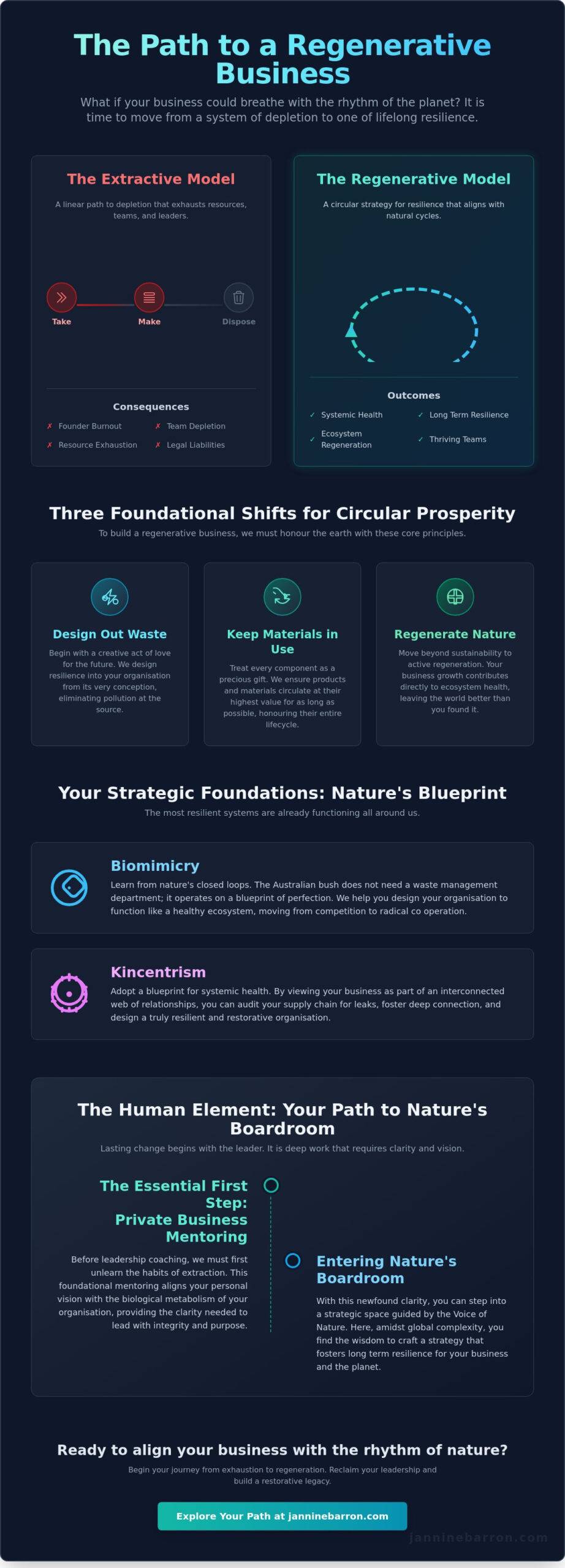
The traditional linear model is built on extractive business models that eventually exhaust the very resources they depend on. This exhaustion is not just environmental; it manifests as founder burnout and a sense of spiritual depletion. In 2026, efficiency is no longer enough for a world that is reaching its limits. With the EU Packaging and Packaging Waste Regulation becoming active in August 2026, the hidden costs of ignoring product lifecycles are now becoming legal and financial liabilities. We can no longer afford to design things that have no place to go when their first life ends.
The Core Pillars of Circular Prosperity
Building a regenerative business requires three foundational shifts that honour the earth. First, we must design out waste and pollution from the very beginning. This is a creative act of love for the future. Second, we keep products and materials in use at their highest value, treating every component as a precious gift. Finally, we focus on ecosystem regeneration. This means your business growth actually leaves the world better than you found it. This journey is deep work. It often begins with private mentoring to help leaders unlearn the habits of extraction and step into the clarity of Nature’s Boardroom.
Biomimicry and Kincentrism as Strategic Foundations
While many view circularity as a technical challenge of logistics, the most resilient systems are already functioning all around us. The Australian bush does not need a waste management department because it operates on a blueprint of perfection. To build a truly effective business strategy for a circular economy, we must stop looking at spreadsheets and start looking at the soil. Biomimicry offers us the intelligence to design organisations that function like healthy ecosystems. This is not about being less bad but about being inherently good by design.
Learning from Natures Closed Loops
Nature is the ultimate mentor. When we apply biomimicry in business, we stop seeing our supply chain as a line and start seeing it as a web of relationships. Consider how a forest manages its resources. Nutrients flow where they are needed most; nothing is hoarded and nothing is discarded. By mimicking these closed loops, we can create industrial processes that are self sustaining. This shift moves us from aggressive competition to radical co operation, where businesses within an industry support one another to ensure the health of the whole system. It’s a way of working that ensures no material ever loses its value, creating a resilience that mechanical models can never replicate.
Embracing Kincentrism in Leadership
Strategic planning often fails because it ignores the silent majority: the living world. Kincentrism is the profound realisation that we are not separate from nature but a part of it. When we embrace this mindset, we invite the Voice of Nature into our decision making. We begin to view the local river or the ancient forest as a key stakeholder with a seat at the table. This is a far cry from the perspective of the US EPA on the circular economy, which focuses primarily on the technicalities of recycling. Kincentrism asks us to consider reciprocity. What are we giving back to the land that sustains our operations? This life centric approach does more than protect the environment; it builds deep brand loyalty with a public that is increasingly seeking authenticity and soul in the companies they support. A business strategy for a circular economy that is rooted in Kincentrism creates a legacy that lasts for generations.
If you feel called to explore these deeper foundations and move beyond traditional models, you might find clarity through the process of unlearning extractive habits. This journey often begins by stepping away from the noise and entering the stillness of Nature’s Boardroom to reconnect with your true purpose as a leader.
Practical Implementation: Designing Waste Out of the System
Moving from philosophical alignment to the tangible architecture of your business requires a keen eye for where life is leaking away. An extractive leak is any point where value, material, or energy is lost to a landfill or a toxic byproduct. Auditing your supply chain is an act of deep care. It is about ensuring every input is life friendly and every output has a future. When you develop a business strategy for a circular economy, you are essentially building a vessel that holds value rather than letting it drain into the soil. This process often feels overwhelming until you step into the stillness of Nature’s Boardroom to find the structural clarity required for such a transition.
Circular Business Models for Ethical Brands
The shift from ownership to access is a powerful way to keep materials at their highest value. By exploring diverse Business Models for the Circular Economy as analysed by the Organisation for Economic Cooperation and Development, leaders can transition to product as a service models that foster long term relationships with customers. For organizations looking to amplify this impact, Carissa Newton Creative provides fractional CMO services that align your marketing strategy with these regenerative goals. Designing for disassembly and easy repair is also essential. In Australia, where vast distances can make centralised recycling difficult, local supply chains and regional repair hubs become vital for resilience. This decentralised approach mimics the way nutrients are managed in a local forest ecology, ensuring that resources stay within the community.
Navigating Regulatory Frameworks in 2026
The global landscape is shifting rapidly. The EU Circular Economy Action Plan is no longer a distant concept; its reach is felt by any brand with international aspirations. In 2026, green taxation is becoming a strategic advantage for those who have already designed out waste. Preparing your organisation for transparent impact reporting is a chance to tell a story of integrity. To navigate these complexities, many leaders find that private business mentoring is the essential first step. It provides the space to unlearn extractive habits and cultivate the leadership consciousness needed to implement these technical shifts with soul and precision. When your strategy aligns with the Voice of Nature, compliance becomes a natural byproduct of your commitment to systemic health.
The Human Element: Leadership Coaching as the First Step
The most sophisticated business strategy for a circular economy will eventually wither if the leader behind it remains rooted in extractive thinking. We often spend months auditing supply chains while ignoring the leader’s internal ecosystem. Strategy fails when the soul is tired. If you are still operating from a place of scarcity and burnout, your circular initiatives will feel like just another set of clinical tasks to manage. True transformation requires a shift in leadership consciousness that moves beyond the mechanical and into the biological.
Systemic change is inherently uncomfortable because it asks us to let go of the take make dispose safety net that has defined success for generations. This transition often triggers a quiet resistance or a deep fear of the unknown. Leadership coaching at this level is about building the emotional capacity to hold that tension. It is a process of unlearning the habits of extraction and restoring the energy of the purpose driven founder. When you heal your own relationship with the living world, your strategic decisions begin to flow with a natural authority that no spreadsheet can provide.
From Manager to Wayfinder
A traditional manager seeks to control variables; a Wayfinder seeks to listen to the system. Regenerative mentoring is distinct from standard corporate coaching because it prioritises life over performance metrics. It invites you to step out of the frantic pace of modern business and into the stillness of the landscape to hear the Voice of Nature. By reconnecting with natural rhythms, you develop the resilience needed to lead your organisation through complex transitions. You stop trying to force growth and start nurturing the conditions where growth becomes inevitable.
Private Mentoring: The Essential First Step
We cannot design out waste in our operations if we are still wasting our own spirit through relentless overwork. This is why private mentoring is the essential first step in your journey. It provides a sanctuary where you can identify the extractive leaks in your own leadership style. Do you hoard information? Do you sacrifice long term health for short term gains? These are the internal patterns that mirror the linear economy. By addressing these habits in a safe, supportive space, you can set a nature aligned intention for your work. This personal foundation ensures that your business strategy for a circular economy is not just a plan but a living legacy.
To begin this internal transformation and find the clarity needed for systemic change, you can explore Nature’s Boardroom for a space of deep reflection and strategic clarity.
Nature’s Boardroom and the Voice of Nature in Strategy
Strategy is too often confined to the grey walls of an office, where the air is stale and the perspective is narrow. Designing a business strategy for a circular economy requires a different frequency of thought. It demands a return to the systems that actually work. Nature’s Boardroom is not just a concept; it is a physical invitation to step into the living world to find strategic clarity. When we move our planning sessions into the woods of Wiltshire or the ancient green spaces of London, the noise of the market fades. We begin to hear the Voice of Nature, which has been managing complex, circular systems for billions of years.
Listening to this voice involves a practice of deep presence. It is about asking the land how it would solve a problem of resource scarcity or material flow. This approach bridges the gap between the pragmatic needs of a global organisation and the poetic wisdom of the earth. By integrating insights from the resilient Australian landscape, we can build strategies that are both globally impactful and locally rooted. The gum tree and the oak both teach us about endurance and reciprocity; lessons that are essential for any leader committed to systemic health. A business strategy for a circular economy that is born in the wild carries a resilience that office based plans simply cannot match.
The Power of Nature Immersion
The most profound breakthroughs rarely happen behind a screen. They happen when the ego settles and the senses wake up. A session in Nature’s Boardroom is an immersion into the intelligence of the wild. Using forest therapy as a tool, we unlock creative solutions for circularity that were previously hidden by corporate stress. This environment allows you to see your business as a part of the ecology, ensuring that every strategic move you make is life affirming. It is a space where the technicalities of supply chains meet the spiritual depth of your purpose, allowing you to breathe again as a leader.
Your Path Forward: The Growth Experience
Transitioning to a nature aligned model is not a weekend task; it is a profound evolution of your leadership and your brand. The Growth Experience is a nine month journey into regenerative business designed for those ready to lead the shift. This programme connects you with a community of ethical brands across the UK and Australia, fostering a network of mutual support and shared wisdom. If you feel the call to move from extraction to contribution, the next step is a simple act of outreach. You can Contact Jannine for a wayfinder conversation to explore how your leadership can become a restorative force for the planet. Together, we can design a future where business and nature thrive in perfect, circular harmony.
Stepping into the Circle of Regenerative Growth
The transition toward a restorative future is not merely a technical adjustment; it is a profound returning to the wisdom of the living world. We have seen that a successful business strategy for a circular economy requires more than just efficient supply chains. It demands a shift in leadership consciousness that begins with private mentoring. By embracing Kincentrism and the blueprints of Biomimicry, you can move away from the burnout of extractive models and toward a business that functions with the grace of a healthy ecosystem.
With over 30 years of experience in ethical business and regeneration, I have dedicated my work to helping leaders find their path as Wayfinders. Whether through the immersion of Natures Boardroom or the structured support of The Growth Experience incubator, the goal is always to align your work with the Voice of Nature. The world is calling for brands that nourish rather than deplete. It is time to answer that call with clarity and soul.
Begin your regenerative journey with private mentoring
Frequently Asked Questions
What is the primary goal of a business strategy for a circular economy?
The primary goal is to align your organisation with the biological metabolism of the planet to ensure long term resilience and systemic health. It’s about moving away from extractive models that deplete life and toward regenerative strategies that contribute back to the living web. This shift ensures that profit becomes a byproduct of a healthy, functioning system rather than the result of exploitation.
How does a circular economy differ from simple recycling?
Recycling is a late stage intervention, whereas a business strategy for a circular economy focuses on designing out waste from the very beginning. While recycling tries to recover value from waste, circularity prioritises product life extension, disassembly, and material recovery. It treats every resource as a precious gift that must stay within the system at its highest value for as long as possible.
Why is private business mentoring considered the first step in this transition?
Private business mentoring is essential because systemic change requires a shift in leadership consciousness before any technical strategy can take root. Leaders must unlearn extractive habits and heal their own relationship with the living world to lead with true authority. This personal foundation provides the emotional capacity and clarity needed to navigate the complexities of regenerative growth without facing burnout.
Can a small business in the UK or Australia afford to be circular?
Circular models are often more affordable for small businesses because they focus on local supply chains and radical resource efficiency. In the UK and Australia, small brands can bypass the massive overheads of global extractive models by designing for repair and using life friendly chemistry. This approach reduces waste costs and builds deep brand loyalty within local communities that value integrity over mass production.
What are the three main principles of circular design in 2026?
The three foundational principles are designing out waste and pollution, keeping products and materials in use, and regenerating natural systems. By 2026, regulations like the EU Ecodesign for Sustainable Products Regulation make these principles a strategic necessity. Modern strategies focus on disassembly and material recovery to ensure every component can return to the earth or the factory safely and effectively.
What does it mean to listen to the Voice of Nature in business?
Listening to the Voice of Nature means stepping into the stillness of the wild to let the intelligence of the land guide your strategic planning. It is a practice of deep presence where you ask how a forest or a river would manage resources or resolve a conflict. This process often happens in Natures Boardroom, allowing leaders to find solutions that are inherently aligned with natural laws.
How does Kincentrism change the way I manage my supply chain?
Kincentrism transforms your supply chain from a line of transactions into a web of relationships where every stakeholder, including the land, is respected. You begin to audit your chain for extractive leaks and ensure that every supplier shares your commitment to reciprocity. This mindset ensures that your business supports the health of the entire ecology rather than just moving materials from one point to another.
Is a circular business model more resilient to economic shocks?
Circular business models are significantly more resilient because they reduce dependency on volatile global commodity markets and virgin raw materials. By keeping resources within a closed loop and fostering local supply chains, businesses protect themselves from the price spikes and shortages common in linear systems. This stability allows for steady, organic growth even when traditional markets face significant turbulence.