
What if the very strategies you have used to protect your company are the ones quietly exhausting your spirit and the soil beneath your feet? As a leader, particularly in regions facing stringent environmental regulations like the 2025 UK Sustainability Disclosure Requirements, you likely feel the weight of increasing climate reporting demands. This persistent eco anxiety is a clear signal that the old ways of doing less harm are no longer enough. You are here because you want to learn how to move beyond sustainability in business by transitioning from extractive habits to life affirming regenerative practices. You likely feel a deep disconnection between your commercial goals and the health of our living world.
As your wayfinder, I promise to show you a path where your organisation no longer merely survives but thrives like a resilient ecosystem. We will explore how private business mentoring allows us to step into natures boardroom to integrate Kincentrism and listen to the voice of nature in every decision. Together, we will map out the tools you need to ensure your legacy and the planet flourish in harmony.
Key Takeaways
- Understand why the traditional sustainability plateau of doing less harm is failing our ecosystems and why we must transition toward restorative action.
- Explore how to move beyond sustainability in business by adopting Kincentrism as a foundational philosophy that transforms supply chains into relational networks.
- Master a strategic framework that shifts your focus from extractive profit models to circular systems where value flows back into the planet and community.
- Step into natures boardroom to find the clarity needed for auditing your business operations while listening deeply to the voice of nature.
- Embark on a wayfinder journey where private business mentoring serves as the essential first step to cultivate the leadership required for a regenerative future.
The Limits of Traditional Sustainability in the 2026 Business Landscape
The business world has reached a quiet plateau where the old maps no longer serve the journey. For decades, we’ve been taught that success means doing less harm. We’ve focused on efficiency, carbon offsetting, and the reduction of our footprint. Yet, the air in our boardrooms feels heavy with the realisation that doing less harm is still a form of harm. It’s a slow walk toward a cliff. Leaders in the UK and Australia are feeling a profound psychological toll as they witness their extractive models depleting both the planet and their own inner fire. They’re looking for a way out. They’re seeking a wayfinder who knows that growth must be life affirming to be truly valid. Understanding how to move beyond sustainability in business requires us to step into nature’s boardroom and listen to the pulse of the living world.
To better understand this concept, watch this helpful video:
Why doing less harm is still harm
Traditional sustainability often acts as a veil for continued extraction. Net zero goals, while well intentioned, frequently focus on maintenance rather than healing. We can’t simply sustain a system that’s already broken. Moving toward a Regeneration (sustainability) approach means we stop asking how to survive and start asking how to thrive. It requires a shift toward Kincentrism, where we recognise our deep connection to all living things. The regenerative shift is a move from maintenance to restoration. It’s about creating a net positive impact where your business leaves the world better than it found it. Private business mentoring is the essential first step in this leadership coaching journey, helping you to birth a vision that nourishes the whole ecosystem.
The specific urgency for UK and Australian leaders
The pressure on our leaders is unique and growing. In the UK, agriculture faces a £2.4 billion annual gap in environmental funding, forcing a radical rethink of soil health and land stewardship. London based financial services are under intense scrutiny to move beyond surface level greenwashing and embrace deep systemic change. Across the ocean, Australian climate resilience has become a driver for urgent innovation after years of devastating bushfires and floods. Leaders in these regions are uniquely positioned to pioneer how to move beyond sustainability in business by listening to the voice of nature. To avoid the traps of the past, it’s vital to understand what to leave behind by studying this extractive business model guide. We’re called to be the midwives of a new economy that values life over mere profit.
Embracing Kincentrism and the Wisdom of Nature Aligned Systems
Kincentrism isn’t just a philosophical shift; it’s a fundamental restructuring of how we exist within the world. To understand how to move beyond sustainability in business, we must first stop viewing the planet as a warehouse of resources and begin seeing it as a web of relations. When we acknowledge that every living being is a relative, our business decisions stop being purely transactional. We begin to lead with a sense of deep responsibility that extends to the soil, the water, and the air. This worldview acknowledges that we are part of nature, not separate from it, and this simple truth changes everything about how we build and grow.
Kincentrism as a new business paradigm
Imagine your boardroom with an empty chair reserved for the local river or the soil that grows your raw materials. This is Kincentrism in action. It requires treating non human entities as vital stakeholders whose health is directly linked to your profit. This shift moves your organisation from a state of competition to one of symbiosis. In Australia, the brand Outland Denim demonstrates this by focusing on the restoration of people and land, ensuring their existence contributes to the vitality of the ecosystem. By viewing your supply chain as a living system, you create resilience that traditional models cannot match. You stop extracting and start nurturing the very foundations of your industry.
Learning from the voice of nature
The voice of nature acts as a strategic guide for any leader willing to listen with their heart and mind. Nature has already solved the problems we face; we simply need to observe. Biomimicry is the practice of mimicking these time tested patterns to solve human challenges. In dense urban centres like London or Sydney, biomimicry can revolutionise logistics by emulating the efficiency of ant colonies or the nutrient distribution of fungal networks. This isn’t just theory; it’s a practical application of biological intelligence to modern commerce. You can explore a more technical breakdown in this guide on what is biomimicry.
Leadership that is nature aligned creates organisations that function like healthy forests. In a forest, there is no central command; instead, there is a distributed network of support and communication. This model allows for rapid adaptation and collective thriving. Transitioning to this way of working is a delicate process of unlearning old paradigms. It begins with private business mentoring, which is the essential first step to recalibrating your leadership style. By stepping into natures boardroom, you gain the clarity needed to build a legacy. As highlighted in Beyond Sustainability: The Regenerative Business, the path forward is about creating more life, not just managing decline. If you feel ready to birth a new way of leading, I invite you to explore the programmes designed for this transformation.
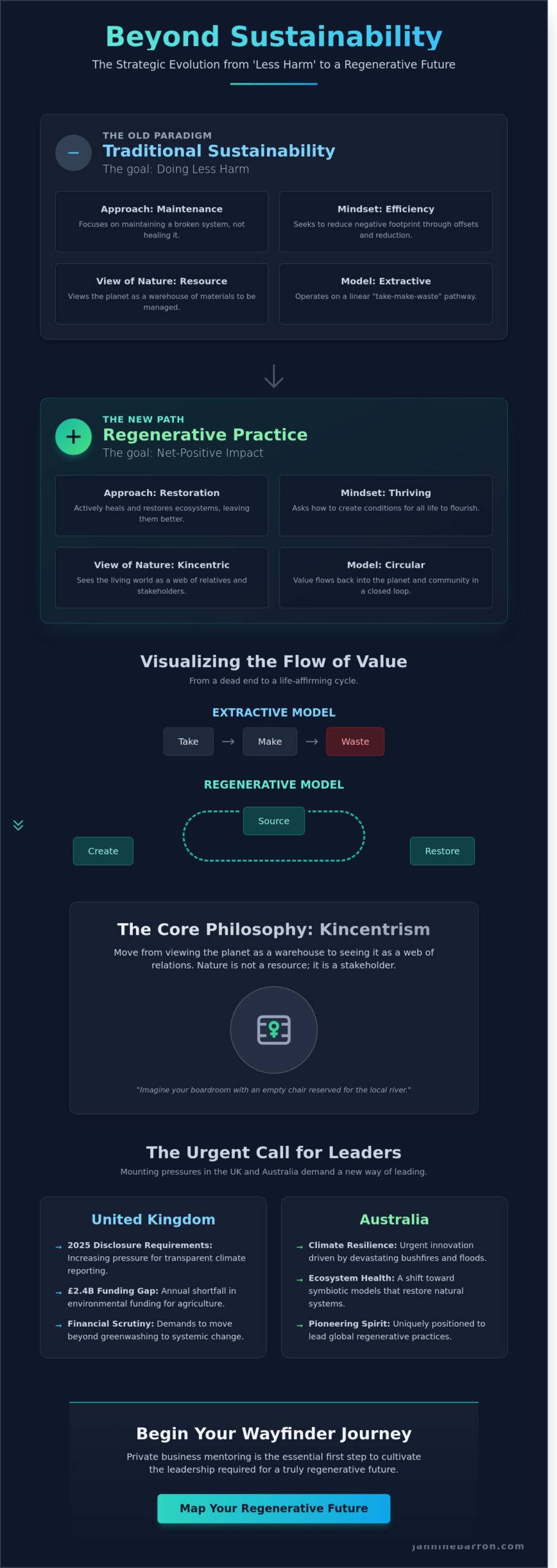
Sustainability vs Regeneration: The Strategic Evolution Framework
Sustainability has reached its plateau. For decades, the corporate world has focused on doing less harm, a defensive crouch that seeks to mitigate damage rather than create vitality. While net zero targets are essential milestones, they are not the destination. To truly thrive, leaders must understand how to move beyond sustainability in business by adopting a regenerative lens. This evolution is not merely a change in policy; it is a profound shift from a mindset of extraction to one of value circulation. It is the difference between a machine that eventually wears out and a forest that grows stronger with every passing season.
Regeneration demands that we look past the next quarterly report to the next century. It invites us to consider the legacy we leave behind. The misconception that this path is less profitable than traditional sustainability is rapidly dissolving. In the United Kingdom, businesses that prioritise a higher purpose and planetary health are proving more resilient to market shocks. Private business mentoring is the essential first step in this leadership journey, allowing a founder to realign their internal compass before attempting to shift an entire organisation. This framework rests on five pillars: purpose, power, networks, ownership, and finance. When these align, the business stops being a drain on the world and starts becoming a source of life.
From resource management to life stewardship
The traditional concept of human resources is a relic of the industrial age, treating people as fuel to be consumed. Regeneration replaces this with life stewardship. Instead of managing people, we nurture human potential. This shift acknowledges that every individual is a vital part of the organisational ecology. We move away from linear supply chains that create waste and toward circular value webs that mimic the interconnectedness found in the voice of nature. To succeed, an organisation must act as a living system where every department and every partner contributes to the health of the whole. This is the essence of Kincentrism, where we recognise our deep connection to all living things within our business decisions.
The business case for flourishing
Choosing a regenerative path is a strategic advantage. Data from the UK B Corp community shows that these purpose driven companies achieved an average turnover growth of 26 percent between 2017 and 2021, significantly outperforming the 5 percent national average for SMEs. This success is driven by a deep attraction and retention of talent. Modern professionals, particularly those in the UK and Australia, are no longer satisfied with a salary alone; they seek a nature based purpose that resonates with their values. When you bring the wisdom of natures boardroom into your strategy, you create a brand that people want to protect and see flourish. For those ready to begin this transition, exploring a regenerative business guide provides the practical steps needed to turn visionary ideas into grounded reality.
Practical Steps to Embed Regeneration into Your UK or Australian Business
Business is a living system, not a machine. When we view our organisations through this biological lens, we begin to understand that survival is a low bar. Evolution is the true goal. Learning how to move beyond sustainability in business requires a shift from damage limitation to active restoration. It asks us to stop merely doing less harm and start doing more good by design. This transformation begins with the leader but quickly flows into the very structures that hold the company together.
Activating natures boardroom
Clarity rarely arrives behind a desk or within the grey walls of a clinical office. To hear the voice of nature, we must physically place ourselves within its rhythm. This is why I facilitate sessions in natures boardroom, where the landscape becomes a co mentor in your strategic evolution. Whether we meet in the ancient, rolling greenery of Wiltshire or along the rugged, salt sprayed coastlines near Sydney, the environment acts as a catalyst for creative breakthroughs.
Nature immersion is a deliberate practice of Kincentrism. By stepping into the forest or onto the beach, we strip away the frantic noise of modern commerce. This space allows leaders to confront creative blocks that have persisted for years. I encourage you to visit natures boardroom to experience how the natural world can solve complex organisational puzzles that logic alone cannot touch.
Regenerating the supply chain
A regenerative supply chain moves past the era of the tick box audit. Instead of merely checking if a supplier meets minimum standards, we begin to partner with them for ecosystem restoration. This is a technical and emotional shift toward radical transparency and systems change. In the United Kingdom, where 70 percent of the land is managed for agriculture, our focus must be on soil health and biodiversity. In Australia, the priority often shifts to water security and fire resilience, acknowledging that 50 percent of the landmass is used for farming and grazing.
- Transition from transactional purchasing to long term stewardship agreements.
- Support farmers in adopting regenerative grazing and no till practices to sequester carbon.
- Implement circular design so that every product is a nutrient for its next life cycle.
- Audit for emotional equity, ensuring that every human in the chain is nourished, not just paid.
True regeneration requires a culture of care that transcends the balance sheet. It involves bábáskodás, or midwifing, new ways of being within your team. We must foster emotional depth, allowing space for grief over what we have lost and hope for what we are building. This is not soft skill training; it is the essential hardening of an organisation against the volatility of the coming decades. If you are ready to begin this journey, private business mentoring is the vital first step to align your leadership with these life affirming principles. You can explore my regenerative business programmes to find the path that suits your current stage of growth.
The Wayfinder Journey: Why Leadership Mentoring Is the Essential First Step
True systemic change within an organisation never begins with a new policy or a revised supply chain strategy. It begins in the quiet, internal spaces of the person at the helm. You cannot solve a crisis using the same level of consciousness that created it. For UK leaders, the pressure to evolve is no longer a distant whisper; it’s a roar. To understand how to move beyond sustainability in business, one must first undergo a personal alchemy. This is why private mentoring is the crucible of the regenerative shift. It’s a protected space where the old, extractive habits of the industrial age are composted to make room for something life affirming.
The role of the regenerative business mentor
Traditional business coaching often feels clinical or aggressive, focusing on performance metrics while ignoring the dying ecosystems outside the boardroom window. A regenerative mentor operates differently. I act as a wayfinder, helping you steer through the complexity of systems change by balancing poetic vision with pragmatic business structure. We bring the voice of nature into our sessions, moving beyond human centric ego to embrace Kincentrism. This approach ensures your business doesn’t just survive but thrives as a vital part of its local and global ecosystem. You can explore the process of choosing a mentor who aligns with these values to ensure your transition is rooted in integrity rather than just greenwashing.
Starting your transformation today
Your journey toward regeneration starts with a single, honest moment of self reflection. Take a breath and consider your current operations. Ask yourself: “Which part of my business model currently takes more than it gives back to the earth or the community?” This simple question is the first step in reevaluating how to move beyond sustainability in business and entering a state of active restoration. In the UK, where 75 percent of the workforce now seeks employers with strong environmental values, this isn’t just an ethical choice; it’s a commercial necessity for long term resilience.
The Growth Experience is designed as a comprehensive incubator for this very transition. It provides the structural support and technical guidance needed to birth new, regenerative ideas into the world. We move through the cycles of growth together, much like the seasons we observe in natures boardroom. If you feel the call to lead with more heart and deeper impact, I invite you to contact Jannine for a private wayfinding session. Together, we can nurture a legacy that serves the future of our planet and your prosperity.
Charting Your Course Toward a Regenerative Legacy
The 2026 business landscape demands more than simple carbon offsets or reduction targets. Understanding how to move beyond sustainability in business requires a shift from human centric models to Kincentrism; a way of leading that honours every living system. You have explored the strategic evolution from maintaining to regenerating and the vital need to listen to the Nature Voice within your supply chains and boardrooms. Real change is not a checklist. It is a deep structural rebirth that aligns your organisation with the wisdom of the natural world.
Since the 1990s, I have mentored purpose driven leaders through these complex transitions. Whether we meet in the ancient woodlands of the UK or the vast landscapes of Australia for Natures Boardroom immersions, the path remains the same. True transformation starts from within the leader. It requires a guide who understands both the technicalities of systems change and the soulful necessity of planetary care. The time for hesitant steps has passed; the era of the wayfinder has arrived. You are ready to plant the seeds of a legacy that flourishes for generations.
Begin your wayfinder journey with private business mentoring today
The forest does not rush, yet everything is accomplished. Your business can find that same rhythmic power.
Frequently Asked Questions
What is the main difference between sustainable and regenerative business?
Sustainability focuses on maintaining the status quo by doing less harm, whereas regenerative business seeks to actively restore and heal the living systems we inhabit. It’s the vital shift from merely surviving to thriving. When leaders learn how to move beyond sustainability in business, they transition from a mindset of neutral impact to one where every transaction nourishes the soil, the soul, and the community as defined by the planetary boundaries identified by the Stockholm Resilience Centre in 2009.
Can a small business in the UK actually implement regenerative practices?
Small UK enterprises are uniquely positioned to lead this change because their agility allows for rapid shifts in supply chain ethics and community engagement. A 2023 report from the British Business Bank indicates that 76 percent of small businesses are already pursuing environmental goals. By sourcing materials from local regenerative farms or adopting circular waste systems, a small shop in Bristol or a studio in London can become a beacon of restoration for its local ecosystem.
How does Kincentrism apply to a modern corporate office environment?
Kincentrism in the office means recognising that our colleagues, our resources, and the land our building sits upon are all interconnected kin. This practice moves us away from viewing staff as human capital and toward seeing them as vital members of a living web. It involves bringing the voice of nature into every meeting and ensuring that office protocols respect the biological rhythms of the people who work there, replacing clinical efficiency with the wisdom of the forest.
Is moving beyond sustainability more expensive for a startup in Australia?
Moving beyond sustainability often proves more cost effective for Australian startups because it builds deep resilience against resource volatility and climate risks. Research from the University of Sydney in 2022 highlighted that companies with integrated environmental strategies often see a 15 percent increase in long term viability. While initial design phases might require an investment of £3,000 to £7,000 for specialist guidance, the reduction in waste and the increase in brand loyalty create a more stable financial foundation.
What are some examples of regenerative business models in 2026?
By 2026, we see the rise of stewardship ownership models where profits are legally bound to be reinvested into ecological restoration and social equity. Some organisations are now using 100 percent mycelium based packaging that actively restores nitrogen to the soil when discarded. Others have formalised the voice of nature by appointing a legal representative for local rivers or forests to their board of directors, ensuring that the landscape has a vote in the company’s future.
How do I start listening to the voice of nature in my business strategy?
You begin by stepping into natures boardroom and quietening the noise of traditional market demands to observe how life actually functions. This requires a shift in rhythm where you align your product launches or strategic reviews with the natural seasons rather than arbitrary fiscal quarters. It’s a practice of deep observation where you ask how your business can function like an oak tree, providing shade, shelter, and nutrients to everything around it while it grows.
Why is private mentoring considered the first step in this journey?
Private mentoring is the essential first step because the transition to a regenerative model requires a profound internal transformation of the leader themselves. As a business doula, I provide the sanctuary needed to dismantle old, extractive habits and breathe life into a new way of being. This intimate partnership ensures you have the emotional support and technical clarity to lead your organisation through the complex birth of a truly life affirming legacy.