
What if the exhaustion you feel isn’t a sign of failure, but a signal that your leadership has outgrown the narrow walls of an extractive machine? You’ve likely felt the heavy weight of trying to fix a broken model by working harder within it, only to find the soil of your organisation increasingly depleted. It’s a common struggle for leaders who sense that the old ways of operating are no longer fit for the living world we inhabit. Understanding how to implement regenerative practices is not about adding more tasks to your list; it’s about returning to a way of being that honours the inherent wisdom of life.
Before we can heal our supply chains, we must first listen to the voice of nature. This transformation begins with private business mentoring, acting as the essential first step in your leadership coaching journey to ground your leadership in Kincentrism. By stepping into natures boardroom, perhaps guided by the ancient rhythms of the Australian landscape, you’ll discover how to transition from extractive models to systems that restore both your organisation and the planet. This article provides a clear framework for nature aligned decision making and practical steps to transform your operations. We’ll explore how to move beyond the clinical approach of traditional consulting and instead begin the vital work of tending to your business as a living ecosystem.
Key Takeaways
- Systemic change starts with the internal landscape of the leader. You’ll learn why private business mentoring is the essential first step to ground your vision in life affirming values.
- Discover how to implement regenerative practices by identifying extractive nodes in your supply chain. It’s time to shift from transactional deals to reciprocal partnerships that truly restore.
- Translate the wisdom of soil health into organisational metaphors that nourish your collective team. A resilient culture requires a level of diversity that reflects the beauty of the natural world.
- Integrate Kincentrism into your strategy by welcoming the voice of nature as a silent stakeholder. Listening to the land in natures boardroom ensures your decisions serve the entire web of life.
Understanding the shift from extractive to regenerative practices
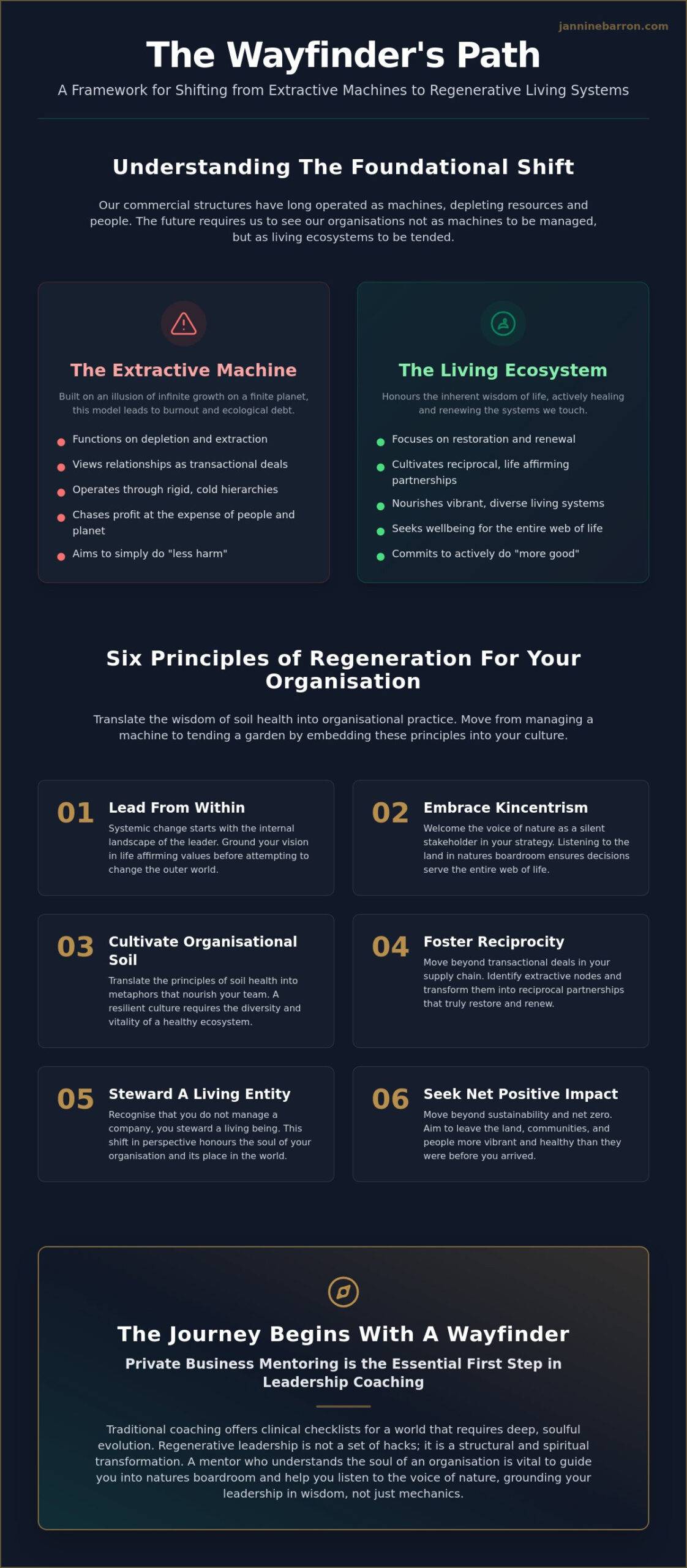
For decades, our commercial structures have functioned like giant machines, pulling resources from the earth and energy from people without ever considering the cost of replacement. This is the extractive model. It’s a system built on the illusion of infinite growth on a finite planet. To truly understand how to implement regenerative practices, we must first acknowledge that our businesses are not machines. They are living systems. Regeneration (sustainability) is the process of moving beyond simply sustaining a damaged status quo to actively healing and renewing the ecosystems we touch. It asks us to transition from a mindset of “doing less harm” to one of “doing more good” by restoring the very foundations of life.
To better understand how this shift manifests in the commercial world, watch this helpful video:
Sustainability has become a comfortable plateau. It often asks us to be neutral, yet in a world facing deep ecological debt, neutrality is no longer enough. The wayfinder leader understands this urgency. They don’t just manage a company; they steward a living entity. By listening to the voice of nature, these leaders find a path through the complexity of systems change. They recognise that every decision made within the boardroom ripples out into the wider world, affecting soil, water, and community well being. This is the essence of Kincentrism, the understanding that we are part of an extended web of life, and our business success is inseparable from the health of that web.
From depletion to restoration in the UK and Australia
In the bustling centres of London or the ancient, quiet hills of Wiltshire, the call for restoration is growing louder. UK businesses are facing a deepening regulatory landscape, yet the real shift is cultural and soulful. For the Australian business founder, the challenge is even more visceral. They operate in a landscape where the fragility and resilience of the environment are impossible to ignore. Moving beyond net zero toward a net positive impact means ensuring that your organisation leaves the land and its people more vibrant than they were before you arrived. It requires a radical commitment to life affirming growth.
Why traditional business coaching fails the regenerative leader
Traditional coaching often focuses on the mechanics of profit at the expense of the person and the planet. It treats leadership like a set of hacks or a clinical checklist rather than a spiritual and structural evolution. This is why private business mentoring is the essential first step in leadership coaching for those who wish to enter natures boardroom. You need a mentor who understands that your organisation has a soul and that its health is inextricably linked to your own internal state. We must move away from aggressive, clinical approaches and toward a way of leading that feels like a deep, steady breath.
Regenerative business is an act of love for the future.
Six principles of regeneration for your organisation
To understand how to implement regenerative practices, we must first look beneath our feet. The soil is not just dirt; it is a complex, living intelligence that sustains all life. When we translate the wisdom of regenerative agriculture practices into a corporate or service environment, we move from managing a machine to tending a garden. This shift toward Kincentrism requires us to see our teams and operations as vibrant ecosystems rather than cold hierarchies. Just as a farmer nourishes the ground to ensure a bountiful harvest, a wayfinder leader nourishes the culture to ensure long term resilience. Before you can apply these principles to your entire organisation, private business mentoring serves as the essential first step to align your own internal compass with the rhythms of life.
The six principles of regeneration offer a map for this journey. We begin by keeping the soil covered, which in a business context translates to psychological safety. We must ensure that the “living root” of our purpose remains active through every season, feeding the soul of the business even during fallow periods. When we sit in natures boardroom, we learn that a healthy system is one where every element belongs. This is not about abstract theory; it is about the practical application of life affirming strategies that allow your business to breathe and grow without depletion.
Minimising disturbance and building resilience
In the natural world, constant ploughing destroys the delicate mycelial networks that allow plants to communicate and share resources. In our workplaces, constant restructuring and frantic “pivoting” act as a heavy plough, breaking the bonds of trust and leading to widespread burnout. Learning how to implement regenerative practices means finding ways to evolve without causing systemic shock. We look to biomimicry to understand how ancient systems handle stress. For example, the Australian bush has evolved to find new life after fire, but only because its core structures remain intact. By building a culture of psychological safety, you create a buffer against external shocks, allowing your team to remain grounded even when the winds of the market change.
Enhancing biodiversity and integration
A monoculture is a fragile system, whether it is a field of wheat or a marketing department that only values one type of thinking. We must move away from the “monoculture of the mind” and instead embrace a rich diversity of perspectives. This integration creates a robust business ecosystem where different ideas cross pollinate to create something entirely new. Listening to the voice of nature reveals that diversity is not a metric; it is a survival strategy. To deepen your understanding of these nature based design principles, you might explore what is biomimicry and how it can be applied to your specific organisational challenges. If you feel called to explore these principles in your own leadership, consider how we might work together to ground your vision in the wisdom of the living world.
Practical steps to implement regenerative systems in your supply chain
If we view our business as a living organism, the supply chain is its circulatory system. For too long, these systems have functioned like one way extractions, pulling value from distant lands and leaving depletion in their wake. Learning how to implement regenerative practices requires us to look beyond the spreadsheet and see the faces and forests at the other end of our contracts. It asks us to move from a mindset of procurement to one of stewardship. By mapping your current operations, you can begin to identify extractive nodes, those points where your business inadvertently drains the life force of a community or an ecosystem. This is where we invite the voice of nature into our decision making, asking not just what a resource costs, but what it requires to be renewed.
The transition from a transactional vendor relationship to a reciprocal partnership is a profound shift in leadership. In natures boardroom, we recognise that no species thrives in isolation. Your suppliers are not just line items; they are vital members of your business ecosystem. When we approach these relationships through the lens of Kincentrism, we begin to co create solutions that foster resilience for both parties. This might mean adjusting payment terms to support a farmers transition to regenerative methods or investing in long term infrastructure that restores local biodiversity. It is a commitment to the health of the whole, ensuring that every exchange leaves both parties more vibrant than before.
Auditing your impact through a regenerative lens
In the UK and Australia, the call for transparency is no longer optional. With the Rainforest Alliance Regenerative Agriculture Standard v1.0 becoming binding in March 2026, the framework for soil health and climate resilience is now a technical reality. However, a truly regenerative audit goes deeper than compliance. It involves asking better questions of your partners in London, Wiltshire, or the Australian outback. Are we supporting regional ecosystems? Are we sourcing in a way that respects the natural cycles of the land? Moving toward local sourcing reduces the energetic burden of logistics and strengthens the community networks that sustain your business during times of global shock.
Creating a circular and restorative flow
A regenerative supply chain is inherently circular. It mimics the forest floor, where there is no such thing as waste, only food for another process. Redesigning your services or products to have a life after their primary use is a pragmatic act of love for the future. This might involve implementing take back schemes or using materials that can safely return to the earth. To begin this process, you must first understand what is an extractive business model so you can clearly identify the practices that must be composted to make room for new growth. By investing in the restoration of the landscapes your business relies upon, you ensure that your presence on this planet is a gift rather than a debt.
Leading with the voice of nature and Kincentrism
To truly understand how to implement regenerative practices, we must shift our gaze from the mirror to the forest. Kincentrism is the profound belief that humans are not separate from the environment but are an integral part of an extended web of life. This is the bridge between business and biology. In a traditional corporate setting, decisions are often made in sterile rooms, far removed from the living world they impact. By bringing the voice of nature into the boardroom as a silent stakeholder, we acknowledge that every strategy has a biological consequence. We begin to ask how this choice serves the next seven generations. This is not a soft or clinical exercise; it is a rigorous realignment of your leadership with the laws of life.
Natures Boardroom is both a physical place and a mental sanctuary for strategy. It is where we step away from the digital noise to listen to the land itself. For those operating in the vast landscapes of Australia, this might mean connecting with the ancient wisdom of the First Nations people, who have lived in deep reciprocity with Country for millennia. Their understanding of the voice of nature provides a blueprint for modern business. It teaches us that we do not own the land; we belong to it. When we apply this to our organisations, we stop trying to dominate the market and instead look for ways to contribute to the health of the entire ecosystem.
Natures Boardroom as a strategic tool
Taking your team into the forest or onto the coast changes the very quality of your decisions. There is a fundamental difference between a standard corporate retreat and a nature based immersion day. A retreat often brings the office to the woods, while an immersion allows the woods to change the office. When you engage with Natures Boardroom, you are not just taking a break; you are entering a space where the complexity of living systems becomes visible. This environment encourages a level of honesty and creative problem solving that is rarely found within four walls. It allows the collective intelligence of the team to sync with the steady, patient rhythm of the natural world.
Developing your nature voice as a leader
Developing your nature voice starts with the quiet practice of deep listening. It requires us to pay attention to the rhythms of the environment around our office or home, whether that is a city park in London or a paddock in Wiltshire. As you explore how to implement regenerative practices, this practice of kincentric thinking reduces the ego, as it reminds us that we are part of something much larger than our quarterly targets. It fosters a sense of collective success where the flourishing of the team is mirrored by the flourishing of the land. If you are ready to explore this path and move beyond extractive models, I invite you to reach out for private mentoring to begin your transformation.
Why private mentoring is the essential first step
True systemic change does not begin with a new policy or a revised supply chain. It begins with the internal state of the founder. When you are exploring how to implement regenerative practices, you are essentially asking how to shift your own consciousness from a model of control to one of stewardship. This transition can feel overwhelming and messy, as it requires you to unlearn decades of extractive habits. Private mentoring provides the safe, structural support needed to navigate this evolution, ensuring that your business transformation is grounded in personal clarity and a deep connection to the voice of nature.
Unlike a traditional executive coach who might focus on clinical metrics and aggressive growth, a wayfinder mentor walks beside you. We look at the soul of your organisation and its place within the wider living world. This approach recognises that your leadership is a reflection of your relationship with life itself. By starting with private mentoring, you ensure that the foundations of your regenerative journey are strong enough to support the complex changes required in your operations and culture.
The role of a wayfinder in your transition
A wayfinder helps you navigate the inevitable uncertainty that comes with systems change. Whether we meet in the quiet expanse of the Wiltshire countryside or through global online sessions, the goal is to find the steady rhythm that allows your business to flourish. This is about more than just strategy; it is about learning to listen to the land and your own intuition. To help you find the right support for this journey, you may wish to explore the process of aligning with a mentor who is best equipped to guide your specific transition toward Kincentrism.
Taking your first step toward regeneration
It is often tempting to jump into a large programme or a complex incubator immediately. However, the most sustainable growth often starts small and focused. Beginning with a private session allows us to tend to the specific needs of your business before you join a wider community of ethical brands. This initial grounding prepares you for the deeper work found within The Growth Experience, our comprehensive journey for leaders who are ready to breathe life back into their industries. If you are ready to move beyond the exhaustion of extractive models and discover how to implement regenerative practices with grace, I invite you to book a discovery call today. Let us step into natures boardroom together and begin the vital work of restoration.
Step into a future of restoration
The journey from extraction to regeneration is not a path of technical tasks but a profound evolution of the heart and mind. We have explored how to implement regenerative practices by shifting our perspective from the machine to the forest, acknowledging that our organisations are living entities within a vast web of life. By embracing Kincentrism and inviting the voice of nature into our decision making, we move beyond the limits of sustainability into the realm of active healing. This transformation requires courage; yet the rewards are a business that breathes with the planet rather than against it.
With 30 years of experience in ethical leadership, I have seen how the right guidance can turn a struggling model into a flourishing ecosystem. Whether we are meeting in the ancient landscapes of Wiltshire or the vibrant wilds of Australia, my work as a facilitator of Natures Boardroom immersions and the creator of The Growth Experience incubator is designed to support your unique wayfinder journey. The most vital seed you can plant is your own commitment to change.
To further explore how these leadership values can be embodied and shared, you can discover Victoria OHare.
Begin your regenerative journey with private business mentoring to ground your leadership in the wisdom of the natural world. Together, we can nurture a new way of doing business that truly honours the future.
Frequently Asked Questions
How do I start implementing regenerative practices if I have a small budget?
The most effective way to begin is by focusing on your internal state and leadership philosophy through private business mentoring. You don’t need a large capital investment to shift from an extractive mindset to one of stewardship. Start by auditing your current decisions and asking how they might better serve the life systems around you. Small, intentional changes in how you relate to your team and local community are the seeds that eventually grow into systemic transformation.
What is the difference between sustainable and regenerative business?
Sustainability often aims for a neutral impact or doing less harm, which essentially maintains a damaged status quo. In contrast, a regenerative business seeks to actively heal and restore the ecosystems and communities it touches. While sustainability is a necessary plateau, regeneration is the ascent toward a net positive future. It requires you to listen to the voice of nature and ensure that your organisation leaves every resource more vibrant than it was found.
Can service based businesses use regenerative practices?
Yes, service based organisations can absolutely learn how to implement regenerative practices by focusing on their human and social capital. Instead of soil health, you might focus on the psychological safety and diversity of thought within your team. By applying the principles of Kincentrism to your professional relationships, you move from transactional interactions to reciprocal partnerships. This creates a resilient business culture that nourishes its people rather than depleting them through burnout.
How long does it take to transition to a regenerative model?
The transition is a continuous, cyclical journey rather than a destination with a fixed deadline. Nature does not rush, and neither should the evolution of your leadership. While structural changes in your supply chain might take several seasons to manifest, the shift in your internal perspective can begin immediately. Most leaders find that the first year of private mentoring provides the essential grounding needed to begin seeing tangible results in their organisational culture and impact.
Why is Kincentrism important for modern leaders in London and Sydney?
Kincentrism is vital because it reminds urban leaders that their businesses are inseparable from the living world, regardless of how many concrete walls surround them. In fast paced centres like London or Sydney, it is easy to forget that we belong to an extended web of life. Embracing this philosophy allows you to make decisions that are aligned with biological reality. This connection reduces the ego and helps you build a brand that is truly life affirming and resilient against global shocks.
Does Natures Boardroom require me to travel to a specific location?
Natures Boardroom is both a physical immersion and a mental space for strategic thinking. While we facilitate deep immersion days in the quiet beauty of the Wiltshire countryside and various ancient landscapes across Australia, the principles can also be accessed through online mentoring. The goal is to help you find a sanctuary where you can step away from digital noise. This allows you to develop your nature voice and gain clarity on your business strategy from any location.
What are the main challenges when moving away from an extractive model?
The primary challenge is often the pressure to return to profit first paradigms that ignore ecological and social costs. Unlearning the habits of an extractive machine requires significant courage and persistent self reflection. You may face resistance from stakeholders who are accustomed to short term clinical metrics. This is why having a wayfinder mentor is essential; they provide the structural and emotional support needed to stay true to your regenerative vision when the old system pulls at you.
How does a regenerative business mentor differ from a life coach?
A regenerative business mentor focuses specifically on the intersection of your leadership, your organisation, and the living systems of the planet. While a life coach might focus on personal goals, a wayfinder mentor guides you through the complexities of systems change and supply chain restoration. We use tools like the voice of nature to help you steward a purpose driven brand. This approach ensures that your professional success is a gift to the future rather than a debt to the earth.