
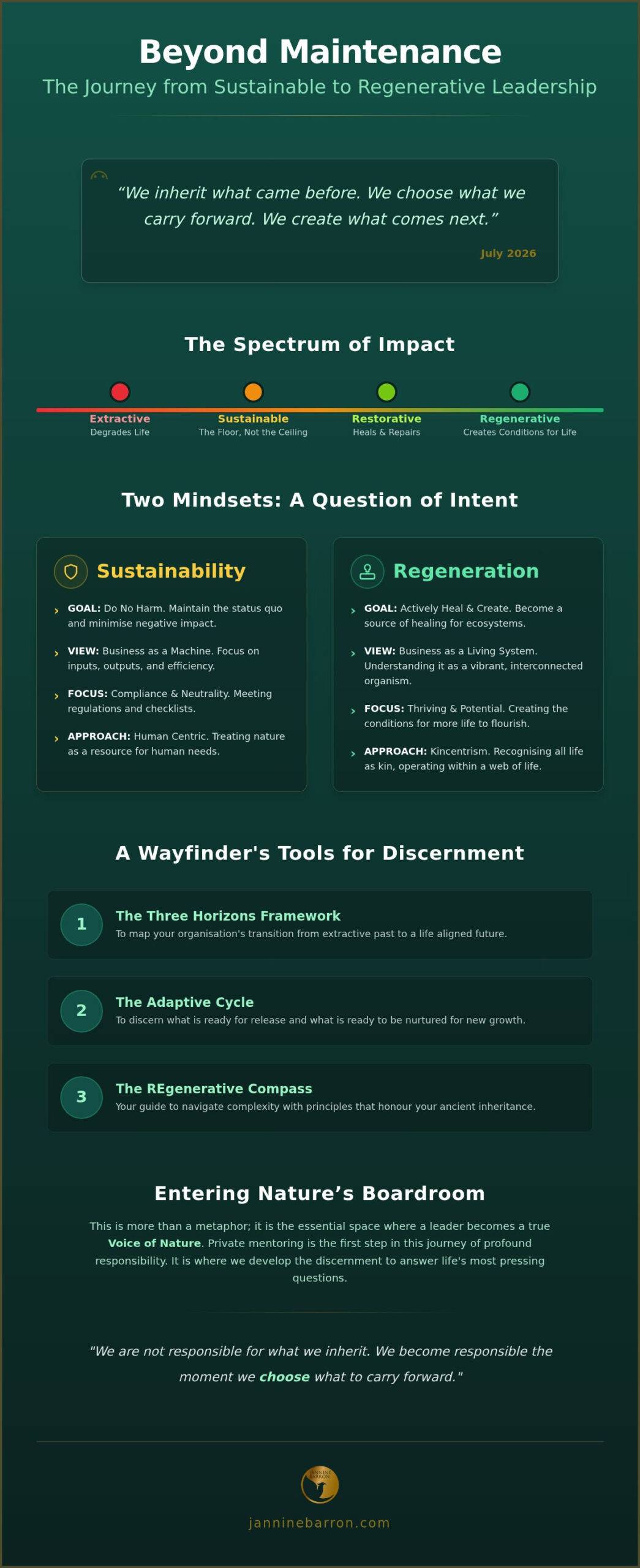
What if the very goal of sustaining our businesses is actually holding us back from the healing our world desperately needs? We inherit what came before. We choose what we carry forward. We create what comes next. These words, written for this moment in July 2026, remind us that leadership is not about maintaining a status quo that no longer serves life. You might feel the heavy weight of traditional green checklists or a growing skepticism toward corporate greenwashing that feels more like a mask than a solution. When we look at sustainability vs regeneration, we see that the former often seeks merely to do less harm, while the latter invites us to become a true voice for nature.
You likely sense that doing no harm is no longer enough for a planet in transition. In this guide, you will discover why moving beyond maintenance to life aligned regeneration is the essential shift for every purpose driven leader today. We will explore a clear framework to transition your leadership through my REgenerative Compass and the Three Horizons Framework. You will find inspiration to build a business rooted in Kincentrism, moving from extractive models toward a future where your organisation actually heals the ecosystems it touches. It is time to step into Nature’s Boardroom and listen to what life is asking of us.
Key Takeaways
- Understand the profound shift in sustainability vs regeneration by moving from a mindset of doing no harm to one that actively creates conditions for more life.
- Learn how to apply the Three Horizons Framework to map your transition from extractive models toward a future that honours our ancient inheritance.
- Discover the power of Kincentrism and how recognising all life forms as kin can transform your approach to Nature Governance and organisational choice.
- Explore the Adaptive Cycle and the REgenerative Compass to discern which parts of your business are ready for release so that new growth can be nurtured.
- Realise why private mentoring within Nature’s Boardroom is the essential first step for leaders seeking to become a true Voice of Nature.
Beyond Maintenance: Why Sustainability is the Floor not the Ceiling
We stand at a crossroads where the old maps of business no longer guide us toward life. Many leaders feel a deep fatigue from chasing green checklists that seem to grow longer every year. It is a world where doing no harm has become the standard, yet the land and our spirits remain parched. We must recognise that sustainability is simply the point of neutrality. It is the moment we stop destroying, but it is not the moment we start healing. When we debate sustainability vs regeneration, we are really asking if we want to survive or if we want to thrive in harmony with the wider web of life.
This transition toward a healing mindset also requires us to look after our own mental well-being; Citizen Coaching and Counselling provides the therapeutic foundation needed to lead with clarity and resilience.
To better understand this concept, watch this helpful video:
Traditional sustainability still centres human needs. It asks how we can keep our supply chains running without exhausting the resources we rely on. It treats nature as a warehouse rather than a relative. This human centric approach is what leads to the burnout many of us feel. We are trying to sustain a system that was never designed to be life aligned. The tension between sustainability vs regeneration lies in our intent. True Regeneration (sustainability) requires us to step out of the machine and into the living system. It asks us to consider our inheritance. We inherit the structures, the stories, and the extractive habits of those who came before us.
The Limits of the Sustainable Business Model
In 2026, we see a shift from voluntary to mandatory disclosure. Regulations like California Senate Bill 253 and the updated B Corp standards now require mandatory minimum performance. While these are necessary steps, efficiency alone cannot solve a crisis of disconnection. A business can be carbon neutral and still be soul destroying. When compliance replaces true care, the organisation loses its pulse. Sustainability in this form is often just a slower way of doing the same thing. It lacks the creative spark needed to call forth a new world.
Ancient Wisdom for Modern Leaders
As a wayfinder, you are called to ask deep questions that go beyond the quarterly report. What is ready to be laid down in your organisation? What ancient wisdom have we forgotten in our rush for growth? We are not responsible for what we inherit, but we become responsible the moment we choose what to carry forward. This discernment is the heart of the process of regenerative leadership. It is about understanding that the past lives on in our businesses, and only by choosing with love can we create what comes next.
The Soul of Regeneration: Aligning with the Rhythm of Living Systems
If we look closely at the natural world, we see that life never settles for just enough. It does not seek to merely sustain a baseline. Instead, life is an active, restless process of creating the conditions for more life. This is the heartbeat of the conversation around sustainability vs regeneration. While sustainability often feels like a heavy weight of maintenance, regeneration feels like a liberation. It is a shift from seeing your business as a machine with replaceable parts to seeing it as a living system, a vibrant organism that breathes within an interconnected web.
When you view your organisation through a machine metaphor, you focus on efficiency, inputs, and outputs. You treat your team as resources and your supply chain as a line to be managed. Regeneration invites you to drop this clinical lens. It asks you to consider how your choices ripple through the soil, the water, and the communities you touch. Just as we see the rise of Regenerative Urbanism in our evolving cityscapes, we must bring this same life affirming logic to our leadership. This requires a new sense of time, moving away from the frantic pace of the fiscal quarter toward the slow, wise cycles of the seasons.
The REgenerative Compass in Action
Navigating this transition requires more than just good intentions. It requires a different kind of map. The REgenerative Compass is a tool I use to help founders find their true north. It moves you beyond profit margins and into life serving principles. Imagine aligning your entire supply chain with the wisdom of the forest, where nothing is wasted and every element supports the health of the whole. By using this compass, you develop the discernment to know what is ready to be laid down and what is now yours to grow. It is about taking responsibility for the creation of what comes next.
Becoming a Voice for Nature
What does it truly mean to give nature a seat at your boardroom table? It is a profound shift from ego to eco. You are no longer the hero at the centre of the story; you are a wayfinder leading from within the ecosystem. This is the essence of Nature Governance. You begin to ask how every decision serves the ancient lineage of the land. You can explore the process of becoming a voice for nature to see how this internal shift transforms your external impact. It is a journey of coming home to your place in the family of things. If you feel called to begin this transition, private mentoring offers the space to nurture these new seeds of leadership.
From Extractive Systems to Kincentrism: A Three Horizons Perspective
The transition from extractive systems to a life aligned future is not a straight line. It is a journey of sight. To move from the old world of extraction to a future rooted in Kincentrism, we need a way to map our progress. This is where The Three Horizons Framework becomes our guide. It allows us to see the world as it is, the world as it could be, and the messy, creative space in between. In the debate of sustainability vs regeneration, the Three Horizons help us understand that sustainability is often the final stage of an old system trying to stay relevant, while regeneration is the birth of something entirely new.
Mapping Your Business on the Three Horizons
Horizon One represents the world as we know it. It is the world of extractive habits where nature is viewed as a resource to be managed or a cost to be mitigated. In this horizon, sustainability is the floor. It is where we try to do less harm within a system that is fundamentally broken. Horizon Two is the space of transition. This is the messy middle where we experiment with Nature Governance and begin to listen to the Voice of Nature. It is here that we exercise our power of choice. We ask ourselves: what do we carry forward from our inheritance? The past lives on in our institutions and our stories, but we must develop the discernment to know what still serves life and what is ready to be laid down.
Horizon Three is the regenerative future. It is the world where Kincentrism is the norm. In this space, we recognise that all life forms are our kin. We no longer lead from above; we lead from within. As I wrote in July 2026: “We inherit what came before. We choose what we carry forward. We create what comes next.” This is the responsibility of the leader. It is about nurturing the seeds of a creation that serves the ancient rhythms of the earth. We are not responsible for what we inherit. We become responsible the moment we choose what to carry forward.
Practising Kincentrism in the UK and Australia
Whether you are navigating the ancient landscapes of Australia or the rolling fields of the UK, the call to Kincentrism is the same. It is a call to move beyond anthropocentrism in your corporate governance. When you step into Nature’s Boardroom, you begin to see that your stakeholders are not just your shareholders or your customers. Your stakeholders include the river that flows near your office and the soil that grows your raw materials. You can learn more about regeneration in practice and how this shift in perspective changes everything. By adopting a regenerative business model, you stop treating the land as a warehouse and start treating it as a relative. This is the heart of Nature Governance. It is how we ensure that the stories we leave behind are stories of life, not just stories of profit.
Navigating the Adaptive Cycle: How Leaders Choose What to Carry Forward
Nature never seeks to stay in a state of permanent, unchanging growth. If you look at a forest, you see a rhythm of expansion, rest, and renewal. This is The Adaptive Cycle, a map of four distinct phases: growth, conservation, release, and reorganisation. Many leaders today are trapped in the conservation phase, desperately trying to sustain structures that have become brittle. When we look at sustainability vs regeneration, we see that sustainability often tries to freeze time in that conservation state. It seeks to keep things as they are. Regeneration, however, has the courage to move with the cycle. It understands that for new life to emerge, something old must be allowed to die.
As we stand in the light of July 2026, we must remember the words that guide this work: “We inherit what came before. We choose what we carry forward. We create what comes next.” This is not just a philosophical statement; it is a strategic necessity. We are not responsible for what we inherit. We become responsible the moment we choose what to carry forward. This choice requires a deep discernment between what is truly ancient and what is simply an old, extractive habit that no longer serves the living world. By embracing the full cycle, you allow your organisation to breathe with the same resilience as an ancient ecosystem.
Building such resilience also involves creating strong local business networks, and you can explore how to lead these referral groups at franchise.networkinaction.com.
The Art of Regenerative Choice
The most difficult part of leadership is often the release phase. It is the moment when we must lay down the products, processes, or even the mindsets that have defined our success but now stifle our growth. How do you facilitate this release without fear? It begins with Nature Governance. By building structures that mirror natural resilience, you create a safe container for transition. You learn to see that the end of one project is simply the composting that feeds the next creation. This is how we move away from an extractive business model and toward one that is life aligned.
Wayfinding Through the Reorganisation Phase
Think of a forest fire. To a human observer, it looks like destruction. To the forest, it is a reorganisation. The heat opens seeds that have been waiting for years. It clears the canopy so light can reach the floor. As a wayfinder, you can use the Adaptive Cycle to predict these shifts in your own business. Instead of fighting the fire, you prepare the soil for what comes next. You become a Voice of Nature by asking what life is trying to call forth through the changes in your industry. If you feel the call to lead with this level of soul and precision, private mentoring can help you navigate these cycles with calm authority.
Nature’s Boardroom: Your Invitation to Regenerative Mentoring
The shift from a mindset of maintenance to one of creation is not a journey you need to walk alone. While the intellectual debate of sustainability vs regeneration often happens in the mind, the true work of transformation happens in the heart and on the land. Private mentoring is the first step in this leadership transition because it allows you to strip away the noise of traditional business coaching. It provides a sanctuary where you can explore your inheritance and decide what you are ready to carry forward. This is where we move beyond the clinical checklists of the past and begin to listen to the Voice of Nature.
You have already explored the philosophical foundations of Kincentrism and the Three Horizons. Now, the question is how to embody these principles in your daily leadership. We are not responsible for what we inherit. We become responsible the moment we choose what to carry forward. This discernment is the core of our work together. It is about developing the courage to follow the Adaptive Cycle and allow new life to emerge from the compost of old systems.
Nature’s Boardroom Experiences in Wiltshire and London
Strategic clarity rarely arrives while staring at a screen in a sterile office. Nature’s Boardroom is an invitation to step out of the digital haze and into the wisdom of the land. Whether we meet in the ancient landscapes of Wiltshire or the hidden green pockets of London, the environment becomes an active partner in our work. What happens when we let the voice of nature guide our decisions? We find that the solutions to complex systems change are already written in the patterns of the forest. You can Discover Nature’s Boardroom as a space to anchor your visionary concepts in the practical reality of the living world. These experiences are designed to help you breathe, think, and lead with the rhythm of a living system.
Your Path as a Regenerative Leader
For those ready to fully commit to this path, The Growth Experience serves as a nine month incubator. This is where we move from theory to embodiment, nurturing your regenerative business strategy until it is ready to thrive. A mentor does not just provide answers; they hold the space for your transformation as you develop the discernment to lead like nature. You are joining a community of wayfinders across the UK and Australia who recognise that our responsibility is to create what comes next. If you are wondering where to begin, check this guide on Finding Your Regenerative Business Mentor.
As I reflected in July 2026, we inherit what came before. We choose what we carry forward. We create what comes next. The work of Nature Governance and Kincentrism starts with a single choice to align your leadership with life. Are you ready to step into the boardroom that has been waiting for you for millions of years?
The Choice to Lead for Life
The path of the wayfinder is one of profound discernment. We have explored why the floor of sustainability is no longer enough and how the soul of regeneration calls us to align with living systems. By using tools like the REgenerative Compass and the Adaptive Cycle, you can now see which extractive habits are ready for the compost and which seeds of ancient wisdom are ready to bloom. In the tension of sustainability vs regeneration, the answer lies in your willingness to become a true Voice of Nature. As a mentor with thirty years of ethical business experience and a facilitator of Nature’s Boardroom, I invite you to step beyond the clinical walls of traditional consulting.
We inherit what came before. We choose what we carry forward. We create what comes next. This is your responsibility as a leader in July 2026. It is time to move from maintaining a broken past to life calling a vibrant future rooted in Kincentrism. Begin your regenerative journey with private mentoring today. The world is waiting for the creation only you can bring to life.
Questions for the Regenerative Wayfinder
What is the simplest way to explain sustainability vs regeneration?
Sustainability is the point where we stop destroying, whereas regeneration is the active process of creating more life. As we look at 2026, the debate of sustainability vs regeneration reminds us that maintenance is no longer enough to support the ancient rhythms of our planet. Think of it as the difference between a patient whose condition is stable versus one who is actively recovering and growing stronger.
Can a traditional business model really become regenerative?
Any organisation can transition by shifting from a machine metaphor to a living system metaphor. This journey begins with private mentoring to develop the discernment needed to know what to carry forward. It requires the courage to enter the release phase of the Adaptive Cycle, letting go of extractive habits to make room for life aligned creation. We inherit what came before; we choose what we carry forward.
How does Kincentrism differ from standard corporate social responsibility?
Standard corporate social responsibility often remains anthropocentric, focusing on how human society benefits from certain actions. Kincentrism is the profound realisation that all life forms are our kin, giving nature a seat at the boardroom table. It transforms Nature Governance from a checklist of social goals into a deep, felt responsibility toward our non human relatives and the land that sustains us all.
What are the first steps for a UK leader moving toward regeneration?
The first step is to step out of the office and into Nature’s Boardroom to find strategic clarity. UK leaders can begin by auditing their inheritance, asking which stories and structures they are ready to lay down. Connecting with a regenerative business mentor helps you navigate the transition from compliance to a future where your organisation actively heals the land and the communities it touches.
Is regeneration just another word for circular economy?
Regeneration is not just another word for the circular economy, though it embraces those principles of resource efficiency. While a circular economy focuses on resource loops and waste reduction, regeneration focuses on the health and vitality of the entire ecosystem. It asks how a business can be a Voice of Nature, ensuring that every cycle of production creates the conditions for more life to flourish.
How does the Three Horizons Framework help with business strategy?
The Three Horizons Framework acts as a map for your transition from extractive models to regenerative ones. It helps you identify which current practices are dying, which innovations are bridge builders, and which seeds of the future you are already planting. This framework ensures your strategy is grounded in the reality of today while reaching for a life aligned tomorrow that honours our ancient inheritance.
What is the role of biomimicry in regenerative business mentoring?
Biomimicry provides the blueprints for regenerative business mentoring by studying how a forest handles forest fires or how an ecosystem manages resources. We use these patterns to build organisational structures that mirror natural resilience. It is about using nature’s ancient wisdom to solve modern leadership challenges, ensuring our creations are as enduring and life affirming as the wild world itself.
How do I know if my business is still operating on an extractive model?
Your business is likely operating on an extractive model if it views nature solely as a resource or your team as replaceable parts. Ask yourself if your organisation leaves the land and its people more vibrant than it found them. If your primary focus is on sustaining profit at the expense of life, it is time to use the REgenerative Compass to find a new direction.