
What if the very growth you’ve spent years cultivating is actually the force that’s quietly depleting your soul and the land you walk upon? Many leaders feel the heavy weight of a legacy built on taking rather than giving, yet they feel trapped in cycles that demand more than the world can offer. Learning how to stop being an extractive business isn’t just a policy shift for 2026; it’s a profound unlearning of the industrial mindset that treats people and nature as mere resources to be mined.
You’re likely tired of the burnout that comes from unsustainable expansion and the quiet guilt of knowing your supply chain might be harming the living world. It’s time to breathe and listen to the rhythms of the land. This guide offers a clear framework for systemic change, helping you move from the prevailing extractive system into a regenerative future. We’ll explore how to align your deepest personal values with your professional governance, ensuring you become the good ancestor your future kin deserve.
Key Takeaways
- Learn to discern which parts of your business legacy to carry forward and which to compost to make room for life affirming growth.
- Discover the practical steps for how to stop being an extractive business by using the REgenerative Compass to navigate your transition toward restorative practices.
- Use the Three Horizons Framework to map your journey from failing extractive systems to a future where your commerce acts as a restorative force.
- Explore how to embody Kincentrism by bringing the Voice of Nature into your boardroom through innovative Nature Governance models.
- Understand why private mentoring serves as the essential vessel for leaders seeking to align their personal values with a regenerative commercial strategy.
The Weight of Inheritance and the Call to Change
We stand at a threshold where the old stories of commerce no longer hold the weight of truth. Most leaders inherit a business architecture designed for a world that once seemed infinite; a world where resources were meant for harvest and people were treated as units of production. To understand how to stop being an extractive business, we must first look at the soil from which our organisations grew. Are we operating on the principles of regenerative economics, or are we simply continuing a legacy of depletion that began long before we took the helm?
To better understand how we can redesign these core structures to serve the living world, watch this helpful video:
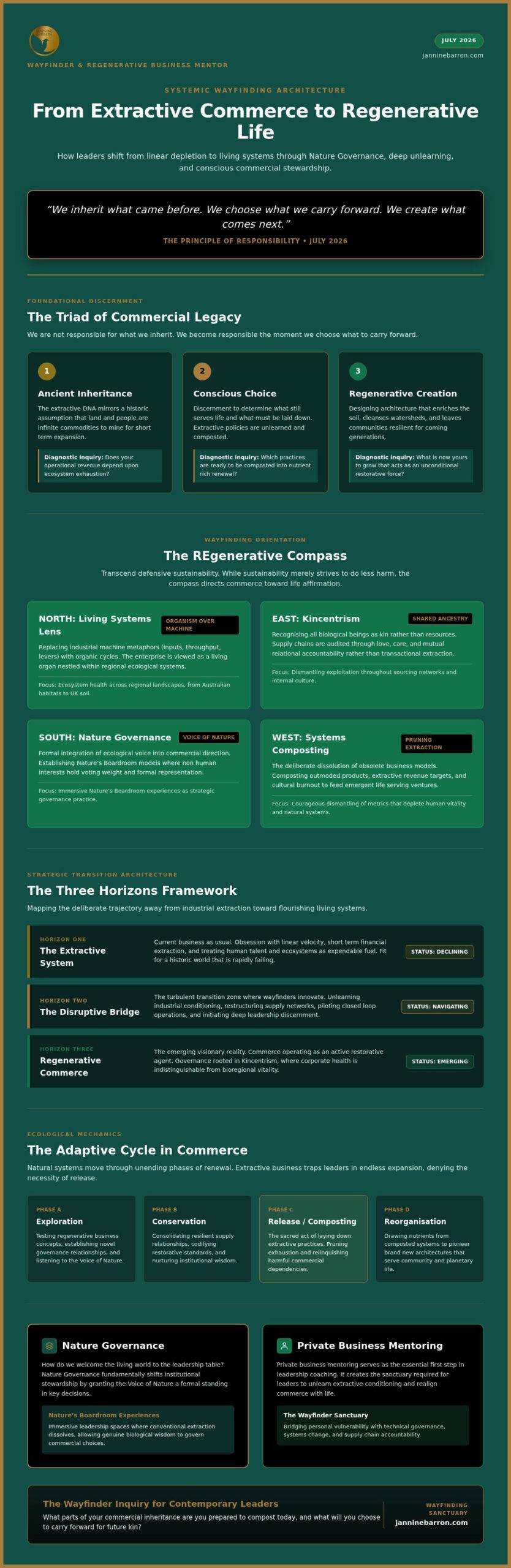
Our organisations aren’t just balance sheets. They are living legacies. Every system we use, from our supply chains to our performance metrics, carries the DNA of its ancestors. Often, that DNA is rooted in the colonial mindset of extraction and the belief that we can take without giving back. As Jannine Barron observed in July 2026, “We inherit what came before. We choose what we carry forward. We create what comes next.” This is the core of our work. It’s the moment where we stop being passive recipients of the past and start being active architects of a future that serves life.
Identifying the extractive patterns in your legacy
The institutions we inhabit today were built on the obsession with linear growth and the pursuit of short term profit. These structures are ancient. They mirror a time when the land was seen as a commodity to be conquered and mined. When we question these roots, we begin to see how the past lives on in our boardrooms. Do your current goals require the exhaustion of your team? Does your profit rely on the degradation of a distant ecosystem? These are the heavy questions that reveal the extractive patterns we’ve been taught to ignore. Understanding how to stop being an extractive business requires us to look at the foundation of our success and ask if it was built at the expense of others.
The moment of choice and responsibility
Responsibility begins with a single breath of awareness. The shift from passive inheritance to active choice is the most significant move a leader can make. It requires a refined sense of discernment that goes beyond simple strategy. Instead of asking how we can grow faster, we must ask what truly serves life within our model. This transition is a journey of unlearning. It’s about deciding which parts of our inheritance are worth carrying into the next decade and which must be composted to nourish something new. You can explore this deeper through the process of regenerative transformation. By choosing what to carry forward, we stop being victims of our history and start being creators of a legacy that heals.
Orienting Your Vision with the REgenerative Compass
Transitioning from an extractive model requires more than a change in policy; it demands a shift in perception. We’ve been taught to view our companies as machines. We talk about levers, inputs, and output. This mechanical lens is the root of extraction. To truly understand how to stop being an extractive business, we must adopt a living systems mindset. This means seeing your organisation as an organism within an ecosystem, whether you’re operating in the rolling hills of Wiltshire or the vibrant landscapes of Australia. You are not just managing a brand; you are tending to a living legacy.
Moving beyond the limits of sustainability
Sustainability has long been defined as doing less harm. It’s a defensive crouch. In a world that’s already depleted, simply slowing the rate of destruction is no longer a leadership triumph. Regenerative business goes further. It seeks to leave the soil richer, the water cleaner, and the community more resilient than we found it. While extractive efficiency focuses on squeezing the last drop of value from a resource, regenerative resilience focuses on the long term health of the entire system. It’s about moving from a model of depletion to one of life affirmation. We must ask ourselves: what if our commercial success was the very thing that healed our local environment?
The four directions of the REgenerative Compass
The REgenerative Compass is a wayfinding tool designed to navigate this complex shift. It doesn’t just track carbon; it explores 21 interconnections across strategy, governance, culture, and place. This framework asks a fundamental question: does this decision nourish the web of life? One powerful application of this is appointing nature to the board of directors, a move that legally enshrines the Voice of Nature in executive choices. It turns a boardroom from a place of transaction into a sanctuary of stewardship.
This framework invites you to stop viewing your business as a separate entity and start seeing it as a nature based entity. Whether you are navigating the regulatory shifts in the UK or seeking deeper alignment with ancient wisdom, the compass provides the orientation needed for systemic change. If you’re ready to discover how to stop being an extractive business through active practice, exploring regenerative programmes can help you find your true north. The journey is significant, but the solutions are already written in the wisdom of organic systems.
Using the Three Horizons Framework to Map Systemic Change
The Three Horizons Framework is not a clinical strategy tool. It’s a wayfinding map for the soul of your organisation. It allows us to see the shift from extraction to regeneration as a natural progression rather than a chaotic collapse. By viewing your business through these three distinct lenses, you can begin to understand how to stop being an extractive business without losing your footing in the present. This framework helps us navigate the turbulent waters between the world that is dying and the world that is being born.
Horizon One represents the status quo. It is the extractive system that is losing its fit with the world. This is the realm of business as usual; a model that prioritises short term gain over the health of the whole. Horizon Three is the dawn. It represents the regenerative future we are calling into being where commerce acts as a restorative force. Horizon Two is the messy, fertile middle ground. It’s the space of innovation, disruption, and deep mentoring where we build the bridges from the old to the new.
Recognising the sunset of extractive paradigms
Identifying the signs that your current model is no longer serving life requires radical honesty. We often cling to the first horizon because it’s familiar, even when it’s clear the system is depleting our energy and our ecosystems. However, the Adaptive Cycle of nature teaches us that release is necessary for rebirth. Just as a forest must occasionally burn to allow new seeds to germinate, a leader must have the courage to prune what is ready to be laid down. If you’re feeling the weight of these legacy structures, you can find more clarity on these patterns in our extractive business model guide.
Cultivating the seeds of a regenerative future
Wayfinding is the art of spotting the third horizon in the present. It’s about finding the small, quiet seeds of a regenerative future that are already germinating in your current work. As a leader, you are the bridge between these worlds. You’re the one who must discern how to stop being an extractive business while keeping the lights on during the transition. This is the path of the good ancestor. It’s about making choices today that ensure the vitality of the world seven generations from now. This isn’t just about survival; it’s about thriving in a way that nourishes everything you touch.
Embodying Kincentrism Within Your Supply Chain and Culture
Kincentrism is the heartbeat of a regenerative organisation. It asks us to look beyond human centric profit and recognise that every species impacted by our work is a vital stakeholder. When you explore how to stop being an extractive business, you move from seeing nature as a backdrop to seeing it as family. This shift changes everything. It changes how you treat your staff, how you source your materials, and how you define success. You begin to understand that your business is not a separate island, but a thread in a much larger, living tapestry. This is where leadership becomes an act of love.
Becoming a voice for the living world
Integrating Nature Governance into your decision making process is a radical act of stewardship. It means becoming a Voice of Nature in the boardroom. Instead of only looking at quarterly reports, you begin to ask what the local river or the ancient woodlands would say about your next expansion. This isn’t just metaphorical. It involves changing your articles of association to give nature a legal seat, much like Faith in Nature did in August 2022. By weaving ancient wisdom into modern corporate settings, you ensure that your leadership is rooted in the reality of the living world. You become a guardian of the future, rather than a consumer of the present. This practice requires a quiet, intuitive listening that most MBA programmes don’t teach.
Restoring the web of your supply chain
Supply chains are often the most extractive part of a business. We’ve been taught to look for the lowest cost and the highest efficiency, often ignoring the depletion of the land and the exhaustion of the people involved. To truly understand how to stop being an extractive business, we must restore the web. We move from transactional extraction to relational regeneration. This means looking at the people and the land behind your products with deep empathy and care. It’s about building supply chains that are webs of mutual love. Whether you’re sourcing from a farm in Wiltshire or a forest in Australia, every interaction is an opportunity for restoration. While the technical challenges of systems change are significant, they are always balanced with a commitment to the living systems they support.
If you’re ready to embody these principles in your own leadership, you can start by booking Private Mentoring to explore your unique path toward Kincentrism.
Nature Governance and the Path of Private Mentoring
The weight of systemic change can feel overwhelming when carried alone. While the frameworks of the Three Horizons or the REgenerative Compass provide the map, the leader still needs a sanctuary to process the unlearning. This is why private mentoring is the essential first step for those navigating how to stop being an extractive business. It provides a confidential vessel where you can dismantle legacy habits of hustle and extraction without the pressure of the public gaze. It’s about moving from a place of frantic delivery to a state of calm, intuitive stewardship. In this space, your personal transformation becomes the catalyst for the organisation’s rebirth.
Stepping into Nature’s Boardroom
True discernment is rarely found behind a screen or within the clinical walls of a standard office. It requires the grounding presence of the living world. Through Nature’s Boardroom, leaders are invited into nature based strategy days in Wiltshire or London. This immersion allows the nervous system to settle, opening up a different quality of strategic thinking. When you walk among the ancient trees of a Wiltshire forest, the questions you ask change. You stop looking for short term patches and start seeing the long term cycles that define true resilience. This is where the Voice of Nature becomes your most trusted advisor, helping you tend to the health of your commercial ecosystem.
The Growth Experience as a vessel for change
For those ready to commit to a deeper metamorphosis, The Growth Experience offers a nine month incubator designed to birth new commercial paradigms. This journey is a collective responsibility shared by ethical brands across the UK and Australia. It’s a space where we move beyond the “do less harm” mindset and actively design businesses that restore natural capital. Over these nine months, you’ll find the support needed to bridge the gap between your personal values and your professional governance. You’ll learn how to stop being an extractive business by actually living the alternative, supported by a community of fellow wayfinders who understand the emotional and technical weight of this transition.
The path ahead is significant, yet you don’t have to walk it without a guide. By stepping into these containers, you’re not just improving a business, you’re answering a higher call to become a regenerative wayfinder. You’re choosing to be the leader who creates what comes next, ensuring that your commercial presence serves as a restorative force for generations to come. The solutions you seek are already present in the wisdom of the land; you simply need the space to hear them.
Tending the Seeds of a Regenerative Legacy
The transition from extraction to restoration is not a destination but a continuous process of wayfinding. You’ve explored how to stop being an extractive business by navigating the Three Horizons and orienting your vision with the REgenerative Compass. By embracing Kincentrism, you move beyond the limits of sustainability and begin to treat your supply chain as a living web of mutual care. This is the work of becoming a good ancestor; a leader who creates what comes next.
As a regenerative business strategist active since the 1990s, I’ve seen that the most profound changes start with a leader’s quiet discernment. Whether we meet in Nature’s Boardroom across the UK or Australia, the goal is to align your commercial success with the rhythms of the living world. You have the power to transform your organisation into a restorative force that secures your legacy and serves all life. The path is ready for your first step.
You can begin your transition with private business mentoring to find the support your leadership deserves. Let’s breathe life back into your strategy and cultivate a future that thrives.
Frequently Asked Questions
What is the difference between a sustainable business and a regenerative one?
Sustainable business practices typically aim for a neutral impact, focusing on efficiency and damage limitation. In contrast, a regenerative model seeks to restore and replenish the living systems it touches. While sustainability asks how we can do less harm, regeneration asks how we can leave the world more vibrant. It’s a shift from merely surviving to actively thriving by aligning your commerce with the self renewing processes of nature.
How do I know if my current business model is extractive?
Identifying how to stop being an extractive business starts with a radical audit of your energy exchange. We must look for the quiet signs of depletion that indicate a model is out of balance. Consider these indicators:
- Your growth requires the constant depletion of your team’s mental health.
- You exhaust natural resources without a plan for replenishment.
- Your commercial success results in a net loss for the living world.
When these patterns emerge, the invitation to change becomes urgent for any leader.
Can a small business in the UK really influence a global supply chain?
Small businesses in the UK hold significant power through the quality of their relationships. By demanding transparency and restorative practices from suppliers, you create a ripple effect that shifts global standards. You aren’t just a buyer; you’re a steward of a network. Choosing to partner only with those who value life ensures that even a small organisation can lead the way in showing others how to stop being an extractive business.
What is Kincentrism and how does it apply to my boardroom?
Kincentrism is the understanding that humans and the natural world are part of an extended family. In your boardroom, this philosophy manifests as Nature Governance. It means moving away from viewing nature as a resource and instead treating it as a stakeholder with a voice. You begin to ask how your strategic decisions affect your kin in the soil, the forests, and the rivers, ensuring every choice supports the whole web of life.
How does the Three Horizons Framework help with business strategy?
The Three Horizons Framework acts as a strategic compass for systemic transition. It allows you to maintain your current operations in Horizon One while simultaneously nurturing the innovative, life affirming practices of Horizon Three. By mapping your journey this way, you avoid the chaos of sudden shifts. It provides a structured path for composting old, extractive habits and carefully growing the regenerative models that will define your business’s future legacy and resilience.
What happens during a Nature’s Boardroom experience?
A Nature’s Boardroom experience is a facilitated immersion day held in the wilder spaces of Wiltshire, London, or Australia. We step away from the digital noise to engage in deep listening and biomimicry exercises. This process calms the nervous system, allowing you to access a deeper level of strategic discernment. It’s a space where the wisdom of the land helps you redesign your business challenges through the lens of living systems and organic growth.
How can private mentoring help me avoid founder burnout?
Private mentoring offers a confidential sanctuary where you can address the root causes of burnout. Often, this exhaustion stems from the friction between your personal values and an extractive commercial culture. By working one on one, we focus on unlearning the hustle mindset and aligning your leadership with your soul’s purpose. This reflective vessel allows you to regain your energy and lead from a place of calm, sovereign authority rather than frantic, unsustainable delivery.
Is regenerative business mentoring relevant for Australian entrepreneurs?
Regenerative business mentoring is deeply relevant for Australian entrepreneurs who are navigating unique ecological challenges and opportunities. The principles of Kincentrism and biomimicry are universal, yet they find a powerful resonance within the Australian landscape. Whether you are based in a bustling city or a rural area, this approach helps you align your commercial goals with the ancient rhythms of the land, creating a business that is both resilient and truly restorative for future generations.