
What if the relentless pressure of extraction that leaves you feeling burnt out is actually the signal that your business is ready to bloom into something more enduring? Many leaders today carry a quiet fear that choosing ecological health means abandoning financial stability. It’s a tension that can feel impossible to resolve while working within old systems. These regenerative business case studies 2026 prove that the opposite is true; profitability and planetary health are now becoming one and the same. From the sprawling landscapes of Australia to the innovative hubs of the UK, organisations are finding that the most resilient path forward is one that honours the voice of nature.
You’re about to discover how leading firms are navigating this shift by integrating Kincentrism into their core strategy. We’ll reveal the technical and emotional roadmap required to move from extraction to life centred success. This journey always begins with private mentoring for the leader, a vital first step that allows you to step into nature’s boardroom with clarity and purpose. By looking at real world examples of firms thriving under new carbon pricing and disclosure regulations, you’ll see exactly how to align your profit with the living systems we all depend upon.
Key Takeaways
- Learn why the most successful organisations in 2026 treat regeneration as a primary driver of value rather than a simple exercise in risk management.
- Examine specific regenerative business case studies 2026 that highlight how Australian agriculture and UK circular startups are thriving through ecological alignment.
- Discover the practical steps to integrate the voice of nature into your executive choices by stepping into natures boardroom for strategic innovation.
- Realise why private business mentoring is the essential first step to anchor your leadership transition in a deeper sense of care and purpose.
- Explore how a structured nine month journey through The Growth Experience can turn abstract theory into a pragmatic roadmap for your organisation.
The Landscape of Regenerative Business Case Studies in 2026
The year 2026 marks a profound threshold for the global business community. We are moving beyond the era of simply doing less harm. In cities like London and Sydney, leaders are waking up to the reality that a business cannot thrive on a dying planet. This shift represents the evolution of regenerative business case studies 2026 from niche experiments into the standard for enduring success. These models are built upon regenerative economic principles that view the organisation as a living entity within a larger web of life. We are seeing a move away from the old paradigm of extraction toward a future where our commercial activities actually nourish the world.
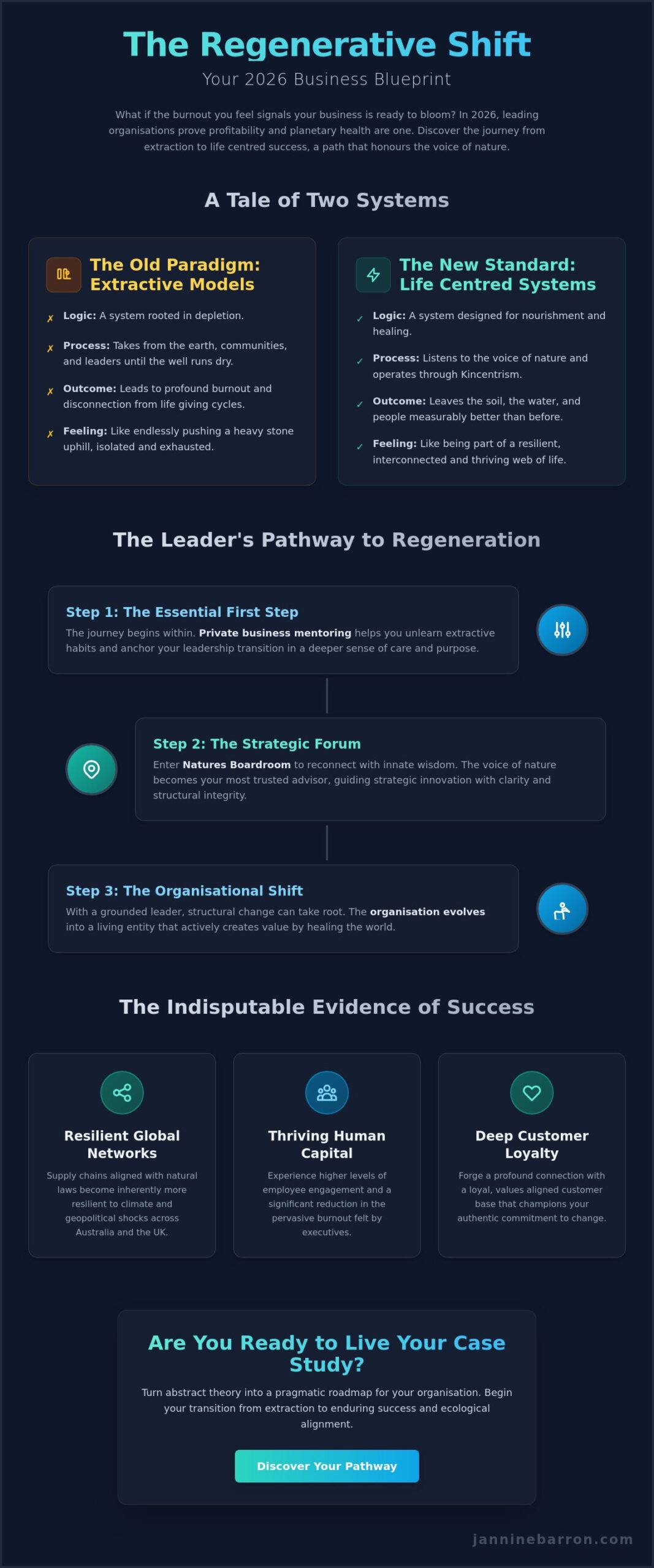
A regenerative business case is a strategy that integrates ecological health into the core profit model. It’s no longer about risk management or ticking compliance boxes; it’s about active value creation. By listening to the voice of nature, companies are discovering that their most profitable path is also their most healing one. This transformation doesn’t happen by accident. It begins with private mentoring to help the leader unlearn the extractive habits that lead to burnout. This personal shift is the essential first step before any structural change can take root within the company.
To better understand how this mindset shift transforms the way we build and lead companies, watch this insightful perspective:
From Extractive Models to Life Centred Systems
Traditional extractive models operate on a logic of depletion. They take from the earth, from communities, and from leaders until the well runs dry. This often results in a profound sense of burnout. Leaders feel they’re pushing a heavy stone uphill, disconnected from the life giving cycles of the natural world. In 2026, life centred systems offer a different way. These organisations prioritise the health of the entire ecosystem. They ensure that every transaction leaves the soil, the water, and the people better than before. As a wayfinder, I help leaders navigate this paradigm shift by reconnecting them with the wisdom found in nature’s boardroom. It is here that we learn to lead with care and structural integrity.
The Economic Reality of Regeneration in 2026
- Greater supply chain transparency and resilience across global networks.
- Higher levels of employee engagement and reduced executive burnout.
- A deeper connection with a loyal, values aligned customer base.
By focusing on the long term health of their supply chains, these businesses secure their own future. You can explore more about these pathways in our detailed overview of regenerative business in the UK and Australia.
Structural Foundations of a Nature Aligned Business Case
Building a structure that lasts requires more than just new policy; it requires a new way of seeing. When we examine regenerative business case studies 2026, we find that success is anchored in the ability to listen. This isn’t a metaphorical exercise. It is the practical application of Kincentrism, where the organisation recognises itself as a member of a biological family. By inviting the voice of nature into the executive suite, we stop making decisions in a vacuum. We begin to design with the wisdom of the earth rather than against it. This shift from extraction to life centred success is what provides the structural integrity needed to survive the volatility of our current era.
Listening to the Voice of Nature in Strategy
Leaders are increasingly turning to biomimicry as a technical tool for redesigning supply chains. Instead of linear, wasteful processes, they are looking at how ecosystems manage nutrient cycles. UK ethical brands in 2026 are already implementing logistics models inspired by mycelial networks, which distribute resources with incredible efficiency. This moves us beyond human centric design into earth centred solutions. As we look closer at these regenerative business case studies 2026, we see that success is often found in the most unexpected places. A powerful example of this in action is Guayakí’s Regenerative Approach, which demonstrates how a core profit model can be built entirely around the restoration of the Atlantic Rainforest. When the forest thrives, the business thrives. It is a symbiotic relationship that creates resilience where traditional models find only fragility.
Natures Boardroom as a Tool for Systems Change
The clinical, grey walls of the traditional office often stifle the very innovation we need. This is why the concept of natures boardroom has become such a vital tool for systems change. By taking strategic planning into wild spaces, leaders experience a profound shift in perspective. Forest therapy principles are no longer just for personal wellness; they are being used to reduce executive burnout and open the door to creative problem solving. Strategic clarity often arrives most clearly when we are under the canopy of a forest or walking along a rugged coastline. This transition is a journey of unlearning, which is why I always suggest starting with private mentoring as the essential first step for any leader ready to step into this new paradigm.
Evidence of Success Across Global and Local Systems
Evidence is the nectar that sustains our collective hope as we move toward a more life centred way of being. While theory provides the map, it is the actual lived experience of organisations that serves as our compass. These regenerative business case studies 2026 illustrate a global movement where the synergy between the UK and Australian markets is creating a powerful new template for success. From the vast, sun drenched plains of rural Australia to the creative corridors of London, a common thread of nature aligned leadership is beginning to weave a story of restoration. This success isn’t found in aggressive expansion but in the quiet, steady work of aligning profit with the rhythms of the earth.
Australian Wayfinders Leading the Way
In rural Australia, the fashion industry is undergoing a quiet revolution. We are seeing brands move beyond sustainable sourcing into true soil to soil supply chains. By embracing Kincentrism, these organisations recognise that their cotton or wool is a gift from a living system that must be replenished. Many of these successful wayfinders have integrated indigenous wisdom into their strategic foundations, ensuring that they give back more than they take. This profound respect for the land has led to increased soil health and carbon sequestration, proving that profit can indeed be a byproduct of planetary healing. UK leaders can learn much from this Australian commitment to deep listening and long term stewardship. It’s a reminder that when we honour the land, the land provides the resilience we seek.
UK Ethical Brands and the Circular Economy
Closer to home, London based startups are taking circular economy principles and infusing them with a regenerative twist. It’s no longer enough to just recycle or reuse. The goal is now to create systems that actively improve the environment they inhabit. In the lush landscapes of Wiltshire and Somerset, small brands are proving that local impact is the heartbeat of global change. These businesses are using biomimicry to redesign their packaging and waste cycles, mirroring the efficiency of a forest floor. This transition requires a level of courage that traditional business coaching rarely addresses. It is a journey that often begins with private mentoring to ensure the leader is emotionally and structurally prepared for the shift. When we see a bakery in Somerset or a textile studio in Wiltshire thriving by honouring the voice of nature, we realise that the regenerative business case is not just viable; it’s the only path that offers true longevity.
These diverse examples share a singular foundation: the leader’s willingness to step into natures boardroom and listen. Whether it’s a large scale agricultural project in Australia or a community focused brand in the UK South West, the shift from extraction to life centred success is always an inside out job. These regenerative business case studies 2026 serve as a beacon for those still standing at the threshold, offering proof that a business can be both a financial success and a force for planetary renewal.
Designing Your Transition Through Private Business Mentoring
The regenerative business case studies 2026 we have explored are not just stories of technical success. They are testimonies of leadership evolution. Behind every flourishing organisation in the UK and Australia is a leader who had the courage to look inward before they looked at their balance sheet. This transition from an extractive mindset to a life centred one is a profound journey of unlearning. It requires a space where you can be both vulnerable and strategic. This is why I always frame private business mentoring as the essential first step in any leadership coaching journey. Mentoring provides the emotional and structural scaffolding for regenerative transition.
The First Step: Mentoring for Personal Regeneration
Many leaders arrive at the threshold of change feeling deeply depleted. The traditional extractive model doesn’t just take from the earth; it takes from the human spirit. If you attempt to restructure your organisation while carrying the heavy weight of burnout, you will likely replicate the very systems you are trying to leave behind. Mentoring allows you to address your own internal landscape first. It builds the capacity to hold the immense complexity of regenerative systems without being overwhelmed. Before we can talk about supply chains or circularity, we must ensure the leader is grounded in their own sense of care and purpose. This personal regeneration is what allows you to eventually lead your team into natures boardroom with a clear heart.
Finding a Wayfinder for Your Organisation
A regenerative business mentor acts as a wayfinder through the dense fog of systems change. In 2026, the qualities of a mentor have shifted away from the clinical distance of traditional consulting. You need someone who understands the technical requirements of a nature aligned business case while also honouring the poetic and spiritual dimensions of the work. This person helps you listen to the voice of nature and brings the wisdom of the living world into your daily operations. They support you in applying Kincentrism not just as a concept, but as a lived reality that informs every decision you make. A wayfinder doesn’t provide a rigid checklist; they help you cultivate the intuition needed to navigate a world in flux.
This collaborative process is about more than just business growth; it’s about life growth. By choosing a mentor who has walked this path, you gain a partner who understands the unique pressures of leading in a time of global transition. You can learn more about how we structure this journey by exploring The Process. If you feel the call to move beyond extraction and begin your own transition, I invite you to reach out for a conversation.
Living the Case Study with The Growth Experience
The journey toward regeneration is not a solitary path. While the regenerative business case studies 2026 we have analysed offer inspiration, they also present a vital challenge to every leader reading this. How will your organisation be remembered when the history of this transition is written? Transforming from an extractive model to one that nourishes life is a process of active creation. It requires a structured environment where you can test new ideas, share group wisdom, and align your commercial goals with the rhythms of the earth. This is the heart of The Growth Experience, an incubator designed to turn visionary leaders into regenerative pioneers.
By joining this movement, you move beyond the role of a passive observer. You become the architect of a new system. The collective power of shared Kincentrism within our community provides a buffer against the pressures of the old paradigm. It allows you to cultivate a business that doesn’t just survive the challenges of 2026 but thrives because of its deep connection to the living world. Your company has the potential to become one of the next definitive regenerative business case studies 2026, proving that profit and planetary health are inseparable threads of the same tapestry.
The Nine Month Journey of Growth
Real change takes time. It cannot be rushed or forced through a weekend workshop. The Growth Experience is a nine month nature aligned journey that mirrors the natural cycles of gestation and birth. This structural overview ensures that ethical brands have the time to deeply integrate new principles into their foundation. Throughout the programme, the voice of nature is not an abstract concept but a practical guide. We bring the curriculum into wild spaces, allowing the environment to inform our strategic thinking and problem solving. Founders emerge with more than just a plan; they possess the emotional resilience and structural clarity to lead for the long term. This sustained support prevents the burnout so common in traditional business circles and ensures that your organisation’s impact is both deep and enduring.
Join the Movement of Life Centred Leaders
The shift toward a life centred economy is already underway. You can begin your own regenerative business case today by stepping away from the clinical isolation of the office and into a global community of purpose driven entrepreneurs. This is an invitation to lead with love, care, and technical precision. Whether you are based in the UK South West or the heart of Australia, the principles of regeneration remain the same. We are all part of the same biological family, working to restore the systems that sustain us. If you are ready to move from theory to practice and see your business bloom, I invite you to explore The Growth Experience. Together, we can live the values of regeneration and ensure that the legacy you leave is one of abundance and health.
Stepping into the Future of Life Centred Success
The transition from extractive practices to life centred success is no longer a distant vision; it is the defining commercial shift of our time. These regenerative business case studies 2026 offer a roadmap for leaders who are ready to move beyond the clinical limits of old sustainability models. By integrating the voice of nature and the technical wisdom of biomimicry into your core strategy, you create an organisation that is both resilient and restorative. Whether through the innovative circular models in London or the soil to soil textile chains in Australia, the evidence is clear. Profit and planetary health are now inseparable partners in a thriving future.
As a wayfinder with 30 years of experience in ethical business, I have dedicated my life to redefining leadership through Kincentrism. I have seen first hand that the most profound organisational shifts begin with a personal commitment to unlearn the habits of extraction. This is why I invite you to begin your journey with a private mentoring session to explore your regenerative potential. As the founder of The Growth Experience incubator, I am here to help you anchor your transition in the wisdom of natures boardroom. The earth is ready for your leadership; let us walk this path together with care and courage.
Frequently Asked Questions
What is the primary difference between a sustainable and a regenerative business case?
Sustainability focuses on doing less harm and reaching a point of zero impact. Regeneration goes much further by actively restoring and healing the ecosystems and communities your business touches. While a sustainable model manages risk, a regenerative model creates active value by ensuring the soil, water, and people are healthier because your organisation exists. It is a shift from merely surviving to thrive through restoration.
Can a small business in the UK actually afford to be regenerative in 2026?
Small businesses often find that regenerative models are more financially viable because they build local resilience and eliminate waste. In 2026, rising costs of extraction and new carbon regulations make traditional models more expensive. By following regenerative business case studies 2026, smaller brands in places like Wiltshire or Somerset are capturing loyal market share from customers who value authentic care and structural integrity over hollow marketing claims.
How does Kincentrism apply to a modern corporate supply chain?
Kincentrism transforms a supply chain from a series of extractive transactions into a web of symbiotic relationships. It requires you to treat every supplier and natural resource as a living relative rather than a line item. This means ensuring your procurement processes nourish the environment and support the dignity of workers. When you lead with this mindset, your supply chain becomes a source of mutual health and long term stability.
Is natures boardroom a physical place or a strategic concept?
It is beautifully both. Physically, natures boardroom involves taking leadership teams into wild spaces to solve complex problems under the canopy of trees or by the sea. Strategically, it is a mental framework that ensures the voice of nature is heard in every executive choice. This practice allows leaders to step away from the clinical pressure of the office and find strategic clarity through the wisdom of natural systems.
How long does it typically take to transition to a regenerative business model?
A deep transition usually requires between nine months and three years. The process begins with the internal unlearning of the leader, which is why I recommend a nine month journey like The Growth Experience. While structural changes to supply chains and waste cycles take time to implement, the shift in perspective happens much faster. This steady pace ensures the new life centred systems are resilient and built to last.
Why is private business mentoring considered the first step for regenerative leaders?
Mentoring provides the essential emotional and structural scaffolding for a leader to change their entire paradigm. Without this personal work, you risk bringing extractive habits and high pressure mindsets into your new model. Private mentoring allows you to address burnout and unlearn the logic of depletion in a safe space. It ensures that you are grounded and clear before you begin the work of organisational transformation.
What are the most common sectors for regenerative business case studies in Australia?
Agriculture and textiles are currently the leading sectors for regenerative business case studies 2026 across Australia. These industries are proving that soil health and indigenous wisdom can be integrated into global fashion and food networks with great success. By focusing on soil to soil supply chains, these Australian wayfinders are setting a global standard for how commercial activities can actively replenish the earth while remaining highly profitable.
Can regenerative practices help prevent founder burnout?
Regenerative practices prevent burnout by aligning the pace of your work with the natural rhythms of life. Instead of the relentless, linear growth demanded by traditional models, you learn to work with cycles of rest and renewal. This shift from constant pushing to rhythmic stewardship allows you to lead with more soul and less stress. By listening to the voice of nature, you find a more sustainable way to hold leadership responsibility.