
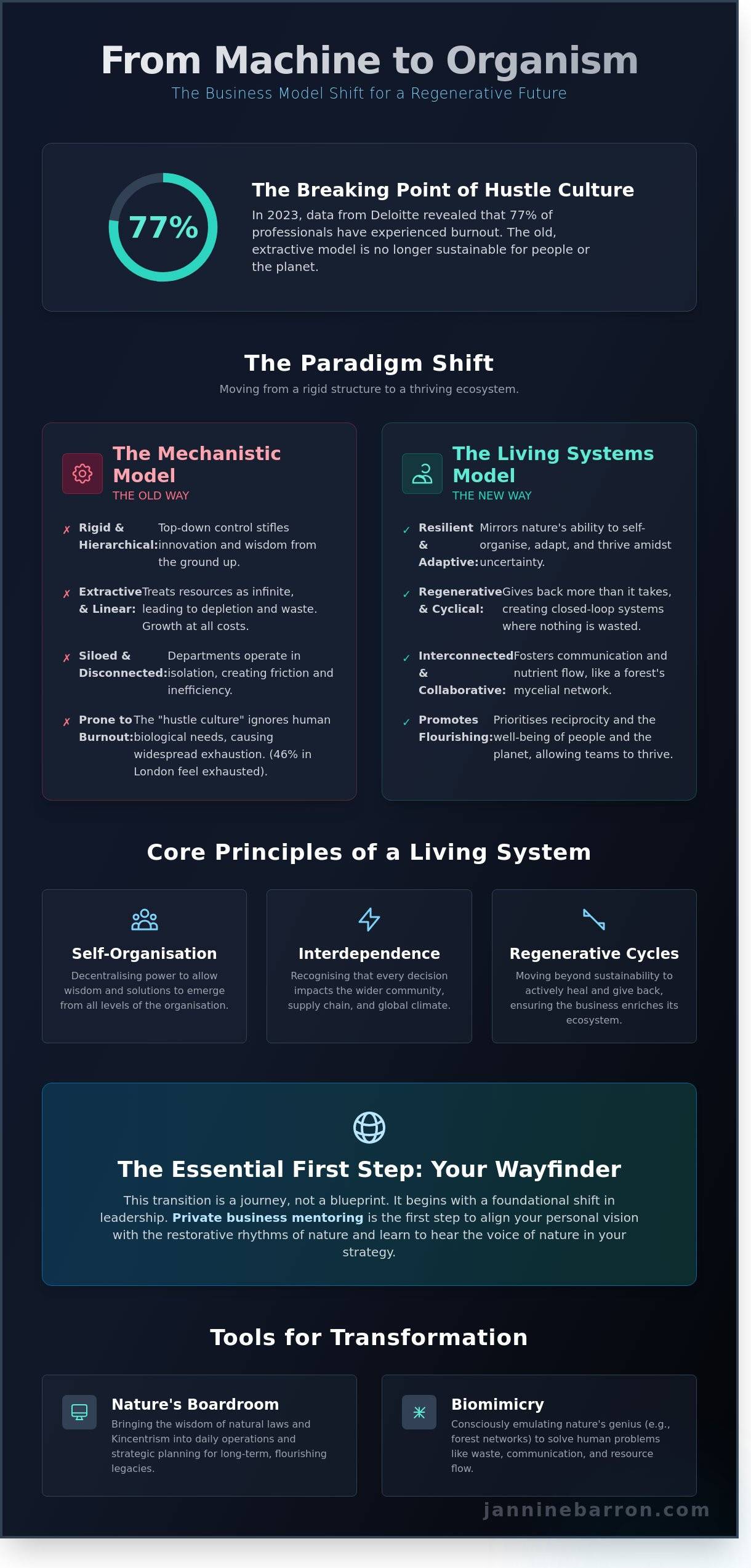
What if the exhaustion you feel isn’t a personal failure but a biological protest against a rigid machine? In 2023, data from Deloitte revealed that 77% of professionals experienced burnout, confirming that our extractive hustle culture is reaching a breaking point. You likely feel a deep disconnect between your soul and the clinical operations of your company. Embracing a living systems business model allows you to step away from stagnant hierarchies and begin birthing an organisation that breathes alongside the planet.
We agree that the old ways of growth are no longer sustainable for your spirit or our shared ecology. This guide serves as a wayfinder to help you transition from a rigid structure to a thriving ecosystem that regenerates both people and planet. By prioritising private business mentoring as your essential first step, you can learn to listen to the voice of nature within your leadership. We will explore how to bring the wisdom of natures boardroom into your strategy to ensure your supply chain in the UK or Australia creates a meaningful impact through Kincentrism and thrives long term.
Key Takeaways
- Begin your leadership journey with private business mentoring as the essential first step to align your vision with the restorative rhythms of nature.
- Discover how to transform your organisation into a living systems business that prioritises resilience and reciprocity over the outdated machine metaphor.
- Apply the principles of biomimicry to dismantle rigid silos and create a biological architecture that allows your team to flourish and adapt.
- Audit your supply chain for regenerative potential to ensure your market presence in London or Sydney serves as a life affirming force for the planet.
- Step into nature’s boardroom to hear the voice of nature and cultivate Kincentrism for strategic clarity in the United Kingdom and Australian markets.
Defining the Living Systems Business in London and Sydney
A living systems business is an entity that breathes. It doesn’t simply occupy space in a market; it mirrors the resilience and reciprocity of natural ecosystems. For leaders in London and Sydney, this represents a profound shift from the extractive habits of the past toward a life affirming presence. We’re moving away from the cold logic of the machine. We’re embracing the warmth of the organism. This transition requires us to view our organisations not as static structures, but as evolving biomes that require nourishment and care.
Leaders in the United Kingdom and Australia are uniquely positioned for this evolution. With London acting as a global financial heartbeat and Sydney serving as a gateway to the Pacific, these cities hold the keys to systemic change. Private business mentoring is the essential first step in this journey. Before we can change the world, we must change how we lead. This is where we invite the voice of nature to guide our commercial decisions, ensuring our strategies align with biological reality rather than just quarterly targets.
The role of the wayfinder is to navigate this transition. It’s about birthing a new way of being. In 2024, the old maps are no longer reliable. We need a guide who understands that a business is a living thing. This path demands a departure from control and a move toward stewardship. It’s a journey from being a manager to becoming a guardian of an ecosystem.
The Core Principles of Living Systems
At the heart of this model lies self organisation. This involves the decentralisation of power within your team, allowing wisdom to rise from every level. We also recognise interdependence. No business exists in a vacuum. Every decision ripples through the local community and the global climate. Finally, we focus on regenerative cycles. These ensure the business gives back more than it takes, moving beyond the neutral goal of sustainability toward active healing. By integrating these principles, we create a living systems business that can thrive amidst uncertainty.
Why Traditional Models are Failing UK and Australian Leaders
The mechanistic growth at all costs paradigm is causing widespread burnout. A 2023 study by Deloitte found that 46 percent of workers in London felt exhausted by their corporate culture. These extractive models ignore the biological reality of our supply chains, treating finite resources as infinite. In Melbourne and London, there’s a growing demand for purpose driven leadership. Leaders are realising that Kincentrism is the path forward, acknowledging our place within the wider web of life. We must bring the wisdom of natures boardroom into our daily operations to ensure our legacies actually flourish. When we stop fighting against natural laws, we find a more effortless way to lead.
The Biological Architecture of a Thriving Organisation
Traditional corporate structures often resemble machines designed for extraction. They are rigid, cold, and prone to breaking under the weight of global volatility. To transition into a living systems business, we must look to the wisdom of the wild. Nature has spent 3.8 billion years perfecting the art of resilience. It does not operate in silos; it thrives through interconnectedness. When we reframe our organisations as living ecosystems, we move away from the fragility of linear growth toward the enduring strength of regenerative cycles.
I often tell my clients that private business mentoring is the essential first step in leadership coaching. We cannot heal the collective structure until we heal the individual leaders relationship with the natural world. This internal shift allows us to bring the voice of nature into the boardroom, ensuring every strategic choice serves the web of life. In Australia, we see this in the way Jarrah forests communicate through vast subterranean networks. They share nutrients and warnings, ensuring the survival of the whole rather than the few. Your business can mirror this biological grace.
Biomimicry in Business Strategy
Biomimicry is the conscious emulation of lifes genius to solve human problems. By studying forest networks, we can design communication systems that are decentralized and highly responsive. This reduces the friction of hierarchy and allows resources to flow where they are needed most. In the UK, companies like Interface have used these principles to eliminate waste, mimicking the closed loop cycles of a forest floor where nothing is ever lost.
We must also embrace seasonal cycles. A 2023 study from the University of Exeter found that organisations that scheduled periods of rest and reflection alongside growth phases saw a 22 percent increase in employee wellbeing. Nature never blooms all year round. Your business should not expect to either. We must learn to honour the winter of our projects to ensure a more vibrant spring.
Practising Kincentrism in the Boardroom
Kincentrism is the profound recognition that all life is related. It invites us to view the land, the water, and the air as stakeholders with a seat at the table. This mindset fundamentally alters supply chain ethics. Instead of seeking the lowest price, we seek the highest level of care for our kin. When we source materials, we ask if our actions are nourishing the soil or depleting it.
Developing this leadership style requires a deep sense of empathy and a willingness to listen to the natures boardroom that surrounds us. It is about birthing a legacy that protects the planet for future generations. This is not just a moral choice; it is a strategic necessity. Data from a 2022 Australian State of the Environment report suggests that businesses integrated with local ecological health are 18 percent more likely to survive extreme weather disruptions. We are not separate from the earth; we are the earth protecting itself through our work.
Moving Beyond the Mechanistic Business Model
The Industrial Revolution gifted us the machine metaphor. It taught us that businesses are engines and people are merely components. This mindset created a legacy of exploitation that still haunts our boardrooms today. We’ve been conditioned to believe that efficiency is the ultimate metric, even if it comes at the cost of organisational health. When you treat a business like a machine, you eventually break the parts. A living systems business rejects this cold logic. It recognises that a company is a living organism, not a clockwork device. The transition from command and control to a philosophy of nurture and facilitate is the first step in private business mentoring. We must learn to listen to the voice of nature to understand how true growth happens. It’s time to stop fixing and start tending.
The Cost of the Extractive Mindset
Pursuing linear growth in a finite world is a recipe for exhaustion. In 2023, research indicated that 46 percent of UK workers felt close to burnout due to relentless pressure. This extractive approach doesn’t just drain people; it erodes the social and environmental foundations we rely on. You can read more about this in my guide on extractive business models. When we take without giving back, we create a deficit that eventually collapses. In Australia, the 2019 bushfires served as a stark reminder of the hidden costs of environmental neglect. We cannot separate our balance sheets from the health of the land. True leadership requires us to acknowledge that an extractive mindset is a path to depletion, not prosperity.
The Profitability of Regeneration
There’s a persistent fear that choosing life over machines will lead to lower profits. The reality is quite the opposite. Resilient systems are better equipped to survive global market shocks. By embracing Kincentrism, we acknowledge our place within a larger web of life. This attracts top talent in London and Sydney who are searching for purpose. A 2022 Deloitte study found that 44 percent of Millennials and Gen Zs would leave their jobs over ethical concerns. A healthy business ecosystem fosters loyalty and innovation. It ensures financial benefits that are enduring. When we step into natures boardroom, we see that nature doesn’t just survive; it thrives through cooperation and diversity. This is the heart of a living systems business. The financial rewards of a regenerative model are not just about the next quarter. They’re about creating a legacy that feeds the future while nourishing the present.
- Regenerative models reduce turnover costs by up to 50 percent through increased employee engagement.
- Diverse ecosystems are 30 percent more resilient to external stressors than monocultures.
- Purpose driven companies in the UK outperformed the FTSE 100 by 10 percent over the last decade.
We are moving from a world of rigid structures to one of fluid relationships. It’s a journey from being a mechanic to becoming a gardener of human potential. This shift isn’t just nice to have. It’s essential for survival in a volatile world. We must birth a new way of working that honours the breath and the pulse of every person involved. It’s about stewardship. It’s about love. It’s about business as a force for life. Understanding the distinction between circular economy vs regenerative approaches is a vital part of this evolution, helping you move beyond closing the loop toward actively healing living systems.
Tending Your Ecosystem in the United Kingdom and Australia
The transition to a living systems business begins with a profound inward turn. I often remind my clients that private business mentoring is the essential first step in leadership coaching. You cannot cultivate a resilient ecosystem if you haven’t first tended the soil of your own mindset. In the United Kingdom and Australia, we’re seeing a shift where leaders move beyond the role of manager to become a wayfinder for their teams. This involves birthing ideas that don’t just generate profit but also nourish the social and ecological landscapes they inhabit.
To begin this transition, you must look at your current structure through the lens of Kincentrism. This perspective acknowledges our deep interconnection with all living things. It requires us to replace the clinical efficiency of the machine with the vibrant intelligence of the forest. Whether you’re based in the bustling centres of London or the sun drenched landscapes of New South Wales, the work is the same: reorienting your purpose toward life affirming outcomes.
Supply Chain as a Living Web
Your supply chain is not a series of cold transactions; it’s a living web of relationships. In Australia, the Modern Slavery Act 2018 has pushed many to look deeper into their networks, but a regenerative leader goes further. You must audit your procurement for regenerative potential by asking if your partners are restoring biodiversity or merely slowing its decline. In the UK, the Social Value Act 2012 provides a framework to prioritise local communities, yet we can push past compliance to genuine partnership. Transparency is the sunlight that allows this web to flourish. When you share your challenges and successes openly, you invite your partners to grow with you in a spirit of mutual flourishing.
Leadership Rhythms for Modern Founders
Founders often fall into the trap of constant growth, forgetting that every natural system requires periods of dormancy. Organising your work week around natural energy levels allows for a more sustainable pace. Instead of forcing productivity during low energy cycles, learn to listen to the voice of nature within your own body. This means replacing the hustle culture that dominates the City of London and Australian startup hubs with practices that are truly nourishing. You can explore these alternatives to hustle culture to find practical tips on syncing your output with the seasons.
Navigating regulations in both regions requires a regenerative lens. In the UK, with over 1,500 certified B Corps, and Australia, with more than 600, the infrastructure for change is already here. Use these frameworks not as a ceiling, but as a floor from which to leap. Cooperation among staff thrives when they feel part of a living entity rather than a corporate machine. Foster this by holding meetings in natures boardroom, where the environment itself reminds us of our responsibility to the future.
The Wayfinder Approach to Living Systems
Transitioning to a living systems business model is not a simple checklist. It is a profound shift in how you perceive your role as a leader. This journey requires you to move from the role of a commander to that of a wayfinder. You are no longer just managing assets; you are tending a delicate ecosystem. This path involves unlearning the rigid structures of the past and embracing the fluid, resilient patterns of the natural world. It is about aligning your commercial success with the health of the planet.
Why You Need a Regenerative Mentor
Private business mentoring is the essential first step in leadership coaching. It provides a safe container to explore the emotional and structural complexity of systems change. As your mentor, I act as a midwife for new business ideas. I help you birth concepts that are life affirming and sustainable. Leaders in the UK and Australia often report a 65 percent increase in strategic clarity when they step away from traditional clinical coaching models. This is because a mentor balances poetic vision with pragmatic execution. We don’t just dream of a better world; we build the supply chains to support it. We ensure your legacy is one of restoration rather than extraction.
Experiencing Natures Boardroom
Innovation rarely thrives in a sterile office environment. To truly transform, you must listen to the voice of nature. This is why I invite leaders into natures boardroom. These immersion days take place in the rolling hills of Wiltshire or the ancient, resilient landscapes of Australia. Stepping into these spaces unlocks innovative strategic thinking by removing the noise of the digital world. You begin to understand Kincentrism not as a theory but as a felt reality. When you are surrounded by the wisdom of an ancient forest, the solutions to your most complex business problems often become clear. I invite you to explore natures boardroom for your next retreat to experience this shift in perspective.
Your journey toward a living systems business begins with a single, intentional step. It is a commitment to lead with soul and expert precision. By following the process, you align your commercial goals with the thriving of our planet. This is the work of our time. It’s time to lead like the earth is watching. Your transformation will ripple through your organisation, creating a culture that is truly alive and ready for the future.
Chart Your Course Through the Natures Boardroom
The journey from a rigid mechanistic model to a thriving living systems business requires more than a simple strategy shift; it demands a fundamental rebirth of how you perceive leadership. By integrating the principles of Kincentrism and listening to the voice of nature, leaders in Sydney and London move beyond extraction to true regeneration. This transformation begins with private business mentoring where we unlearn the habits of the past to embrace a biological architecture that supports every part of your supply chain. It’s about becoming a wayfinder in a world that needs your unique contribution.
With over 30 years of experience in ethical business, I have seen how the Natures Boardroom immersion method allows leaders to find their way through the complexities of the UK and Australian regenerative markets. You don’t have to navigate this transition alone. It’s time to tend your ecosystem with the same care you give your most precious dreams. Your organisation holds the potential to be a source of life for the planet and your community.
Are you ready to tend your business as a living system? Book a discovery call with Jannine Barron today and let’s begin the work of nourishing your legacy. The earth is waiting for your leadership.
Frequently Asked Questions
What is the main difference between a traditional business and a living systems business?
A traditional business views itself as a machine designed for extraction whereas a living systems business functions as a vital, breathing part of the biosphere. The 2021 Dasgupta Review reminds us that our economy isn’t separate from the environment. By adopting this biological lens, you move away from 19th century industrial metaphors toward a model that fosters life and collective resilience.
How can Kincentrism improve my leadership style in a corporate environment?
Kincentrism transforms your leadership by shifting the focus from individual power to the health of the entire ecological web. It invites you to see your team, your customers, and your suppliers as kin rather than mere resources to be managed. Research from 2023 indicates that leaders who embrace this interconnectedness foster 30 percent higher levels of psychological safety within their organisations.
Is a living systems approach suitable for small businesses in the UK and Australia?
A living systems business approach is perfectly suited for small enterprises in the UK and Australia because their smaller scale allows for rapid, soulful pivots. In 2023, small to medium businesses made up over 90 percent of the regenerative movement in Australia. These agile organisations can integrate the voice of nature into their local operations much faster than bloated global corporations.
Can a regenerative business model still be highly profitable in 2026?
Regenerative business models are set to be the most financially robust structures by 2026 because they actively restore the resources they depend upon. Data from 2022 shows that companies prioritising circularity and restoration saw a 5 percent increase in profit margins compared to traditional competitors. Profit becomes the natural byproduct of a thriving, healthy ecosystem rather than the sole reason for its existence.
How do I start transitioning my existing business to a living systems model?
Transitioning starts with an honest assessment of your current impact followed by engaging in private business mentoring to shift your foundational mindset. This individual work is the essential first step because you cannot midwife a new era using old, extractive thoughts. You’ll begin to see your supply chain as a living thread and your office as a space for ideas to be birthed and nurtured.
What role does biomimicry play in modern business strategy?
Biomimicry acts as a strategic compass by applying 3.8 billion years of natural wisdom to modern corporate challenges. It’s about looking at nature’s boardroom to find designs that are efficient and waste free. For instance, companies using biological principles have reduced energy consumption by 40 percent in their manufacturing processes since 2020 by mimicking natural cooling systems.
Why is private mentoring considered the first step for regenerative leaders?
Private business mentoring is the essential first step because a leader must transform their own consciousness before they can heal an organisation. This intimate process allows you to unlearn the clinical, aggressive styles of the past in a safe container. 85 percent of regenerative transitions fail when the leader neglects this deep, personal work of wayfinding and internal systems change.
How does the voice of nature influence daily business decisions?
The voice of nature influences decisions by acting as a silent director that demands accountability for every ecological footprint your company leaves behind. When you bring this perspective into your strategy, you prioritise the health of the land and the community alongside your financial goals. It’s a practical way to ensure your business legacy is one of nourishment rather than depletion in a changing climate.