
What if the greatest risk to your company’s future isn’t a market downturn, but the fact that your board is still speaking a dead language while the living world is gasping for air? You likely feel the weight of this silence every time you prepare for a meeting. It’s a lonely path for a visionary leader, searching for the vocabulary to bridge the gap between the Australian landscape and the balance sheet. You’re likely wondering how to convince my board on regeneration without being dismissed as an idealist who’s lost touch with the bottom line.
I understand that fear. This guide will help you master boardroom persuasion by translating living systems logic into strategic resilience. You’ll learn how to frame this transition as an essential evolution rather than a disruption. We’ll explore a roadmap for your presentations, navigate 2026 regulatory shifts like the EU Packaging and Packaging Waste Regulation, and show you why private mentoring is the essential first step in your leadership journey. We’ll invite the voice of nature into your strategy, ensuring you lead with the confidence of a mentor who knows that the most successful organisations mimic life itself.
Key Takeaways
- Translate living systems logic into the language of supply chain resilience to bridge the gap between the natural world and corporate operations.
- Discover a clear roadmap on how to convince my board on regeneration by framing life affirming strategies as the most effective shield against systemic risk.
- Move your strategic planning beyond the clinical office environment and invite your directors into natures boardroom for an immersion in Kincentrism.
- Recognise why deep personal work through private business mentoring is the essential foundation for any leader seeking to guide a systems change transition.
- Learn to amplify the voice of nature in your decision making by launching pilot programs that demonstrate the practical success of regenerative business models.
Understanding Why Boards Resist the Call of Regeneration
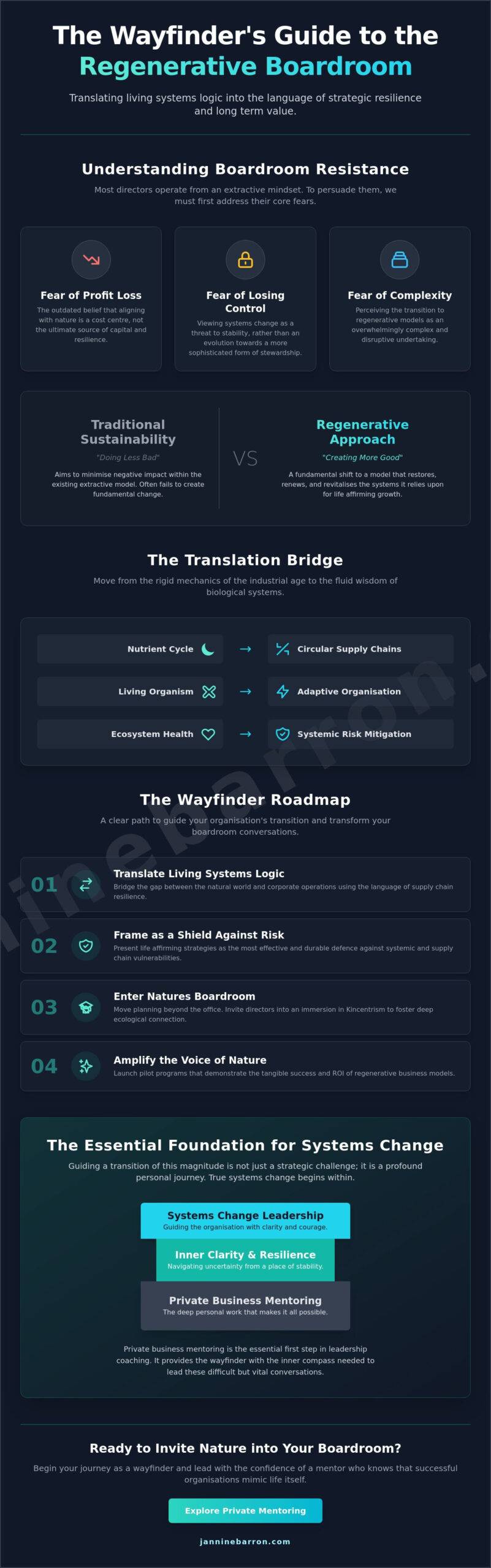
Regenerative business is not a mere extension of green initiatives. It’s a fundamental shift from a model that depletes to one that restores the very systems it relies upon. When you explore how to convince my board on regeneration, you must first acknowledge that most directors are still operating from an extractive mindset. This historical relic treats the natural world as an infinite warehouse, a logic that now creates profound systemic risk. While traditional Corporate Sustainability often fails to move the needle because it aims for “less bad,” regeneration offers a path toward life affirming growth.
To better understand how systems require active renewal to function correctly, watch this helpful video:
Boards usually resist this call because of three primary fears. They worry about a loss of profit, a loss of control, and the perceived complexity of systems change. In the Australian context, where our landscapes are both ancient and fragile, these fears are often amplified by a desire for immediate stability. However, with six of the nine planetary boundaries already crossed as of late 2023, the real risk lies in maintaining the status quo. If you want to change the narrative, you must address the psychological barriers that keep your directors tethered to the past.
The Fear of Unknown Territory
Directors often view systemic change as a direct threat to the stability they are sworn to protect. This leads to cognitive dissonance, where the board acknowledges environmental collapse but continues to fund extractive practices. We use wayfinder logic to navigate this uncertainty. Instead of presenting a rigid five year plan, we offer a compass. By embracing Kincentrism, we recognise that the organisation is a living entity within a larger ecosystem. This shift in perspective helps the board see that they aren’t losing control; they’re gaining a more sophisticated form of stewardship. This transition starts with you. Private business mentoring is the essential first step in leadership coaching, providing you with the inner clarity needed to lead these difficult conversations.
The Profit versus Planet Fallacy
The greatest hurdle is the outdated belief that nature alignment is a cost centre. By 2026, this definition of value is obsolete. The global regenerative agriculture market alone is projected to reach 10.53 billion dollars this year, growing at a rapid pace. We must reframe life as the ultimate capital. In natures boardroom, profit is a result of health, not a replacement for it. When we deconstruct the fallacy that we must choose between the planet and the balance sheet, we reveal that true resilience comes from supply chains that can actually regenerate themselves. Mastering this data is key when you consider how to convince my board on regeneration.
Translating Living Systems into Boardroom Language
Boards often speak in the clinical language of spreadsheets and quarterly returns. To bridge this gap, we must act as translators, moving from the rigid mechanics of the industrial age to the fluid wisdom of biological systems. Nature does not have a waste department; it has a nutrient cycle where every output becomes the vital input for another process. When you consider how to convince my board on regeneration, you are essentially inviting them to look at the business as a living organism rather than a static machine. This isn’t just a poetic shift. It’s a pragmatic necessity. By presenting The Business Case for Regeneration, you can demonstrate that restorative practices are the only way to ensure longevity in a volatile world where resources are no longer guaranteed.
In Australia, this conversation is particularly urgent. Our unique biodiversity and the escalating climate risks of drought and fire mean that supply chain resilience is no longer a luxury. It’s a survival strategy. We must introduce the voice of nature as a silent stakeholder in every meeting. Imagine a seat at the table for the Great Dividing Range or the Murray Darling Basin. By acknowledging the ecosystems that sustain your raw materials, you ground your corporate strategy in physical reality. This is where natures boardroom becomes a practical tool for governance, allowing directors to see the business as part of a larger, interconnected web of life.
Resilience as a Strategic Asset
Regenerative models do more than just protect the environment. They actively mitigate long term climate and social risks that traditional sustainability models often overlook. Organisations that are diverse and adaptive, much like an old growth forest, find profound financial benefits in their ability to withstand external shocks. Systems change is the core of future proofing. It requires us to redesign our operations so they contribute to the health of the whole system. When the surrounding ecosystem thrives, the business thrives with it.
Kincentrism in the Corporate Structure
We must also look at how we treat the human elements of our systems. Kincentrism offers a way to view both employees and nature as kin rather than resources to be extracted for profit. In global hubs like London and Sydney, this shift significantly improves employee retention and sparks genuine innovation. When people feel they are part of a life centric system, their creativity flourishes because they are no longer working against the grain of their own humanity. We are moving from a human centric model of exploitation to one that honours all life. If you feel ready to explore this transition, you might find that beginning with a personal process allows you to embody these values before you step into the boardroom.
Beyond Sustainability: Building the Business Case for Life
Sustainability has become a comfortable blanket for many directors. It suggests we can keep doing what we are doing, just a little more slowly. But by 2026, “doing less harm” is no longer a viable business strategy. It’s simply a slower way to fail. When you are looking for how to convince my board on regeneration, you must pivot the discussion toward the creation of new value. We are moving beyond the era of mitigation and into the era of active restoration. This isn’t just about ethics; it’s about the fundamental survival of your supply chains in a world where the safety nets are fraying. True leadership now requires us to see the organisation as a contributor to life rather than a consumer of it.
Extractive Models versus Regenerative Models
The primary hurdle in the boardroom is often the invisible ghost of the extractive mindset. This model views the world as a collection of resources to be converted into capital as quickly as possible. It ignores the reality that a business cannot breathe if the forest around it is burning. You can find a deeper exploration of these extractive business models to help you identify the symptoms within your own organisation. In contrast, a regenerative model operates like a healthy ecosystem. It invests in the vitality of its soil, its people, and its communities. It understands that profit is a byproduct of a flourishing system. This shift requires a deep systems change that begins with the individual leader. This is why I always frame private business mentoring as the essential first step in leadership coaching. You cannot guide a board toward life if you haven’t first cultivated that connection within yourself.
The Cost of Inaction
The financial risks of remaining extractive are mounting. By August 12, 2026, the EU Packaging and Packaging Waste Regulation will become applicable, mandating radical shifts in how products are brought to market. In the United States, Colorado’s EPR program begins its financial obligations in January 2026. These aren’t just distant threats; they are the new rules of the game. If your board remains silent, they are essentially choosing brand irrelevance. The voice of nature is already speaking through these regulatory shifts and the crossing of six out of nine planetary boundaries. Failing to listen means accumulating an ecological debt that no amount of creative accounting can erase. Regeneration is the only path to radical innovation and true market leadership in the coming decade. It allows you to step into natures boardroom and design solutions that are as resilient as they are profitable.
The Wayfinder Roadmap: Steps to Boardroom Transformation
Convincing a board is rarely a single moment of triumph. It is a slow and deliberate cultivation. When you are navigating how to convince my board on regeneration, you must act as a wayfinder who understands the importance of preparing the soil before planting the seed. You don’t need a total overhaul on day one. You need a path. This roadmap begins with quiet observation and moves toward a profound strategic immersion that allows the voice of nature to speak through your corporate decisions. By focusing on small wins, you build the confidence needed for systemic change.
Preparing the Ground
Before you step into the boardroom, you must conduct an internal audit of the extractive points within your organisation. Where are you depleting life rather than nourishing it? This isn’t about shame; it’s about clarity. Identify your allies within the senior leadership team. Look for those who already feel the tension between their values and their work in Sydney, London, or beyond. Build a narrative that doesn’t discard the existing company mission but evolves it. You are showing them that regeneration is the ultimate fulfilment of what the company always claimed to be. This preparation ensures that when you finally speak, your words carry the weight of practical reality.
Natures Boardroom as a Strategy Tool
One of the most effective ways to break through cognitive dissonance is to change the environment. Clinical office spaces reinforce clinical thinking. By inviting the board into natures boardroom, you bypass the usual defensive posturing. This is where creative problem solving begins. We use forest therapy principles to quiet the nervous system, allowing directors to think in systems rather than silos. If you are based in Europe, a corporate nature retreat UK provides the perfect setting for this strategic immersion. Moving the meeting outside allows the voice of nature to become an active participant in your strategy sessions.
This roadmap is your guide on how to convince my board on regeneration by proving that life is the most profitable partner we have. Once they have experienced this connection, present your data alongside stories of restoration and vitality. Use the 2026 market projections, such as the 10.53 billion dollar valuation for regenerative agriculture, to anchor your vision in reality. Secure a commitment not just for a one off event, but for a long term regenerative business program that integrates Kincentrism into the core governance. This transition requires a leader who is deeply grounded and resilient. This is why I always frame private business mentoring as the essential first step in leadership coaching. It provides the emotional and technical foundation you need to lead a board through the complexities of systems change. If you are ready to bring this wisdom to your leadership team, exploring our tailored programmes is the next logical step on your wayfinder journey.
The Vital First Step: Private Mentoring for Regenerative Leaders
Leadership is an act of resonance. When you stand before a group of directors to discuss the future of the organisation, they don’t just hear your data. They feel your conviction. Mastering how to convince my board on regeneration requires more than a polished slide deck. It requires a leader who has done the deep work of internal alignment. This is why I always frame private business mentoring as the essential first step in leadership coaching, a perspective shared by the executive development specialists at Significant Business Results. You cannot lead a board toward a regenerative future if you are still tethered to extractive habits in your own decision making.
A mentor provides the mirror you need to see where your own logic has become mechanical. They help you find the voice of nature within yourself, allowing you to speak with a sovereignty that is unmistakable. When you are navigating how to convince my board on regeneration, your greatest asset is your own grounded presence. This isn’t about traditional business coaching that focuses on efficiency and quarterly targets. It’s about a fundamental rewiring of your perspective. Once you have found this inner clarity, you no longer need to convince in the traditional sense. You simply invite others into a reality that you already embody.
Personal Transformation Leads to Organisational Change
The transition to a regenerative model is as much a psychological journey as it is a strategic one. We have all been schooled in extractive habits that prioritise short term gain over long term vitality. Unlearning these patterns takes time and a safe container for reflection. Building the emotional resilience needed to hold a regenerative vision in a space of resistance is a core part of the process. When you change your internal landscape, the external landscape of the organisation begins to follow. You become a wayfinder for others, showing them that another way is not only possible but inevitable.
Invitation to The Growth Experience
For those who feel called to lead this transition, we offer a dedicated nine month regenerative journey. The Growth Experience is designed for leaders in the UK and Australia who are ready to move beyond the clinical limits of standard corporate strategy. This programme provides the technical systems thinking and the emotional support needed to anchor your vision in reality. We explore supply chain resilience and Kincentrism while ensuring you have the private mentoring required to stay grounded. If you are ready to stop feeling alone in your visionary role, I invite you to book a discovery session today. Let us begin the work of bringing your organisation back to life.
Leading the Transition to a Living Economy
We stand at a threshold where the old extractive mechanics no longer hold. You have the map. You understand that regeneration is not a cost but the ultimate source of resilience. By moving from a human centric view to Kincentrism, you invite the voice of nature into your strategic core. You’ve seen that the business case for life is rooted in the very survival of our global supply chains. The roadmap we have explored is not just about changing a policy; it’s about shifting the very soul of your organisation.
If you are still navigating how to convince my board on regeneration, remember that your own presence is the most powerful tool in the room. I’ve been active in ethical business since the 1990s and have served as a wayfinder for global regenerative leaders. As the creator of Natures Boardroom immersions, I know that when a leader embodies the change, the board follows. You don’t have to carry this vision alone. Begin your leadership transition with private business mentoring today. The living world is waiting for your leadership. It’s time to bring your organisation home to the systems that sustain us all.
Frequently Asked Questions
How do I start the conversation about regeneration with a skeptical board?
Start the conversation by highlighting the systemic risks of continued extraction. When you consider how to convince my board on regeneration, you must frame the transition as a move toward long term resilience. Use the fact that six of nine planetary boundaries were crossed by late 2023 to ground the urgency in scientific reality. By showing that the business cannot survive in an extractive vacuum, you open the door for a more heart centred discussion about stewardship.
What is the difference between a regenerative business and a sustainable one?
The difference lies in the direction of the impact. Sustainability seeks to maintain a status quo or reach a point of net zero harm. Regeneration goes further by actively renewing and restoring the health of the living systems the business touches. It’s a shift from being a consumer of resources to being a contributor to life, ensuring that the organisation leaves the landscape more vibrant than it found it.
How much does it cost to transition to a regenerative business model?
Transition costs are best viewed as a strategic investment in life capital rather than a standard expense. While initial changes to supply chains or governance models require resources, the long term benefits include significantly reduced risk and enhanced innovation. Every business journey is unique, which is why private business mentoring is the essential first step in leadership coaching to clarify your specific investment path and find your own voice.
Can a large corporation truly become regenerative or is it only for startups?
Large corporations are uniquely positioned to lead this change because of their systemic reach. While startups can design for regeneration from the beginning, established organisations have the leverage to transform entire global supply chains. By 2026, the regenerative agriculture market alone is projected to reach 10.53 billion dollars, proving that scale and restorative practices are increasingly intertwined in the global economy and essential for future proofing.
What are the legal implications of adopting regenerative governance in the UK?
Legal requirements are becoming more stringent with a clear trend toward mandatory environmental accountability. In the UK and Europe, regulations like the EU Packaging and Packaging Waste Regulation, applicable from August 2026, are forcing a rethink of corporate responsibility. Adopting regenerative governance helps directors navigate these shifts while meeting their fiduciary duty to ensure the long term survival of the organisation within a changing climate landscape.
How do I measure the success of regenerative practices for board reporting?
Success is measured through holistic indicators that track the vitality of the whole system. Move beyond quarterly returns to report on ecosystem health, community resilience, and the diversity of your supply chains. By listening to the voice of nature, you can develop metrics that show how the organisation is building real value that sustains both the planet and the balance sheet, providing the board with a truly multidimensional view.
Is Kincentrism applicable to a traditional corporate boardroom environment?
Kincentrism is highly effective in corporate environments as it reframes the relationship between the business, its people, and the earth. By viewing stakeholders as kin, you foster a culture of deep care and mutual support. This shift improves employee retention and sparks the kind of radical innovation needed to solve complex challenges, moving the boardroom from a place of extraction to one of stewardship and collective flourishing.
What is the role of biomimicry in convincing the board of nature aligned strategy?
Biomimicry acts as a bridge between biological wisdom and corporate strategy. It allows you to present nature aligned solutions as sophisticated, time tested designs that have already solved for resilience and efficiency. When you use biomimicry, you show the board that the most successful organisations are those that mimic the regenerative cycles found in the natural world. This practical application of living systems logic makes the visionary seem inevitable.