
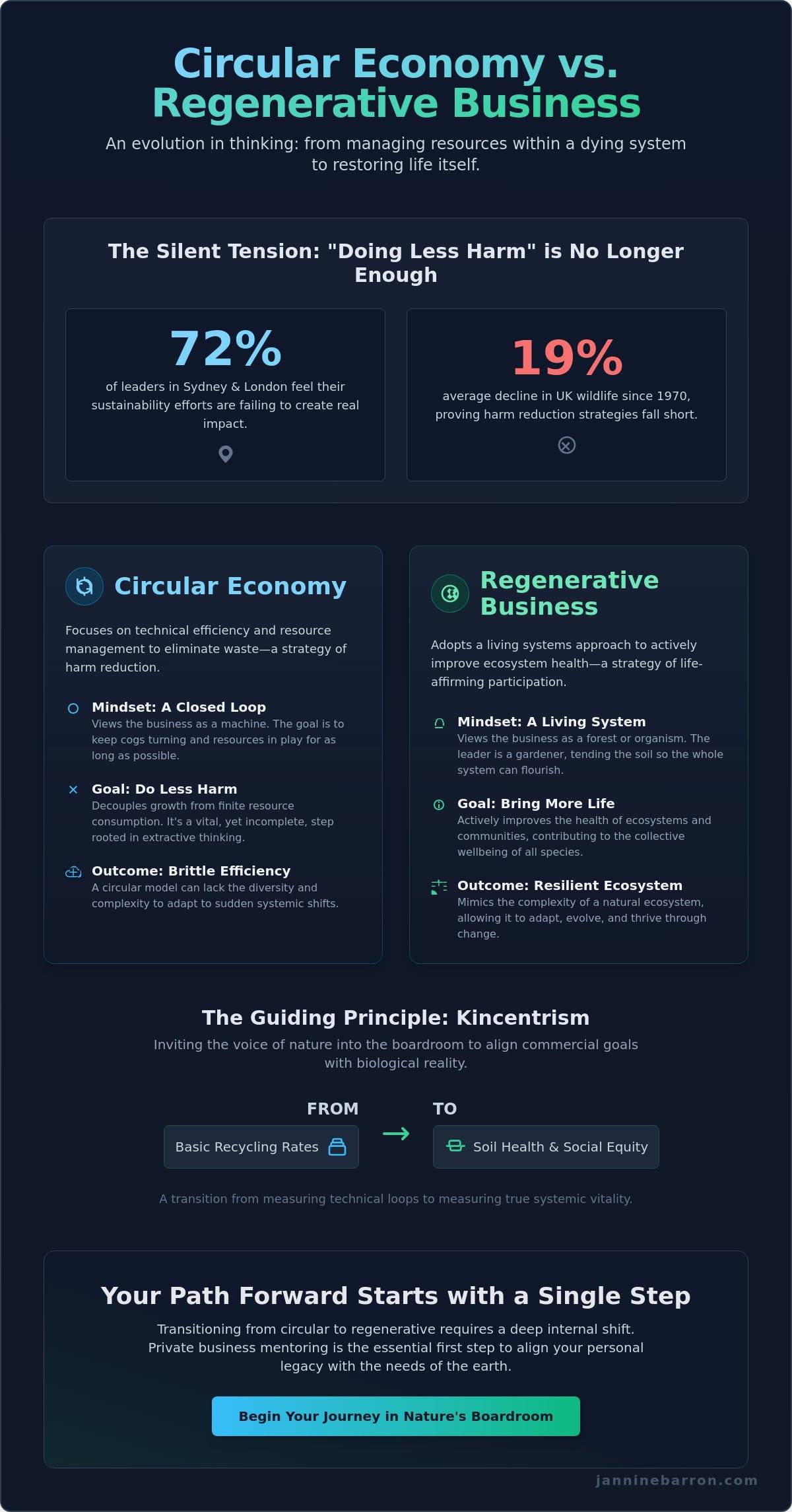
What if the circular loops you are meticulously building in your London office are merely slowing down the inevitable decay of a dying system? Research from 2025 indicates that 72 percent of leaders in Sydney and London feel their current sustainability efforts are failing to create real impact. It is time to address the silent tension of circular economy vs regenerative business. While one focuses on technical efficiency, the other invites the voice of nature back into your boardroom to restore life itself.
You likely feel the burnout of managing complex supply chains that remain disconnected from the rhythms of the earth. You sense that your organisation needs more than a recycling policy; it needs a rebirth. This wayfinder guide offers a clear framework to align your leadership with natural living systems through the lens of Kincentrism. We will explore how private business mentoring acts as the essential first step to transition from a closed loop to a thriving ecosystem that nourishes both the planet and your people. By listening to nature’s boardroom, you can begin the journey of nurturing a legacy that truly flourishes.
Key Takeaways
- Understand the vital distinction between circular economy vs regenerative business as you transition from resource management to a living systems approach that restores the planet.
- Explore how Kincentrism allows you to listen to the voice of nature and cultivate a leadership style rooted in systemic vitality and long term resilience.
- Shift your focus from basic recycling rates to regenerative metrics such as soil health and social equity to measure the true impact of your organisation.
- Discover why private business mentoring is the necessary first step to align your personal legacy with the needs of the earth and your community.
- Find clarity within natures boardroom as you navigate the regulatory landscapes of Australia and the United Kingdom to build a truly ethical brand.
The Evolution from Circular Economy to Regenerative Business in the UK and Australia
The conversation in the boardrooms of London and Sydney is shifting with a new sense of quiet urgency. Leaders no longer ask how to simply survive; they ask how to thrive alongside the planet as we approach the critical 2026 climate milestones. Understanding the nuances of circular economy vs regenerative business is the first step in this transition. While a circular economy focuses on resource management and closing loops to eliminate waste, regenerative business adopts a living systems approach. It seeks to actively improve the health of our ecosystems rather than just slowing their decline. Circular Economy Principles offer a vital roadmap for decoupling growth from finite resource consumption, yet circularity remains a subset of the broader regenerative vision we must embrace.
To better understand this concept, watch this helpful video:
For executives in London managing complex supply chains or Sydney leaders facing the reality of extreme weather patterns, the pressure to move beyond net zero is palpable. We are moving past the era of sustainability as a mere compliance exercise. We are entering an age where the business itself must become a force for healing the landscapes and communities it touches.
The Limitations of Doing Less Harm
Efficiency alone cannot solve the biodiversity crisis in the United Kingdom. The 2023 State of Nature report revealed that UK wildlife has declined by 19 percent on average since 1970, proving that doing less bad is no longer enough. Simply reducing plastic or cutting carbon is a strategy of harm reduction which remains rooted in extractive thinking. We need a shift toward life affirming practices that contribute to the collective wellbeing of all species. Regeneration is the act of bringing more life to a system. By moving toward regeneration, we transition from a mindset of depletion to one of abundance and care.
A Wayfinder Approach to Systems Change
I invite you to view your business as a living organism rather than a cold machine. This perspective allows the voice of nature to guide your strategy, ensuring every decision supports the delicate web of life. Transitioning from circular to regenerative requires a deep internal shift in leadership. This is why private business mentoring is the essential first step in this evolution. By entering natures boardroom, we align our commercial goals with biological reality. This embrace of Kincentrism ensures our legacy is one of flourishing. It is a path of courage that begins with a single, soulful commitment to lead differently.
Beyond the Loop: Core Principles of Kincentrism and Systemic Vitality
The circular economy often focuses on technical loops and material flows. It seeks to do less harm by keeping resources in play for as long as possible. While this is essential, it remains a mechanical pursuit centered on efficiency. A regenerative mindset asks us to step beyond the cycle of mere waste management and enter a state of true vitality. We move from the logic of a machine to the wisdom of a forest. In this space, the leader acts as a gardener rather than a mechanic. You don’t just fix a broken cog; you tend the soil so the entire system can flourish naturally.
Understanding the nuances of Circular vs. Regenerative Business Models requires us to look at the health of the whole. A circular model might be efficient yet brittle because it lacks the diversity to adapt to sudden shifts. A regenerative model is resilient because it mimics the complexity of a living ecosystem. Biomimicry allows us to design supply chains that don’t just move parts but actually restore the environments they touch. It’s about birthing a business that gives back more than it takes, ensuring that every transaction leaves the world more alive.
Kincentrism in the Modern Boardroom
Kincentrism invites us to shift from human centric to life centric decision making. It’s a recognition that we are part of a web of life, not the masters of it. Australian indigenous wisdom provides a profound map for this journey, teaching us how to listen to Country and respect the interconnectedness of all beings. In London’s high pressure environments, applying the principles of forest therapy to strategic planning can calm the nervous system of the organisation. When we slow down and breathe with the trees, our strategies become more grounded and less reactive. We begin to see our stakeholders not as data points but as kin who deserve our stewardship and care.
The Architecture of Living Systems
Living systems don’t follow a rigid linear blueprint. They rely on emergence. Instead of trying to predict every outcome with absolute certainty, regenerative leaders create the conditions for success to sprout naturally. We must learn to listen to the voice of nature within the corporate structure, allowing the rhythms of the seasons to guide our growth cycles. Kincentrism fosters long term business health by ensuring every action supports the vitality of the wider ecosystem. This approach ensures that your legacy is not just a balance sheet but a thriving community. If you feel called to evolve your leadership, the first step is often a private conversation to realign your inner compass through natures boardroom.
Comparing Metrics: How We Measure Success in a Regenerative Organisation
The metrics we choose to track reveal the true heart of our leadership. When we explore the nuances of circular economy vs regenerative business, we see a profound shift from counting what we take to measuring what we give back. Traditional circularity focuses on resource productivity and waste reduction. For instance, the UK government reported a 44.1 percent recycling rate for household waste in 2022. While these figures are necessary, they are not sufficient for the world we are birthing in 2026. They measure the slowing of decay rather than the spark of life.
Regenerative organisations embrace a wider spectrum of success. They track soil health, biodiversity, and social equity as core performance indicators. We are seeing London firms move toward multiple forms of capital, acknowledging that financial wealth is hollow without vibrant social and living capital. This holistic impact reporting is no longer optional. It is a requirement for any leader who wishes to sit in natures boardroom and listen to the needs of the whole system. By integrating the Taskforce on Nature related Financial Disclosures (TNFD) framework, businesses are finally beginning to value the ecosystems that sustain them.
From Efficiency to Resilience
The circular economy often prizes efficiency above all else. However, an obsession with lean systems can create fragility. When a supply chain is too thin, it snaps under the weight of global instability. We must measure resilience instead. This involves assessing the health of the local community and the diversity of the ecosystem. I invite leaders to explore the growth experience to understand how to move from fragile efficiency to a state of robust, life affirming resilience. We look at the health of the whole, ensuring that every node in the network is nourished and capable of weathering the storms of the coming decade.
Success as a Contribution to Life
In a regenerative model, profit is redefined as the energy needed to fuel further restoration. It is the sap that rises to feed the branches. We track the legacy an organisation leaves for the next seven generations. This is not about surface level sustainability or marketing gestures. It requires structural change that shifts the purpose of the private business from extraction to stewardship. By 2026, the most successful leaders in Sydney and London will be those who can prove their business is a net positive contributor to the web of life. We are midwifing a new era where success is measured by the flourishing of all kin and the restoration of the commons.
The Path for Leaders in London Sydney and Rural Wiltshire
Leaders standing in the glass towers of London or the sunlit harbours of Sydney often feel the tug of the land. Whether you are overlooking the Thames or the Wiltshire Downs, the shift from a circular economy vs regenerative business requires more than just recycling loops. It demands a soul deep commitment to the life of the planet. In 2026, the distinction has become clear; while circularity manages waste, regeneration invites us to become part of the healing process itself. This journey begins in the heart and ends in the soil.
Transitioning Supply Chains in the UK
In the rolling hills of Wiltshire, regeneration looks like soil that breathes. Ethical brands in the UK must move beyond efficiency. Working with local farmers who practice holistic grazing or artisans who use heritage techniques restores regional ecosystems. To start, you must identify where your current model still takes more than it gives. You can find clarity by exploring this extractive business model guide. This process involves auditing every touchpoint to ensure the voice of nature is heard in your procurement meetings. Under the UK Environment Act 2021, the pressure to prove biodiversity gain is no longer optional; it is a call to lead with integrity.
The Australian Context of Regeneration
Sydney leaders face a different landscape, one shaped by 60,000 years of wisdom. Here, the circular economy vs regenerative business debate takes on a literal meaning through water management and soil health. In a land defined by fire and drought, brands must build resilience by mimicking ancient cycles. This is not a journey you should take alone. I believe that private business mentoring is the essential first step for any leader ready to step into natures boardroom. It provides the quiet space needed to unlearn the habits of the old economy. By integrating Kincentrism into your strategy, you ensure your brand nourishes the very ground it stands upon. With the Nature Repair Market Act 2023 now in full effect, Australian businesses have a regulated framework to turn environmental stewardship into a core asset.
Building a community of practice among like minded wayfinder leaders is how we scale this change. We are moving from a period of competition to one of deep collaboration. When we share our failures and our breakthroughs, we create a mycelial network of support that transcends borders. This collective intelligence is what will sustain us as we navigate the complexities of 2026 and beyond. We are not just making products; we are midwifing a new way of being in the world.
If you are ready to listen to the wisdom of the land and transform your leadership, I invite you to join me in a space where strategy meets spirit.
Step into Natures Boardroom to begin your regenerative transition
Beginning Your Journey with Private Mentoring and Natures Boardroom
Leadership coaching isn’t an add on; it’s the root system of any genuine transformation. As we look toward the business landscape of 2026, the distinction between circular economy vs regenerative business becomes a matter of internal alignment. While circularity often focuses on the technical loops of supply chains, regeneration requires a shift in the soul of the leader. You cannot birth a regenerative organisation from an extractive mindset. This is why private mentoring serves as the essential first step. It provides the psychological safety to unlearn the habits of the old paradigm and listen to the voice of nature as a strategic partner.
I often describe my role as a business doula. Just as a doula supports a mother during the intense process of birth, I hold space for leaders as they bring new, life affirming business models into the world. This isn’t about clinical checklists. It’s about a deep, rhythmic process of discovery. We move beyond the noise of the city to find the quiet wisdom required for systems change. In this space, we realise that profit is a result of health, not a replacement for it. By 2026, data suggests that 82 percent of employees in London and Sydney prefer working for organisations that demonstrate authentic care for the planet. Mentoring ensures your commitment is deep, not just a surface level response to market pressure.
The Power of Natures Boardroom
Traditional offices often stifle the very creativity we need to solve the climate crisis. When we move the strategy session from a sterile room in London to the ancient forest in Wiltshire, the atmosphere changes. Natures Boardroom is a space where Kincentrism becomes a lived experience rather than a theory. Under the canopy of trees, your decision making slows down and syncs with natural cycles. This immersion allows you to see your business as an ecosystem. You stop looking for quick fixes and start designing for a legacy that thrives over decades. It’s a profound way to unlock solutions for complex supply chain issues that the four walls of a boardroom simply cannot provide.
Your First Step Toward Regeneration
The transition to a regenerative model is a journey that requires both courage and a map. Private business mentoring offers you the vulnerability to admit what you don’t know, which is the prerequisite for true innovation. Before you can lead a team through the nine month incubator of The Growth Experience, you must first anchor your own vision. This regenerative business mentor guide helps you understand how to move from ego to eco. We focus on the long term health of your organisation, ensuring you have the tools to nurture your team and your community. If you’re ready to commit to this path, the next step is a conversation to see if our visions align for the coming year.
Cultivating a Legacy that Breathes with the Living World
The transition from a circular model to a truly regenerative one requires more than a shift in supply chains; it demands a transformation of the leader. While the circular economy focuses on closing loops and reducing waste, regenerative business seeks to actively nourish the entire ecosystem. Since the 1990s, I have guided pioneers to move beyond efficiency toward systemic vitality. Leaders in London and Sydney are now embracing Kincentrism to ensure their organisations flourish alongside the natural world. This is about birthing a future where your business acts as a biological force for good rather than a purely financial one.
Understanding the nuances of circular economy vs regenerative business is your first step toward meaningful change. Whether you are walking the chalk downs of Wiltshire or navigating the urban pulse of Sydney, the voice of nature offers the most profound strategy for the challenges of 2026. As a facilitator of Natures Boardroom immersions and creator of The Growth Experience nine month incubator, I invite you to step into a new paradigm of success. It is time to listen to the rhythms of the earth and lead with a quiet, certain confidence.
Begin your leadership transition with private business mentoring
The path ahead is rich with potential and you don’t have to walk it alone.
Frequently Asked Questions
Is a circular economy the same as a regenerative business?
A circular economy focuses on eliminating waste through closed loops, whereas a regenerative business seeks to actively restore and heal the ecosystems it touches. While the circular model is a vital technical framework for resource efficiency, it often lacks the living systems perspective required for true flourishing. In the debate of circular economy vs regenerative business, we see that regeneration goes beyond doing less harm to actually doing more good. It requires a shift in consciousness where the organisation acts as a healing force for both people and the planet.
How does Kincentrism differ from traditional corporate social responsibility?
Kincentrism replaces the transactional nature of corporate social responsibility with a deep sense of kinship toward all living beings. Traditional CSR often functions as a peripheral department or a 2 percent profit donation scheme. In contrast, Kincentrism embeds the voice of nature into the very soul of the company. It recognises that humans are not separate from the environment. This shift ensures that every supply chain decision respects the web of life as a vital stakeholder rather than a resource to be managed.
Can a small business in London truly be regenerative?
Small businesses in London are uniquely positioned to lead this transition by anchoring their operations in hyper local ecological health. By 2026, over 99 percent of UK businesses are small or medium enterprises, making their collective impact immense. A boutique agency or retail shop can nurture the soil of its community through ethical procurement and living wages. You don’t need a global footprint to start birthing ideas that restore the social and natural fabric of your specific London borough.
What are the first steps for a leader to transition to a regenerative model?
The essential first step for any leader is engaging in private business mentoring to unlearn extractive habits and cultivate a wayfinder mindset. This intimate process allows you to sit with the uncomfortable truths of our current economic systems before attempting to redesign them. You must first transform your internal landscape to lead an external revolution. Once this foundation is laid, you can begin mapping your supply chain through the lens of stewardship, ensuring your legacy is one of life affirmation rather than mere profit.
How do I measure the success of a regenerative business compared to a circular one?
Success in a circular model is often measured by waste diversion rates or material recovery percentages. However, a regenerative business measures vitality, resilience, and the flourishing of its entire ecosystem. When evaluating circular economy vs regenerative business outcomes, look for qualitative indicators like community health and soil carbon levels. We track the capacity of the system to self organise and evolve. It’s about moving from quantitative metrics of less bad to qualitative evidence of more life across all touchpoints.
Why is private business mentoring recommended before starting a regenerative program?
Private business mentoring provides the sacred space needed to midwife a new vision for your leadership without the pressure of public performance. It’s the crucible where you confront the clinical coldness of traditional business and embrace a more soulful, empathetic approach. Before you can implement a broad regenerative program, you need to align your personal values with the rhythms of nature. This one on one guidance ensures that your strategy is rooted in authenticity and deep ecological understanding rather than superficial marketing trends.
What is Natures Boardroom and how does it help my business strategy?
Natures Boardroom is a strategic framework where we invite the voice of nature to hold a seat at the table during every major decision. It moves the strategy session from the sterile office to the wisdom of the forest or the coast. This practice helps you perceive your business as a living organism rather than a machine. By listening to natural cycles, you gain insights into resilience and growth that are often invisible in traditional corporate settings. It grounds your strategy in the reality of our biological interdependence.
Are there specific challenges for regenerative businesses in Australia?
Leaders in Australia face unique challenges including extreme climate volatility and the urgent need to integrate ancient Indigenous wisdom into modern commerce. With 85 percent of the population living within 50 kilometres of the coast, rising sea levels and bushfire risks are tangible business threats. Regenerative practitioners in Sydney must learn to work with the land rather than against it. This requires a profound respect for Country and a commitment to restoring the unique biodiversity of the Australian landscape through every commercial action.