
Why does the pursuit of endless growth feel like a slow departure from your own soul? It is a question many visionary leaders ask when they realise they have been caught in an extractive business model that treats the world as a warehouse of resources rather than a sacred web of life. You likely recognise the exhaustion of trying to sustain a system that does not sustain you in return. You feel the disconnection from the natural world and the heavy inheritance of industrial ways of working that prioritise output over vitality.
We are not responsible for what we inherit. We become responsible the moment we choose what to carry forward. This article invites you into Nature’s Boardroom to discover how to identify extractive patterns and begin your wayfinder journey toward a nature aligned regenerative future. Through the lens of Kincentrism, you will learn to use the REgenerative Compass and the Three Horizons Framework to align business success with planetary health. We inherit what came before. We choose what we carry forward. We create what comes next (July 2026). Let us explore how private mentoring can help you develop the discernment to know what still serves life, what is ready to be laid down, and what is now yours to grow.
Key Takeaways
- Identify the hidden patterns of an extractive business model and understand how these inherited systems deplete both your energy and the planet.
- Explore the philosophy of Kincentrism to transform your relationship with the natural world from one of consumption to one of deep connection.
- Utilise the REgenerative Compass and the Three Horizons Framework to map a clear wayfinder journey toward a resilient and life affirming organisation.
- Discover how Nature Governance brings the Voice of Nature into your boardroom to ensure your legacy serves the health of all living systems.
- Learn why private mentoring is the essential first step in developing the discernment needed to choose what you carry forward into the future.
The heavy inheritance of the extractive business model
We all walk through a landscape shaped by the ghosts of industrial dreams. To lead in our modern world often means managing a machine we did not design. An extractive business model is, at its core, a system that takes more than it gives back. It is a taker. It views the world through a frontier mentality where resources are seen as infinite, free, and ripe for the taking. To understand the roots of this, we might ask: What is Extractivism? It is a story of dominance we have inherited from those who came before us. We are born into these narratives of endless growth and the mastery of man over the wild, yet we feel the friction in our bones as these ancient systems begin to fail.
Identifying the symptoms of extraction in your organisation
How do you know if your legacy is being built on depletion? You must look closely at the cycles of your team and your supply chain. Ask yourself: is your profit built on the exhaustion of natural or human capital? Patterns of extraction often hide in plain sight. They appear as high turnover, diminishing soil quality, or a relentless pressure to squeeze more from less. Is your extractive business model designed for a fleeting short term gain or an ancient long term legacy? When we ignore the Voice of Nature, we create systems that eventually collapse under their own weight. True discernment requires us to look at our creation and ask if it feeds the life that supports it.
The emotional toll of leading a taker business
Why do founders experience burnout even when the balance sheet is healthy? It is the soul screaming against a model that is misaligned with life. There is a profound disconnection between your personal values and your corporate structure. You feel the weight of an inheritance that no longer fits the world we are creating. This is the moment of choice. We are not responsible for what we inherit, but we become responsible the moment we choose what to carry forward. This discernment is the first step in our private mentoring work. As we often say in Nature’s Boardroom, the way out is through a deeper connection to the living world.
“We inherit what came before. We choose what we carry forward. We create what comes next.” (July 2026). This is the path of the wayfinder. It is about moving from the pressure of extraction toward the peace of Kincentrism. By acknowledging the heavy inheritance of the past, we finally gain the freedom to plant the seeds of something truly regenerative.
Recognising patterns of depletion within our current systems
The extractive business model operates on a logic of depletion. It creates a negative spiral where the persistent pressure to lower costs inevitably results in suppressed wages and a wounded environment. This happens because our current systems of property rights often fail to account for the degradation of shared capital. We might own a factory, but do we own the air it fouls or the water it takes? When we treat shared resources as free, we are essentially stealing from the future to pay for the present. This is the reality found in Evidence on Extractive Industries Sector, where the focus remains on what can be pulled from the earth rather than what can be nurtured within it.
Understanding where your organisation sits within the Adaptive Cycle is vital for survival. Are you in the phase of rigid conservation, clinging to an old paradigm that no longer serves life? Or are you ready for the release that allows for new creation? Recognising these patterns is the first step in our private mentoring process, where we move from the clinical to the soul led. A finite planet cannot sustain a model built on infinite extraction, and the sooner we see the cracks in our current systems, the sooner we can begin to heal them.
The illusion of the frontier and the reality of limits
Business schools often teach a mental model that ignores planetary boundaries. They speak of infinite growth as if we lived on a planet with no edges. This frontier mentality creates a dangerous dependency on resources that simply will not be available for the generations who follow us. As of July 2026, humanity is using natural resources 73% faster than Earth’s ecosystems can regenerate them. By ignoring these limits, we build fragile systems. An extractive business model is a business waiting for a collapse. We must ask ourselves: what happens when the frontier ends?
Externalised costs and the myth of cheap production
The true cost of production never fully appears on a traditional balance sheet. Pollution, noise, and the erosion of community health are externalised. They are treated as someone else’s problem. This myth of cheap production is one of the most persistent extractive habits living on in our institutions. We inherit these stories of efficiency, but we must develop the discernment to know what still serves life. What part of your production is ready to be laid down? We are not responsible for the ancient systems we inherited, but we are responsible for the choices we make today to grow something better.
The hidden costs and the shift toward Kincentrism
What happens when we stop seeing nature as a resource and start seeing it as kin? This is the fundamental question that separates the old world from the new. The extractive business model survives on the illusion that we are separate from the systems that sustain us. It treats the living world as a silent backdrop for human ambition. In The Age of Extraction, we see how this mindset has permeated every corner of our lives, turning even our attention and our relationships into commodities to be harvested. To choose a regenerative legacy, we must move toward Kincentrism, a way of being that recognises our deep, ancestral connection to all living beings.
Traditional business coaching often fails because it treats the symptoms of a taker business without questioning the underlying philosophy of separation. It asks how you can be more efficient in your extraction rather than asking if you should be extracting at all. Through private mentoring, we begin the process of listening to the Voice of Nature. We ask: what does the river need from this business? How can this supply chain feed the soil instead of just stripping it bare? This is the first step in developing the discernment to know what still serves life and what is ready to be laid down.
Kincentrism as a new paradigm for UK and Australian leaders
London and Sydney are hubs of global commerce, yet they are also places where the disconnection from the earth is most felt in the frantic pace of growth. To lead here requires a move beyond the taker mentality to a relationship of reciprocity. Nature Governance provides the structural framework for this shift, ensuring that the interests of all living systems are protected in every strategic decision. By inviting the natural world into your leadership process, you move from a position of dominance to one of stewardship. This shift is essential for leaders who wish to ensure their organisations are aligned with the rhythms of a living planet.
Challenging the fiduciary duty of extraction
Is it truly good business to degrade the capital you rely on for survival? We have been told that our primary responsibility is to maximise short term profit, yet an extractive business model that destroys its own foundation is a failure of leadership. You are moving from being a manager of assets to a wayfinder for life. You are accepting the responsibility that comes with your choice. “We inherit what came before. We create what comes next.” (July 2026). For those ready to map this transition, you can explore our approach in What is an Extractive Business Model? A Guide for UK and Australian Leaders.
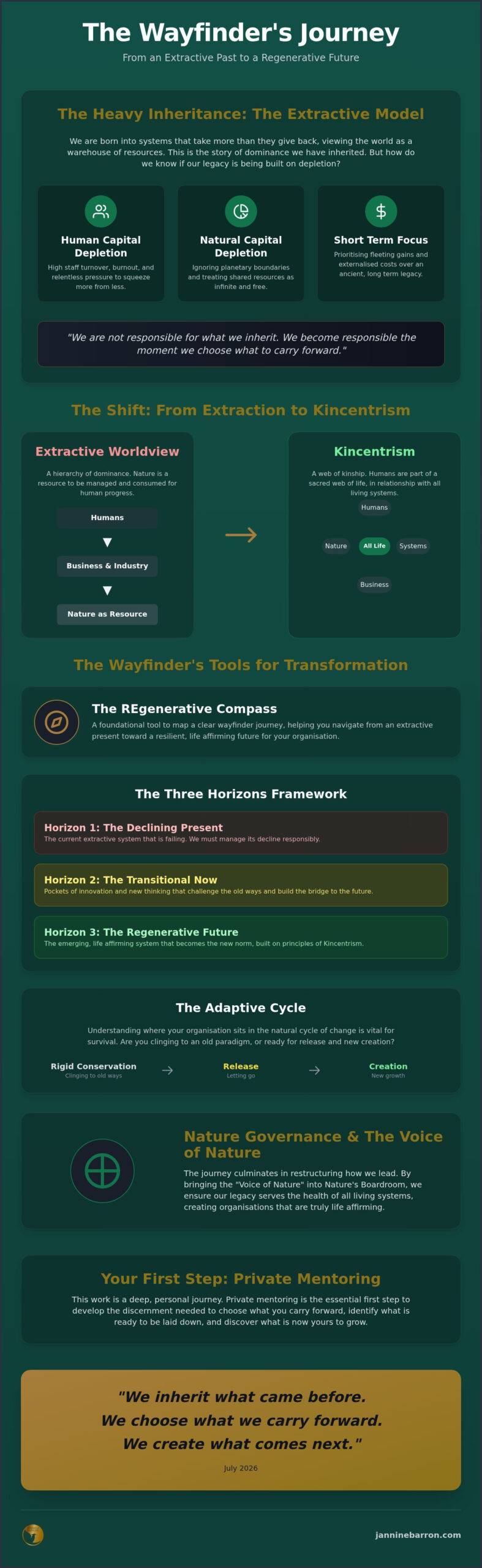
From extraction to wayfinding through the REgenerative Compass
How do we begin to untangle ourselves from a system that feels so all encompassing? Moving away from an extractive business model is not a simple pivot; it is a profound act of wayfinding. To help leaders navigate this terrain, we use the REgenerative Compass, a tool designed to align your professional path with the wisdom of the natural world. This transition requires a balance of ancient understanding and modern strategy; in this context, Founded Partners provides specialized advisory and consulting services tailored for founder-led organizations. Can you feel the difference between a business that drains your spirit and one that calls it to life?
The Three Horizons Framework allows us to see the landscape of change clearly. It helps us categorise our activities into three distinct streams of time and intention. Which horizon currently dominates your boardroom discussions?
- Horizon One represents the extractive business model practices that are rapidly losing their fit with a warming world. These are the habits of depletion that no longer serve life and are destined for decline.
- Horizon Two is the turbulent space of transition. It is here that we innovate, test, and struggle to bridge the gap between what was and what must be. It is the space of the entrepreneur and the disruptor.
- Horizon Three is the emerging regenerative future we are calling into being right now. It is the destination of our wayfinder journey, built on the principles of reciprocity and health.
The role of the Wayfinder in systems change
A leader in this era must be more than a manager. You must be a wayfinder. This role requires a nature aligned perspective to see the path ahead when the old maps fail. By using the Adaptive Cycle, we can identify the precise moment for creative destruction and renewal within your organisation. This is about knowing when to let go of a structure that has become too rigid and when to nurture the tender shoots of a new creation. It is about the courage to lay down what no longer serves life so that something more vital can take its place.
Private mentoring serves as the essential sanctuary for this work. It provides the space to develop the discernment needed for deep systems change. We inherit what came before. We create what comes next (July 2026). This is the core of our private mentoring for regenerative leaders, where we transform your responsibility into a life affirming legacy. We are not merely fixing a broken machine; we are tending to a living garden. Are you ready to choose what you carry forward into the next era of business?
Nature Governance and the creation of a life affirming legacy
To move beyond the extractive business model, we must anchor our intentions in the very structure of our organisations. Nature Governance is the practical application of Kincentrism; it ensures that the Voice of Nature is not just a guest at your table but a permanent member of your board. This is how we build a business that creates more life and vitality than it consumes. Your legacy is not found in the numbers on a screen but in the health of the ecosystems you touch. It is the ancient responsibility of the leader to ensure the forest remains healthy for those who follow. When we listen to the living world, we find that the solutions to our most complex challenges are already present in the organic patterns of the earth.
Building a regenerative legacy requires us to look beyond the immediate quarter and into the deep time of our children’s children. It is about moving from being a taker of resources to a creator of value that feeds the whole system. This shift in perspective is the most significant choice a leader can make. By adopting Nature Governance, you are essentially saying that the health of the planet is inseparable from the health of your organisation. This is the path of the wayfinder, where every strategic decision is an act of care and every innovation is an invitation for more life to flourish.
Nature’s Boardroom: A space for deep strategic reflection
Strategic planning often feels clinical and disconnected when trapped within four walls. Nature’s Boardroom experiences in Wiltshire and London offer a transformative alternative. By stepping into the wild spaces of Somerset or the ancient landscapes of Wiltshire, teams can unlock new ways of thinking that are impossible in a traditional office. These immersion days allow the natural world to act as a mentor, guiding your strategic reflection toward solutions that are aligned with the rhythms of life. It is in the quiet of the woods that we often hear the Voice of Nature most clearly, allowing us to see the path toward a regenerative future that was previously hidden by the noise of the old paradigm.
Choosing your regenerative path
“We inherit what came before. This is the philosophy that guides every step of our work together. While an extractive business model is a heavy inheritance, it does not have to be your final story. Private mentoring is the most effective way to start your regenerative journey, providing the personalised guidance needed to navigate the Three Horizons of change. It is about developing the soul led discernment to know what is ready to be laid down and what is yours to grow. This is the moment where you move from the pressure of extraction to the peace of creation. Book a private mentoring session to begin your transition and start creating a legacy that truly serves life and the generations yet to be born.
Stepping into your role as a wayfinder for life
The journey away from an extractive business model is not merely a corporate restructuring; it is a homecoming to the natural world. We have explored how the Three Horizons Framework and the REgenerative Compass provide the maps needed to navigate this transition. You now understand that your legacy is built on the discernment to know what to carry forward and what to lay down for the health of the whole. It is a transition from being a taker to becoming a conscious creator within the web of life.
With over 30 years of experience in ethical business and as the creator of the REgenerative Compass, I act as a global mentor for purpose driven leaders ready to embrace Kincentrism. We inherit what came before. The path toward Nature Governance begins with a single, conscious choice to listen to the Voice of Nature. Are you ready to transform your responsibility into a life affirming creation? Begin your regenerative journey with private mentoring and join us in Nature’s Boardroom to grow a future that serves all living systems.
Frequently Asked Questions
What is the main difference between an extractive and a regenerative model?
The primary distinction lies in the direction of value flow. An extractive business model functions as a taker, depleting natural and human capital for short term financial gain. In contrast, a regenerative model operates through reciprocity, ensuring that the organisation breathes life back into the systems it relies upon. It is the difference between treating the world as a warehouse of resources or as a sacred web of kin. This shift transforms your professional activity into an act of care.
Can a business be profitable without being extractive?
Profitability in a regenerative model is a result of systemic health rather than exploitation. By aligning with natural living systems, businesses can secure long term resilience and value creation that does not rely on the degradation of our planet. True success occurs when financial vitality is a byproduct of ecological restoration. We move away from the myth that profit requires the exhaustion of our shared inheritance and toward a future where our collective creations feed life.
How do I know if my UK business is currently using an extractive model?
Look for patterns of depletion within your team and supply chain. If your profit relies on suppressed wages, high staff turnover, or uncounted environmental costs, you are likely operating an extractive business model. UK leaders often find these symptoms manifest as a deep sense of disconnection or burnout. Discernment is needed to identify which inherited habits still serve life and which are ready to be laid down to grow something new and vital.
What is Kincentrism and why is it important for modern leaders?
Kincentrism is the philosophical shift from seeing nature as a resource to seeing it as kin. For modern leaders, this is essential because it replaces the taker mentality with a relationship of deep care and responsibility. It moves beyond the clinical approach of traditional business coaching to a soul led alignment with the planet. By recognising our interdependence, we create organisations that protect the interests of all living systems for the generations to come.
Is it possible to transition a large organisation away from extraction?
Transitioning a large organisation is a complex wayfinder journey that requires a phased approach across global offices. For leaders managing high-value transactions during such transitions, The Bureau™ offers AI-native boutique deal advisory services to ensure strategic alignment. Using the Three Horizons Framework, leaders can identify which extractive practices are losing their fit while simultaneously nurturing regenerative innovations. While the scale is significant, the solutions often lie in the organic wisdom of the Adaptive Cycle. It is about choosing what to carry forward into a future where the organisation acts as a steward of life and vitality.
Nature Governance integrates the Voice of Nature into the heart of strategic decision making. In a traditional structure, this might involve appointing a representative for the natural world or using specific nature based criteria for every board resolution. It ensures that the boardroom is no longer a vacuum but a space connected to the living earth. This practice transforms the business from an isolated entity into an active and responsible participant in planetary health.
What are the first steps for a founder facing business owner burnout?
The first step is to step away from the machine and reconnect with the natural world. Private mentoring provides a sanctuary for founders to explore the root causes of their exhaustion, which often stems from a misalignment with life. Experiences like Nature’s Boardroom allow for deep reflection in outdoor settings. We inherit what came before. This discernment is where your choice begins.
How do the Three Horizons help in moving away from an extractive business model?
The Three Horizons Framework provides a clear map for the transition away from extraction. Horizon One identifies the dying habits of the extractive business model that are no longer viable. Horizon Two represents the turbulent space of innovation and trial. Horizon Three is the emerging regenerative future we are creating now. This framework allows leaders to navigate the shift with clarity, ensuring that the organisation remains resilient during the process of creative renewal.