Why this moment matters and the two convergences that signal a new regenerative business threshold
A personal essay on why I created The Grass Tree Fellowship Program.
It was 2022. Hannah Cox had invited me to speak at the very first Better Business Summit in Manchester, and the brief was “Growth” with a nature theme.
I was late for the Zoom call so I pulled into a car park in Tisbury, opened my laptop, and joined from there. Just me in a parked car, a weak wifi signal, and trying to find a decent angle for meeting people for the first time on a screen.
After meeting Hannah Cox and fellow speaker Ngunan Adamu I hesitantly put forward an idea for the Better Business Summit. “Could we place an empty chair on the stage and call it the Nature Chair?”
Yes! Hannah said immediately. As I came to know Hannah over the years, I realised she was someone who always said yes to the big and new ideas, even the ones that felt impossible, until they didn’t.
The First Convergence
What none of us knew, in that moment of quiet experimentation with a nature chair, was that a company just a few miles away from Hannah in Manchester was about to make history. Faith in Nature became the first company in the world to legally appoint Nature to its board. With less than 100 employees, they were investing in nature having formal, binding voice in organisational decision-making. On the other side of the world, Patagonia announced that Earth was now its only shareholder. They have over 3,500 employees. One nature chair and two huge steps for nature governance, all decided in the same month. What are the odds of one idea landing in different places without each other knowing?
We had all arrived at the same question from entirely different directions.
I remember the feeling of that convergence. Was it the ‘hundredth monkey effect’? A hypothetical explanation of why an idea suddenly spreads spontaneously across geographical barriers, as if by collective consciousness.
The reason this idea could emerge across geographical and cultural boundaries is that the idea hundreds of sustainability professionals had been quietly growing frustrated at the lack of impact from their work, their minds were conjuring a new way and somehow that all landed in the solution that has come to be known as; The Voice of Nature
That Nature Chair at the Better Business Summit felt like our own little revolutionary act, but the systemic governance shift was the game-changer that allowed this idea to grow That’s not to downplay the effect that this empty chair had on participants. Its constant presence a visual reminder of the invisible governance. They worked well together.
Summit participants felt the absence. And it was that feeling that allowed them to imagine nature’s presence.
What would change in your organisation if nature had a vote?
The House of Hackney soon followed as the second company in the world to give nature a voice in its governance. They included a profound addition to their name: “Mother Nature and Future Generations,” they called it. This followed a small charity, “Friends of Cave Creek Canyon” who made nature a director in the US. Then Hannah Cox of the Better Business Network in the UK leapt from the nature chair idea to become the third company in the world to give nature a formal voice in their board. Each one, in their own way, was feeling for the edges of something that had no map yet.
In the years that followed, I watched these companies do something rare and quietly radical: they stayed with the discomfort of not knowing. They tried things. They asked what nature’s voice actually meant in a Board meeting, in a procurement decision, in a moment of crisis. That willingness to take an idea seriously enough to let it change you was itself the growth.
I had always had nature in my business, literally in my name (Nature’s Child). In that business “nature” signalled something deeper to our customers than branding, it was a declaration of values, health and ecological integrity. In supply chains, we had strict organic certification that held us all accountable to these ideas. But the voice of the nature movement invites us all in to go deeper in our work.
I’ve been holding what I call “Nature’s Boardroom experiences” since 2021. These are a combination of coaching and forest bathing, taking leaders out of their offices and into nature itself to have the conversations they most needed to have but didn’t quite know how, or where, to begin. The spaces are private, brave, and unhurried. Something always shifts in the people who walk with me. It’s profound watching people shift one person at a time, but we need this at a scale. The voice of nature movement has the capacity to do this. Something bigger and systemic has been born.
“Something bigger and systemic has been born.”
For my own exploration of this depth, I spent two years inside the Kincentric Leadership programme to explore interspecies communication and a further year as a Dandelion Fellow with the Earth Law Centre to deepen my understanding of Nature Governance and explore what being a voice for nature really meant. So I know the power of education and have made life long connections with people doing this work globally.
At the same time I was growing, something else was unfolding: people began finding their way to me, no longer only seeking business mentoring and growth, but recognising the deeper connection to nature and governance. The two were now clearly connected, and I was ready. They wanted to know what was theirs to do next.
was also finding my way to others. Leaders like Giles Hutchins, whose work at the intersection of nature and organisational life helped me feel less alone on my path. One remarkable night, camping alone in the woods during one of his Overnight Nature Immersions, something settled in me that no workshop or framework had reached. These convergences were readying me for what came next.
In December 2025, I found myself in Australia visiting family, and made one important diversion: a meeting with Dr Michelle Maloney of the Australian Earth Laws Alliance. No Australian company had yet established formal nature governance in law, but Australia had a strong track record on nature rights, and Dr Maloney was championing Earth Jurisprudence.
Michelle and the Australian Earth Laws Alliance was the natural collaborator to bring the practice from the UK to Australia. Together we began to ask: what might this look like on the Australian continent, with its own ancient ecologies, its own First Peoples’ wisdom, its own particular relationship between land and law? This felt like an important evolution, not a transplant.
The answer that emerged was not a replica of anything we had seen before. It was something distinctly of this place: a fellowship woven through with Indigenous voices, grounded in regenerative business that holds ecological and commercial life in conversation. A journey, not a framework. A becoming, not a blueprint.
The Grass Tree Fellowship Program launched this week.
The Second Convergence
The second wave of any idea tells us, as a society, that something has moved beyond the fringe. Those first steps by the UK companies could have remained isolated experiments, but instead, something was beginning to travel.
The Earth Laws Centre in the US and Lawyers for Nature in the UK had been two of the organisations that helped nature governance become tangible, supporting Faith in Nature and others as they felt their way into this new territory. Their work was no longer confined to nature rights alone; it was growing into something broader, nature’s voice inside the organisation itself.
We were deep in the final weeks of launching The Grass Tree Fellowship in April 2026 when we realised we had missed announcements gathering around us, each one signalling the same shift. The House of Hackney launched The Greenprint just a week before us. Char Love, the company’s Voice for Nature and colleague John Elkington galvanised 900 MBA students at Harvard Business School to discuss what it had truly meant to appoint Mother Nature and Future Generations to their board. And then we discovered that Lawyers for Nature had launched a few weeks earlier, something they called the School of Nature Law, dedicated to exploring rights for nature and the voice of nature inside organisations.
Mainstream press articles were appearing as well such as this one in The Guardian Newspaper on Interspecies communication. This would have been considered too weird to write about a few years ago; something really was shifting.
The appetite for education and support had been initiated by The Earth Laws Centre with their first Dandelion Fellowship in 2024, a programme I joined in 2025. The enrolments in that fellowship told their own story: broad, cross-sector interest from people who were ready to go deeper. The hunger for education, for language, for community around this work had been building quietly beneath the surface.
None of these launches in April 2026 were coordinated. All of us had arrived at the same place within weeks of each other, just as the first companies had, back in 2022.
The second convergence is about education, information sharing, and the support that would allow this work to truly take root systemically.
Beyond the few organisation names I have listed here, many more community and corporations are embracing this movement, and we will explore many of them and their learnings in The Grass Tree Fellowship.
A Voice of Nature Movement is finding its feet
Just three years ago, the first companies in the world gave nature a legal voice in their boardrooms and trusts. Since then, this movement has gathered momentum faster than any of us anticipated, and what is becoming clear is that there is no single way to do this. Nature’s voice can enter organisations legally, symbolically, and culturally. It can sit as Purpose, as Adviser, as Shareholder, as Director, which The Earth Law Centre shares in its Onboarding Nature Toolkit. I’ve taken this a little broader myself, where I like to talk about nature as experience, citizen and inspiration. Not because I want to anthropomorphise nature, but to help us all grasp what is possible and find the bridge to embrace nature differently. Each approach is taking root. Each is teaching us something. And in a remarkably short time, a rich body of real-world practice has grown up around us.
Sustainability has been a vital step in recent decades, and all the work that has been done matters deeply, but the living world is still diminishing under our watch. So I can’t see that we have any choice but to pause and ask what has to change in sustainability from here?
I can’t see that we have any choice but to pause and ask what has to change in sustainability from here?
What the voice of nature movement reaches for is something more, not just less harm, but the regeneration of life itself. A fundamentally different relationship between organisations and the living world they depend on.
And yet this is not merely a philosophical choice. Speak to any counsellor and they will tell you that anxiety levels in society are through the roof. We are all genuinely wondering whether there is a future, not in the abstract, but in the lived, daily, quietly terrifying sense that the polycrisis brings. That is real. And it is, perhaps unexpectedly, profoundly motivating.
I learnt many years ago that I am at my best in a crisis. In the dark of a river, our car having broken through a wooden bridge and plunged in, I focused on what had to be done to get us all out alive.
Even a polycrisis, which is a trauma complex far greater than a sinking car. I tend toward solutions rather than paralysis, and leadership is my natural ground.
I have spent three decades founding and leading businesses grounded in organic and regenerative principles. I have been part of nature governance since its earliest experiments in the UK, and have sat with Indigenous custodians, Earth lawyers, Deep Ecology pioneers, and regenerative business founders to explore this evolution for decades.
Through all of it, I kept returning to the same question. How do we bring these qualities into the business world? With acceptance. With integrity. With wisdom. With real impact and systems change. And more recently, I’ve asked a deeper question. How do we do this in a way that honours living kinship with the same weight that legal, financial, and political systems determine?
Those systems have sustained us but were built, it turns out, to measure everything except what matters most. Nature and Life.
This intersection is precisely where I now choose to stand.
If you feel called to be part of this early movement where the conversations are still being shaped, and real change remains possible, then what I am about to share is for you.
So whilst the world feels like it is burning for some, I find myself seeing pathways, possibilities, and people ready to rise. Everything I have built, learnt, and lived is now oriented toward one thing: helping others find their own pathway, and their own important place, in growing a better future.
If you feel called to be part of this early movement, where the conversations are still being shaped, and real change remains possible, then now is the time. Step forward. The work needs your voice, your courage, and your willingness to not yet have all the answers.
The Grass Tree Fellowship Program
I’ve spent a lifetime exploring what it means to do business with genuine purpose, and I’ve come to believe one thing above all else: our dependence on the natural world for life, health, and meaning is still there but buried beneath so many layers of separation that we have lost the very thread that could guide how we lead, decide, and create healthy organisations and a healthier society.
Healing that connection by finding our way back to belonging and kinship with the living world I believe is the key to healing how business makes decisions.
Sustainability tried to address this. Regeneration took us deeper. What’s needed now is something more direct: an honest reckoning with our relationship with nature, as a philosophical shift first, and then as a structural, legal strategy.
There are some incredible, courageous people already coming on this journey. And now it’s time to invite you.
Will You Join us?
It is Australia’s first structured learning journey for leaders, founders, governance professionals and regenerative practitioners who are ready to bring nature’s voice into the heart of their organisation. And it is unlike anything else that exists in this space because it was designed not just to inform, but to transform.
We are not managing nature. We are learning to accept our interconnection to nature and know that belonging and kinship is a better place to govern from. We are also connecting with First Nations Peoples who have the lived experience of this connection.
Our symbol for the Fellowship
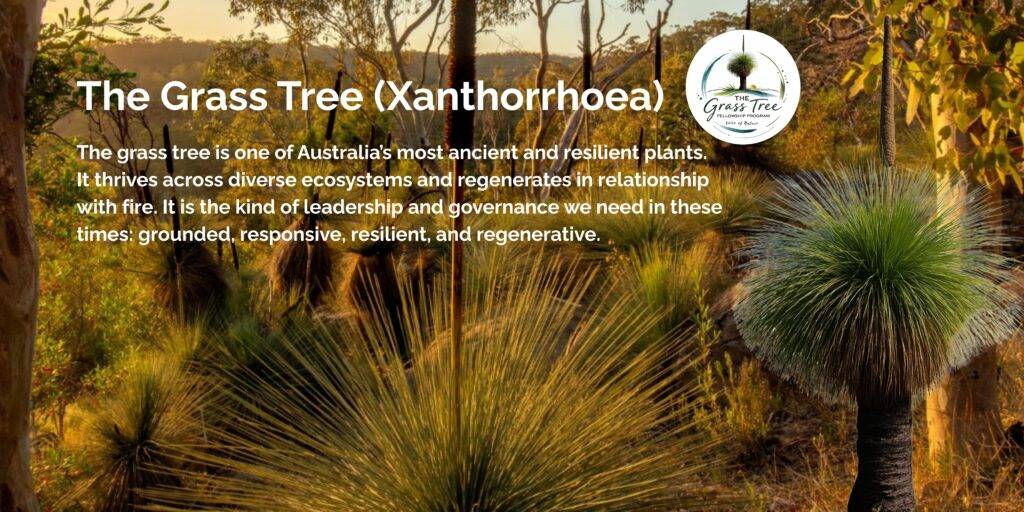
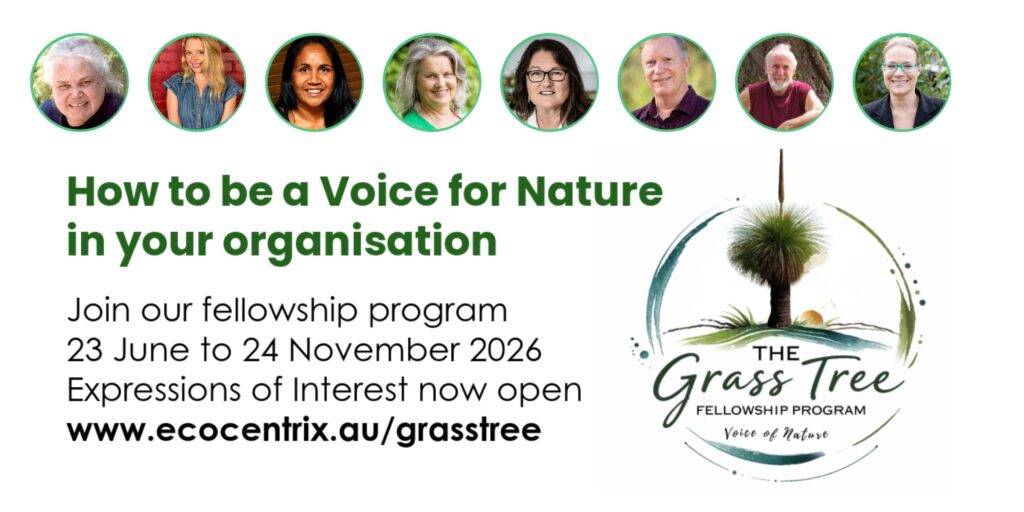
The grass tree (Xanthorrhoea) is one of Australia’s most ancient plants, unique to this land and thriving across diverse ecosystems and regenerating in relationship with fire. Some live for up to 600 years and more. Their enduring presence through drought, fire and renewal makes them a living reminder of the long story of this land and of what it means to lead with deep roots and a long horizon. this is why it is our beautiful symbol for our fellowship program. The grass tree has lived for centuries in Australia through fire and renewal. Patient, grounded and regenerative which are the very qualities of leadership we need in these times.
What makes this fellowship different
This is not another online course. This is a five-month co-learning journey with four distinct layers because this kind of transformation cannot happen through content alone.
You can download the Program Outline here, and complete your expression of interest here.
We are the first fellowship to include a weekend nature immersion to ensure our experience of nature is embodied and not just academic. Meeting on Arakwal Land on Bundjalung Country. (Byron Shire, Northern Rivers)
Our weekend happens on the 25 to 26 July, 2026 which is early in the fellowship. You will be guided by Delta Kay, Arakwal custodian, who will share her living relationship with Country so you can understand in this unique personal experience, a First Nations worldview of relationship with nature.
I will also be guiding you through the Japanese practice of Shinrin-Yoku, or forest bathing to connect your senses and intuition so you can bring this into your work. And we will walk through the grass tree forests that the public does not normally have access to with Michael Howes, founder of Australia’s Manuka.
Michael will walk you through the grass tree forests that first inspired this fellowship. He will show you his nature supply chain in its natural ecosystem and share how ecological kinship and commercial flourishing are not in contradiction.
Woven through the five months are online learning sessions bringing together international and Australian voices at the frontiers of Nature-inclusive Governance including legal frameworks, global case studies and Indigenous perspectives on relational governance.
Between sessions, we gather in facilitated integration circles to pause, reflect and share what is alive for you. We don’t just learn here. We grow knowledge together through honest dialogue and collective sense-making.
And throughout the second half of the fellowship, you will be designing your own personal blueprint, a practical roadmap for bringing nature’s voice into your own organisation, project or community. Something tangible to carry forward long after the fellowship ends.
The voices joining us
I am deeply honoured by the people who have said yes to this founding cohort. Our guest speakers will appeal to a wide audience including corporate, charity and small business. We welcome Char Love, Global Ambassador at Natura and Mother Nature and Future Generations Director at House of Hackney, who is also Executive-in-Residence at Saïd Business School, University of Oxford; Dr Mary Graham, Adjunct Associate Professor at the University of Queensland and Kombumerri person of the Yugambeh Language Speaking People; Delta Kay, Bundjalung woman of the Arakwal people and custodian of Country; John Seed, rainforest activist and a leading international voice in Deep Ecology; Dominique Hes, regenerative practitioner with Regen Melbourne; and Michael Howes, founder of Australia’s Manuka.
The fellowship is co-hosted with Dr Michelle Maloney Australian Earth lawyer, Co-Founder of the Australian Earth Laws Alliance, and one of the most important voices and facilitators of the education of earth jurisprudence in Australia.
Is this for you?
If you feel that nature deserves a voice in how we make decisions and you sense that you have a part to play in how that unfolds, this fellowship is for you.
It is for board members and executives, founders and NGO leaders, government professionals and regenerative practitioners, Nature proxies and systems thinkers. It is for anyone contributing to decisions that affect land, community or long-term wellbeing.
And if you are simply drawn to this without quite knowing why trust that instinct. You belong in this conversation.
The fellowship is uniquely Australian in its grounding, and open to the world in its vision. If the immersion weekend in Northern NSW is beyond reach, you can still participate fully online as long as you can join sessions at 6–8pm Brisbane time.
Three pricing tiers are available to suit corporate to small business from AU$800 to AU$2,800 to ensure this programme is accessible across sectors and organisation sizes.
A long way from Manchester
I often think about that empty chair in Manchester in January 2023. How such a small gesture, a seat, a name, a question asked aloud, could open something that had been waiting to be opened.
That is what this Grasstree fellowship is; an opening. A space where the question can take root, where people who feel the same pull can find each other, and where the work of bringing nature’s voice into governance can begin carefully, courageously, and with the wisdom this moment deserves.
The founding cohort opens 23 June 2026. Places are limited and applications close 15 June.
Nature’s voice grows louder when more of us choose to carry it. I hope you will join us.
This is where the conversation takes root.
Ready to explore?
Read the full programme outline and complete your Expression of Interest at ecocentrix.au it is not a commitment, simply a signal that you are ready to be part of something that matters. We will be in touch within 14 days.
Any questions? Email us at contact@ecocentrix.au
Jannine Barron is the founder of The Grass Tree Fellowship Program and creator of Nature’s Boardroom and The Growth Experience Regenerative Business Incubator. She is a regenerative business mentor, educator and historian working at the intersection of Nature-inclusive Governance, leadership and business across Australia and the UK. She is a steward of Voices of Nature UK, a Kincentric Leadership Fellow and a Dandelion Fellow.
You can subscribe to Jannine’s inspiring short newsletters, event invitations, and business mentoring tips here. You can read more articles written by Jannine on Substack, or LinkedIn.