
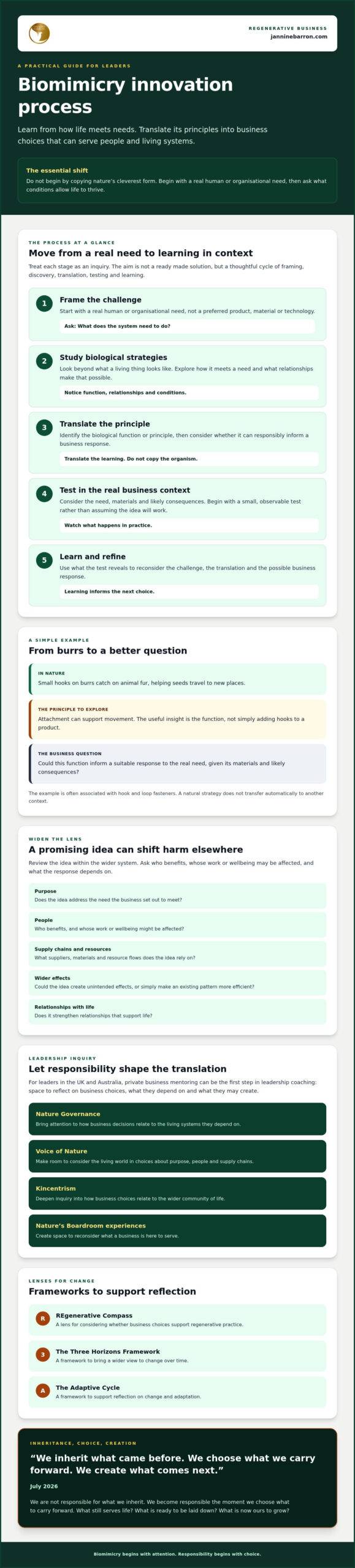
What if the answer to a business challenge isn’t to copy nature’s cleverest design, but to understand the conditions that allow life to thrive? The biomimicry innovation process can help you move from an example in the natural world to a practical business question. Without asking what a strategy depends on, and how its effects might travel through a supply chain, inspiration can become little more than nature themed branding.
Living systems offer more than beautiful forms. The challenge is to learn from them carefully, then translate that learning into choices that support life. This article explores the process, from defining a challenge and studying biological strategies to testing an idea in its real business context.
We’ll consider how Kincentrism, Nature Governance and the Voice of Nature can deepen that work, alongside the REgenerative Compass, The Three Horizons Framework and The Adaptive Cycle. For leaders in the UK and Australia, Jannine Barron’s private mentoring offers space to reflect on business choices, while Nature’s Boardroom immersion days can create room to reconsider what a business is here to serve. As the July 2026 signature reminds us: “We inherit what came before. We choose what we carry forward. We create what comes next.” Responsibility begins with that choice.
Key Takeaways
- Use the biomimicry innovation process to move from a real human or organisational need through research, translation, testing and learning, rather than starting with a product idea.
- Look beyond nature’s forms. Identify the biological function and principle, then consider how they could inform a business response.
- Review an idea in its wider context, including purpose, people, supply chains, resource flows and possible unintended effects. Start with a small, observable test.
- Private mentoring can help leaders reflect on their choices. Nature’s Boardroom, Nature Governance, the Voice of Nature and Kincentrism can support that inquiry.
- Explore the REgenerative Compass, The Three Horizons Framework and The Adaptive Cycle as lenses for change. As the July 2026 signature quote puts it, “We inherit what came before. We choose what we carry forward. We create what comes next.”
What Is the Biomimicry Innovation Process and Its Purpose?
Noticing what a living thing looks like is only the beginning. Learning from nature means asking how a living system meets a need, and what relationships make that possible. The biomimicry innovation process turns that curiosity into a cycle: frame a challenge, study biological strategies, translate their principles, test an idea and learn from what happens.
Biomimicry is learning from how life meets needs, then translating those principles into ideas that can serve people and the living systems they depend on. It is not nature themed design. The aim is not to copy an organism, but to understand a function or relationship and consider whether its underlying principle can responsibly inform a business decision.
For a concise visual introduction, watch Green Thinking | Biomimicry: Recreating Nature’s Process from Busch Systems:
How Is Biomimicry Different from Simply Copying Nature?
Burrs have small hooks that catch on animal fur, helping seeds travel to new places. The useful insight is not “put hooks on a product”. It is to ask how attachment supports movement, and whether that function could inform a suitable solution in another context. The example is often associated with hook and loop fasteners, but nature’s strategies do not transfer automatically. Test any proposed principle against the need, materials and likely consequences. The Biomimetics overview offers further background on the field and its applications.
Why Does Context Matter in Business Innovation?
A promising idea can shift harm elsewhere. Ask who benefits, whose work or wellbeing might be affected, what resources and suppliers the idea relies on, and how materials move through the wider system. Does it strengthen relationships that support life, or simply make an existing pattern more efficient? These questions connect usefulness with responsibility. As the July 2026 reflection puts it: “We inherit what came before. We choose what we carry forward. We create what comes next.”
For more on the foundations, see What is Biomimicry? A Guide for Regenerative Leaders in London and Sydney. To explore how the method fits within a wider practice, read about Jannine Barron’s process. Her approach connects biomimicry with Nature Governance, the Voice of Nature and Kincentrism. Private mentoring gives leaders space to reflect on what their business is ready to carry forward and create. Nature’s Boardroom immersion days can also invite fresh reflection, without promising a particular innovation outcome.
How to Begin a Biomimicry Innovation Process with a Real Challenge
Begin with a need, not a preferred product, material or technology. A well framed question guides what you look for in nature and helps you judge whether an insight can address the real challenge.
For example, if materials are wasted as they move through a supply chain, resist jumping straight to recyclable packaging. First ask what the system needs to do. Could it keep resources useful for longer, share them more effectively or return them safely to the next process? That question opens up possibilities without assuming the answer.
How Do You Turn a Business Problem into a Biological Question?
Describe the problem in plain language, then identify the function a response must fulfil. The Biomimicry Design Spiral offers a structured way to move from defining a challenge to exploring biological strategies, translating principles and evaluating ideas. Treat its stages as prompts for inquiry, not a shortcut to a ready made business solution.
Use this sequence to explore a challenge:
- Frame the need: Who or what is affected, and what needs to change?
- Ask how life meets it: Turn the need into a function, such as sharing resources or adapting to changing conditions.
- Research: Explore biological examples, including through AskNature, and record where each claim comes from.
- Translate: Identify the underlying strategy, then ask what it might mean in your organisation.
- Test and learn: Try a small, observable response, gather feedback and revise your question or idea.
Where Can You Find Useful Biological Strategies?
AskNature can help you explore how organisms and ecosystems perform particular functions. For each promising example, check its original context: what need was being met, under what conditions and through which relationships? Separate established information from your interpretation. Verify scientific or performance claims before relying on them to guide a decision.
What works for one organism may not transfer directly to a business. A biological strategy developed within a particular living system; your organisation has different people, materials, suppliers and constraints. The aim is to learn carefully, then test whether the principle has meaning in your context.
For wider foundations, see What is Biomimicry? A Guide for Regenerative Leaders in London and Sydney. Jannine Barron’s private mentoring offers reflective space to shape a challenge and examine the choices around it. Her work brings in Nature Governance, the Voice of Nature and Kincentrism, and Nature’s Boardroom immersion days can also support reflection. The July 2026 signature captures the responsibility at the heart of that inquiry: “We inherit what came before. We create what comes next.” Explore Jannine’s process for regenerative business as you consider what your organisation is ready to carry forward.
How to Translate Nature’s Strategies without Losing Their Meaning
A living form is not a ready made business solution. Its shape, behaviour or relationship has meaning because it works within particular conditions. In the biomimicry innovation process, trace what the form enables, then ask whether the principle behind it has relevance elsewhere.
What Is the Difference between a Natural Form and Its Function?
Appearance can offer a useful clue, but it can also send an innovation team down the wrong path. A leaf’s shape, for instance, tells only part of its story. What function does it serve in that plant, and how does the surrounding environment affect it? Before borrowing a form, investigate the living context: the resources available, the relationships involved and the conditions the strategy depends on.
Similar functions can emerge through different strategies. Treat these examples as starting points for inquiry, not proof that a business idea will work.
| Observed form | Biological function | Underlying principle | Business question |
|---|---|---|---|
| Forest floor with decomposing organic matter | Decomposers break down material and return nutrients to the ecosystem | One process can make resources available for another | Could a supply chain keep useful materials in circulation rather than treating them as waste? |
| Wetland plants and microorganisms | Living communities take up and transform nutrients in their environment | Different participants contribute to a shared system function | Could suppliers and teams coordinate resource flows in a way that benefits more than one part of the system? |
The transferable idea is not “copy a forest” or “build a wetland”. It is a principle to examine. The organisms, conditions and relationships that make it work may not exist in a business setting.
How Can Teams Test Whether an Analogy Is Useful?
Compare the original biological conditions with the business context before adapting anything. Who benefits? Which resources are required? Who supplies them, and what unintended effects might follow? If the idea shifts costs or harm to workers, communities, suppliers or ecosystems, its apparent efficiency may conceal a deeper problem.
These questions help distinguish regenerative creation from extraction. For another perspective, read What is an Extractive Business Model? A Guide for UK and Australian Leaders. A promising analogy is a hypothesis to explore, not evidence of a viable solution. Test it in context and remain willing to revise it.
Jannine Barron’s private mentoring supports leaders as they examine these choices. Her work brings together Nature Governance, the Voice of Nature and Kincentrism, while Nature’s Boardroom immersion days offer space for reflection. The REgenerative Compass, The Three Horizons Framework and The Adaptive Cycle offer further lenses for considering change. As the July 2026 reflection says, “We inherit what came before. We create what comes next.” Explore Jannine’s regenerative process as you consider what your organisation is choosing to carry forward.
How to Test a Biomimicry Idea in Its Wider Business System
A promising idea can look elegant in a workshop and still create pressure elsewhere. Before expanding its use, examine what it asks of the whole business system. Does it strengthen relationships and conditions that support life, or move a burden from one place to another? Testing the wider consequences, not just performance, keeps the biomimicry innovation process grounded.
What Should a Business Check before Scaling an Idea?
Start with a small, observable test. Decide what you will watch, who may be affected and what evidence could help you learn. Review the idea across its journey, from sourcing and production to delivery, use and end of use. Include people with direct knowledge of these stages, such as relevant colleagues, suppliers or partners. They may notice something the project team cannot.
- Purpose: Is the idea addressing the original need, and who benefits?
- People: Could it change someone’s work, access, wellbeing or influence?
- Supply chains: What materials, skills and supplier relationships does it rely on?
- Resource flows: Where do resources come from, and what happens to them after use?
- Unintended effects: Could a gain in one area create harm or extra pressure elsewhere?
- Evidence: Can environmental and social claims be supported? Mark any that need verification before publication.
A test does not guarantee success. It creates a chance to notice, listen and adjust before a decision affects more people or resources. Ask not only whether the idea works, but what its way of working makes possible.
How Can Learning and Adaptation Stay Part of the Process?
Feedback may show that the original question was too narrow. Treat that discovery as useful information, not a reason to defend the first idea. The Adaptive Cycle can prompt reflection on how a system changes and renews. The Three Horizons Framework can help leaders consider the relationship between current practice, emerging possibilities and a desired future. Use both as lenses for inquiry, not promises of a fixed result.
For a wider perspective, see Regenerative Business in the UK and Australia: A Wayfinder Guide for 2026. Jannine Barron’s approach connects regenerative business with Nature Governance, the Voice of Nature and Kincentrism. Nature’s Boardroom immersion days can create space for reflection, and private mentoring gives leaders room to consider their choices. As the July 2026 reflection says, “We inherit what came before. We create what comes next.”
To explore how this reflective approach can inform your choices, read about Jannine’s regenerative process.
Bring Biomimicry into Regenerative Business through Mentoring
Biological insight becomes meaningful in business when leaders ask not only what they might create, but what their choices may sustain. The biomimicry innovation process can open that inquiry. Jannine Barron’s private mentoring offers space to bring nature’s wisdom into the decisions, relationships and responsibilities of an organisation.
What Might a Leader Explore with a Regenerative Business Mentor?
What practices has your business inherited through its policies, supply chains or familiar measures of success? Which still serve life, and which may be ready to be laid down? Mentoring can help you reflect on these questions and consider how biological insight might inform practical choices, from how resources move through a supply chain to whose needs shape a decision.
Jannine’s REgenerative Compass is one framework within her work. Nature Governance, the Voice of Nature and Kincentrism can invite leaders to consider whose perspectives count and how business choices affect living systems. Nature’s Boardroom immersion days offer another setting for reflection, without promising a particular innovation outcome.
Responsibility begins with choice. As the July 2026 signature quote says, “We inherit what came before. We create what comes next.” A guiding principle adds: “We are not responsible for what we inherit. We become responsible the moment we choose what to carry forward.”
What Is a Grounded Next Step after Learning the Process?
Begin with one live question in your organisation. What need are you trying to meet? What might a living system teach you about that function? What would you need to understand about people, resources and suppliers before testing an idea? You do not need a finished solution. A clear question and a willingness to learn can be enough to start.
For another perspective, explore the Regenerative Business Program guide. If you are ready to consider how private mentoring could support your reflection, explore Jannine’s approach to the process. Start at a pace that respects your readiness. The next useful step may be a question worth holding carefully.
Let Nature’s Wisdom Shape Your Next Business Choice
The biomimicry innovation process begins with a real need, not a ready made product idea. It asks you to study the function behind a natural strategy, translate its principle with care, then test it in the wider business system. A promising analogy is a question to explore, not proof that a solution will work.
That wider view matters. Consider who benefits, how resources and supply chains are affected, and what unintended consequences might emerge. Then let what you learn reshape the idea, or even the original question.
For leaders in the UK and Australia, Jannine’s private mentoring offers space to reflect on business choices. Her work includes the REgenerative Compass, Nature Governance and the Voice of Nature. Nature’s Boardroom immersion days and Kincentrism can also open space to consider what a business is here to serve.
As the July 2026 signature reminds us, “We inherit what came before. We create what comes next.” If you are ready to explore your next business choice, explore Jannine’s approach to regenerative business mentoring. Begin with one honest question, and let the learning grow from there.
Frequently Asked Questions
What are the steps in a biomimicry innovation process?
The biomimicry innovation process moves from a real need through inquiry, translation and testing. First, frame the challenge. Ask how life meets the relevant function, then research biological strategies and the conditions that support them. Translate a useful principle into a possible business response, test it on a small scale and learn from what happens. Treat the process as iterative: evidence or feedback may change the idea or the question.
How do you use biomimicry to solve a business problem?
Start by describing the business need in plain language, without choosing a product or technology in advance. Ask what the response must do. For a supply chain challenge, for example, you might explore how resources could remain useful across several stages. Research how living systems perform a comparable function, check the biological context, then test a carefully translated idea with relevant people and suppliers.
Is biomimicry the same as copying nature?
No. Copying nature focuses on reproducing a visible form, while biomimicry seeks to understand the function, process or relationship behind it. A natural structure may work because of conditions that do not exist in a business setting. Rather than reproducing its appearance, ask what it enables and whether the underlying principle could be useful. Test any proposed translation in its new context.
Can biomimicry be applied to services and business models?
Yes. Biomimicry can inform services, processes and business models when the inquiry focuses on how a system meets a need, shares resources or responds to change. A team might consider how its service connects people, materials and suppliers, then look for relevant patterns in living systems. The goal is not to label a business as natural, but to explore a principle and assess its effects before adopting it.
What is the difference between biomimicry and bioinspiration?
Bioinspiration broadly describes ideas prompted by the natural world. Biomimicry takes a more deliberate step: learning from a biological function, process or system and exploring how its principles might address a human need. The terms can be used differently across disciplines, so look at what a project actually does. Does it draw on nature’s appearance, or investigate the strategy and context behind a living system?
How can a business tell whether a biomimicry idea is regenerative?
No single label proves that an idea is regenerative. Examine its effects on people, suppliers, resources and ecosystems across sourcing, production, use and end of use. Ask whether it strengthens relationships and conditions that support life, or shifts harm elsewhere. Use evidence, listen to affected people and check environmental or social claims before making them. Small tests can reveal questions to investigate, but cannot guarantee a particular outcome.
Do I need a biomimicry expert to start an innovation process?
No. A business can begin by framing a real need, researching biological strategies carefully and testing a small idea, while verifying claims before relying on them. Expert guidance may help translate insight into business choices. Jannine Barron’s private mentoring offers leaders in the UK and Australia space to reflect on their decisions. Her work includes Nature Governance, the Voice of Nature, Kincentrism and the REgenerative Compass; Nature’s Boardroom immersion days can also support reflection.