
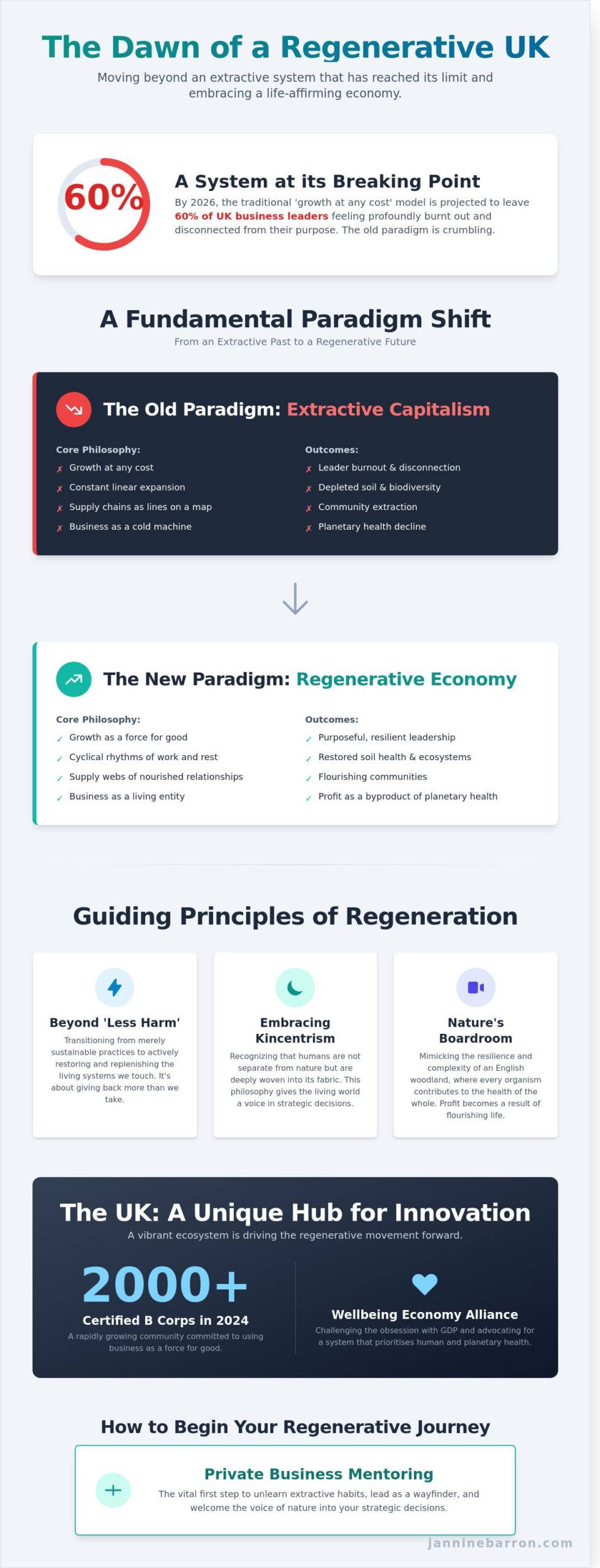
What if the exhaustion you feel isn’t a personal failing but a symptom of an extractive system that has finally reached its limit? By 2026, the traditional growth at any cost model will have left 60 per cent of UK business leaders feeling profoundly burnt out and disconnected from their purpose. You probably recognise that the old ways of profit are crumbling. The old paradigm is dying. This is why looking at regenerative business examples uk is no longer a luxury but a necessity for survival. These pioneering organisations are stepping into nature’s boardroom to listen to the voice of nature and build supply chains that actually nourish the planet.
I promise to show you how these life affirming companies are healing ecosystems while remaining profitable. We will explore concrete success stories from across the British Isles that prove growth can be a biological force for good, often drawing on deep wisdom from the Australian bush to inform their land stewardship. You will discover why private business mentoring is the vital first step to midwife this transformation in your leadership. By the end, you will have a clear roadmap to move beyond confusion and embrace Kincentrism as your new guiding star.
Key Takeaways
- Move beyond the goal of doing less harm by transitioning toward a life affirming economy that mimics the resilience of an English woodland.
- Study pioneering regenerative business examples uk to see how organisations are restoring ecosystems through seed to stitch fashion and soil health restoration.
- Discover the power of Kincentrism and how giving the living world a legal vote can invite the voice of nature into your strategic decisions.
- Understand why private business mentoring is the essential first step to unlearn extractive habits and begin your journey in Natures boardroom.
- Learn to lead as a wayfinder who nurtures the birth of restorative systems and protects the land for future generations.
What defines a regenerative business in the United Kingdom?
Regeneration is a profound act of healing. It represents a departure from the traditional model of extractive capitalism that has long dominated the British landscape. While sustainable practices often focus on doing less harm or reaching a neutral state, a regenerative business seeks to actively restore and replenish the living systems it touches. It is an invitation to move beyond the clinical efficiency of the boardroom and into a more soulful relationship with our work. We are seeing a shift toward a life affirming economy that mimics the resilience and complexity of an ancient English woodland where every organism contributes to the health of the whole.
By 2026, the standards for corporate responsibility have evolved. Simply reducing plastic waste is no longer the benchmark for leadership. True regenerative business examples uk organisations are now integrating Kincentrism into their foundational structures. This philosophy recognises that humans are not separate from nature but are deeply woven into its fabric. The shift begins with private business mentoring, a foundational step for those ready to welcome the voice of nature into their strategic decisions. This process is like bábáskodás, or birthing a new way of being that treats the business as a living entity rather than a cold machine.
The core principles of the regenerative wayfinder
A regenerative wayfinder rejects the pressure of constant linear growth. Instead, they embrace cyclical rhythms that respect the seasons of a business. There are times for expansion and times for quiet rest, much like the fallow fields of our agricultural heritage. Within the British regulatory framework, this requires a sophisticated understanding of systems change. It means looking at supply chains not as lines on a map but as webs of relationships that must be nourished. Leaders are now asking how their presence can improve the soil, the water, and the community spirit in the towns where they operate.
Why the UK is a unique hub for regenerative innovation
The United Kingdom has become a vibrant centre for this movement, driven by the rapid growth of the B Corp community which surpassed 2000 certified businesses in 2024. In London and beyond, the Wellbeing Economy Alliance is challenging the obsession with GDP, advocating for a system that prioritises human and planetary health. The local landscapes in Wiltshire and Somerset provide a powerful backdrop for this work, where the rolling hills and ancient sites inspire leaders to adopt a more grounded, nature aligned approach. This British awakening mirrors similar shifts in Australia, where the call to protect fragile ecosystems has sparked a global solidarity among those committed to an economy that serves life. We are witnessing the birth of an era where profit is a byproduct of planetary flourishing.
Regenerative agriculture and food systems across the British Isles
The British landscape is currently undergoing a quiet yet profound transformation. For decades, our food systems operated on a model of extraction that left our soils depleted and our biodiversity in decline. Today, a new wave of pioneers is proving that profit and planetary healing can coexist beautifully. These regenerative business examples uk demonstrate that when we listen to the voice of nature, we find solutions that are both ecologically sound and commercially viable. It is about moving beyond sustainability into a space where our very presence as a business adds value to the living world.
Wildfarmed: Fixing the food system from the soil up
Wildfarmed is not simply a flour company; it is a movement that invites us to rethink our relationship with the land. By working with more than 100 farmers across the UK, they have introduced a method of growing wheat in permanent pastures without the use of harmful chemicals. Their approach creates nature friendly environments by fostering natural resilience within the ecosystem itself. This model shifts the consumer role from a passive buyer to an active participant in landscape restoration. Regenerative agriculture is a system that restores soil health while producing nutrient dense food. This simple truth guides every decision they make, ensuring that every loaf of bread helps sequester carbon and invites life back into the fields. They are effectively bringing the wisdom of the meadows back into our kitchens.
Riverford and the power of collective stewardship
Riverford Organic Farmers provides a masterclass in how structural integrity supports ecological goals. In 2023, the organisation completed its transition to 100% employee ownership, a move that anchored its purpose in the hands of those who actually tend the land. This shift is a structural pillar of a regenerative organisation; it ensures that long term health is never sacrificed for short term gain. They are deeply committed to building a regenerative supply chain that prioritises soil health and fair pay. By sharing the stories of their fields with their customer base, they bring the voice of nature into thousands of homes across the country. If you feel called to lead your own organisation toward this level of harmony, exploring mentoring for your leadership journey is a powerful way to begin that transition. These regenerative business examples uk show us that local resilience is built through community supported agriculture and a commitment to Kincentrism, where every living being has a seat in the boardroom.
Circular fashion and textile innovations in London and Somerset
Fashion is frequently viewed as a surface level industry, yet in the United Kingdom, it’s transforming into a vessel for deep ecological healing. Oshadi provides one of the most compelling regenerative business examples uk offers today. Their seed to stitch model goes beyond merely making clothes; it actively restores the soil where the cotton grows. By treating the supply chain as a living system, they ensure every garment acts as a witness to land restoration. This shift requires a new kind of leadership. I often remind my clients that private mentoring is the essential first step before stepping into Natures Boardroom. We must first heal our own relationship with growth before we can guide a brand toward true Kincentrism.
Toast: Cultivating a culture of repair and care
Toast has evolved from a simple retailer into a dedicated steward of longevity. Their Somerset roots ground them in a landscape of traditional craft. Through their in store repair workshops, they invite customers to participate in the regeneration of their own wardrobes. This isn’t just about mending a hole in a woollen jumper; it’s about fostering a soul led connection to our possessions. By supporting British craftsmanship, Toast helps maintain the cultural diversity of our regional textile hubs. These hubs are vital for reducing the carbon footprint of British fashion, keeping production close to home and heart.
Biomimicry in the London fashion scene
In the busy streets of London, designers are listening to the voice of nature to solve complex technical challenges. We see brands birthing materials from fungal leather and seaweed fibres that return to the earth without leaving a trace. These innovations replace toxic chemicals with biological wisdom. Applying nature based design in high ticket retail isn’t just a trend; it’s a pragmatic response to the climate crisis. When we look to the forest floor for design solutions, we create products that are life affirming. This is the essence of why these brands are such powerful regenerative business examples uk. It’s about moving beyond sustainability into a space where our very existence nourishes the world around us. By shortening the distance between the farm and the studio, these London designers are proving that style can be a force for planetary renewal.
Service and tech organisations embracing Kincentrism
The shift toward a life affirming economy requires us to see the natural world not as a resource but as a relative. This philosophy of Kincentrism is taking root within the UK service and technology sectors, moving beyond traditional sustainability into active regeneration. We are seeing a beautiful emergence of organisations that no longer view themselves as separate from the ecosystems they inhabit. Instead, they act as stewards, birthing new models of cooperation that prioritise the health of the soil, the water, and the community alongside financial viability.
Faith in Nature: Giving nature a boardroom seat
In September 2022, the UK beauty brand Faith in Nature made history by legally appointing Nature as a director on its board. This was achieved through a rigorous technical process of amending their articles of association, ensuring that the company’s legal purpose includes a fiduciary duty to the natural world. This structural change means that every strategic choice, from packaging innovation to supply chain logistics, must undergo a “nature check” to ensure no harm is done. Through the voices of designated human guardians, the needs of the ecosystem are articulated as clearly as any quarterly profit report within the corporate setting.
Service businesses as ecosystem supporters
UK based consultancies and financial institutions are reimagining their role as wayfinders for a regenerative future. We see this in the rise of ethical banking providers like Triodos, which only lends to projects that deliver positive social or environmental impact, currently supporting over 700 such organisations in the UK. Many service based leaders are now stepping away from the clinical boardroom environment to seek clarity in the wild. Using natures boardroom as a space for strategic reflection allows leadership teams to align their business cycles with the rhythms of the natural world.
The tech sector is also evolving, with platforms like Olio facilitating the circular economy by connecting neighbours to share surplus food and household items. Since its launch, Olio has enabled over 100 million portions of food to be shared in the UK, directly reducing waste and strengthening local bonds. These regenerative business examples uk leaders are setting show that when we use our financial capital to support ecological flourishing, the entire system begins to thrive. We are moving toward a model where business is a force for healing, and technology serves as a bridge back to local exchange and mutual support. To truly understand whether your organisation is thriving or merely surviving, it is worth exploring regenerative business metrics that track the flourishing of your entire ecosystem rather than extraction alone.
If you feel called to transition your leadership toward a model that honours the voice of nature, I invite you to explore the first steps of this journey.
How to begin your regenerative leadership journey in the UK
The transition to a life affirming economy requires more than a simple strategy shift; it demands a rebirth of your identity as a leader. Moving beyond the clinical coldness of traditional coaching allows you to embrace a soulful, nature aligned form of guidance. We cannot solve systemic ecological problems using the same extractive mindset that birthed them. Instead, we must look toward private mentoring as the essential first step to unlearn the habits of a dying paradigm. By studying successful regenerative business examples uk, we see how leaders are already moving from mere sustainability toward active contribution and healing.
The essential first step: Private business mentoring
Radical leadership evolution requires a safe space to dismantle old certainties. Traditional business coaching often focuses on high pressure growth and clinical metrics, yet regenerative leadership asks you to dive into the emotional depth of change. As a wayfinder mentor, I guide you through this transition by providing the structural support needed to birth new ideas. This process involves a deep audit of your current operations through the lens of Kincentrism, where we recognise the interconnectedness of all living things. We move away from the isolated ego toward an ecosystemic awareness that prioritises the health of the whole.
Stepping into natures boardroom
Strategic clarity rarely arrives while staring at a digital screen. To find the answers to complex challenges, you must leave the office and enter the wild landscapes of Wiltshire or Somerset. Stepping into natures boardroom allows you to reset your perspective on what success actually looks like. These immersion days are designed to help you reconnect with the voice of nature, allowing the rhythms of the land to inform your decision making. You will learn to listen to the wisdom of the soil and the seasons, which is a practice I have carried with me from my work in the ancient landscapes of Australia to the green heart of the UK.
- Audit your supply chain: Look beyond cost to see the human and ecological stories behind every purchase.
- Embrace Kincentrism: Shift your perspective to treat your business as a living entity within a wider biological community.
- Join a community: Surround yourself with like minded leaders who are equally committed to sustaining this difficult but necessary transition.
True regeneration is about creating conditions where life can flourish. It requires us to slow down and breathe, ensuring our professional legacy is one of restoration rather than depletion. By choosing this path, you aren’t just changing a business model; you are honouring your responsibility to the planet and future generations.
Cultivating Your Legacy in the Life Affirming Economy
The shift toward a life affirming economy is no longer a distant dream but a tangible reality unfolding across the British Isles. From the soil of Somerset where regenerative agriculture restores carbon to the circular textile hubs in London, these regenerative business examples uk demonstrate that profit and planetary health can thrive together. True success in 2026 requires moving beyond the extractive models of the past toward Kincentrism; a philosophy where every decision honours the voice of nature. This transformation demands a new kind of leadership that prioritises the health of the entire ecosystem over short term gains, much like the ancient land management practices I have observed in the Australian bush which offer timeless lessons for our British landscapes.
As a business doula with over 30 years of experience in ethical business, I have seen how the right guidance can midwife a vision into reality. Whether through The Growth Experience incubator or the deep quiet of Natures Boardroom immersions, the path to a resilient future begins with inner alignment. Your role as a leader is to facilitate this transition within your organisation. The most vital first step in this journey is a personal one. Begin your regenerative journey with a private mentoring session to anchor your strategy in the wisdom of the living world. The earth is ready for your contribution.
Frequently Asked Questions
What are some regenerative business examples in the UK for small brands?
Small brands like Riverford Organic Farmers and Hodmedod’s provide excellent regenerative business examples UK by prioritising soil health and community wealth. Riverford transitioned to 100 percent employee ownership in 2018; ensuring the business serves its people and the land rather than external shareholders. Hodmedod’s works with British farmers to produce pulses and grains that restore nitrogen to the earth; proving that even small operations can heal our local ecosystems.
How does a regenerative business differ from a sustainable one?
Sustainability focuses on doing less harm and maintaining the status quo; whereas regenerative business models actively restore and renew the living systems they touch. While 90 percent of sustainable brands aim for net zero impact; a regenerative approach seeks a net positive contribution to the biosphere. It is the difference between merely surviving and truly flourishing; moving beyond efficiency toward the creation of more life and vitality in every transaction.
Can a service based business be regenerative?
A service based business can certainly be regenerative by redesigning how it cycles its intellectual and social capital back into the community. You might choose to allocate 20 percent of your billable hours to local ecological restoration or use your influence to shift the mindsets of your clients. This transformation often begins with private business mentoring; which is the essential first step to align your leadership with the rhythms and wisdom of the natural world.
What is the role of Kincentrism in UK business models?
Kincentrism shifts the focus from human centric profit to a shared destiny with all living beings within our UK landscapes. It recognises that your organisation is part of an interconnected web where every decision impacts the soil; the water; and the air. By adopting this philosophy; leaders act as stewards who care for the earth as a relative; ensuring that the business nourishes the entire ecosystem rather than just extracting value from it.
Is it expensive to transition to a regenerative business model in the UK?
Transitioning requires an initial investment in systems change but often reduces long term operational costs by 15 to 25 percent through improved resource efficiency and brand loyalty. You don’t need a million pound budget to start this journey; as many small UK brands begin by reallocating existing marketing spends toward soil health or local social projects. It’s an investment in the legacy you’ll leave behind; birthing a model that is resilient against future climate shocks.
How do I find a regenerative business mentor in London or Somerset?
Finding a mentor in London or Somerset starts with seeking those who inhabit natures boardroom and understand the unique challenges of the UK market. I offer private business mentoring as the essential first step for leaders who feel called to this deep; transformative work. Somerset’s growing hub of 400 plus B Corps and organic farms provides a fertile ground for these connections; offering a space where soulful leadership and pragmatic strategy meet.
What does giving nature a voice on a board actually mean?
Giving nature a voice on your board means legally appointing a representative to speak for the environment during every strategic decision. Faith in Nature became the first UK company to do this in 2022 by amending their legal articles of association to include a guardian for the natural world. This practice ensures the living world has a seat in natures boardroom; shifting the focus from short term gains to the long term health of our planet.
What happens if my supply chain is global rather than UK based?
If your supply chain is global; your responsibility extends to the health of those distant ecosystems and the dignity of the people who tend them. You must apply the same radical care to a cotton farmer in India as you would to a neighbour in Devon. Mapping 100 percent of your tier one and tier two suppliers allows you to identify where restoration is most urgently needed; ensuring your global footprint leaves a trail of life rather than depletion. Adopting regenerative business metrics for UK and Australian leaders can help you track the ecological and social impact of every tier of your global supply chain.