
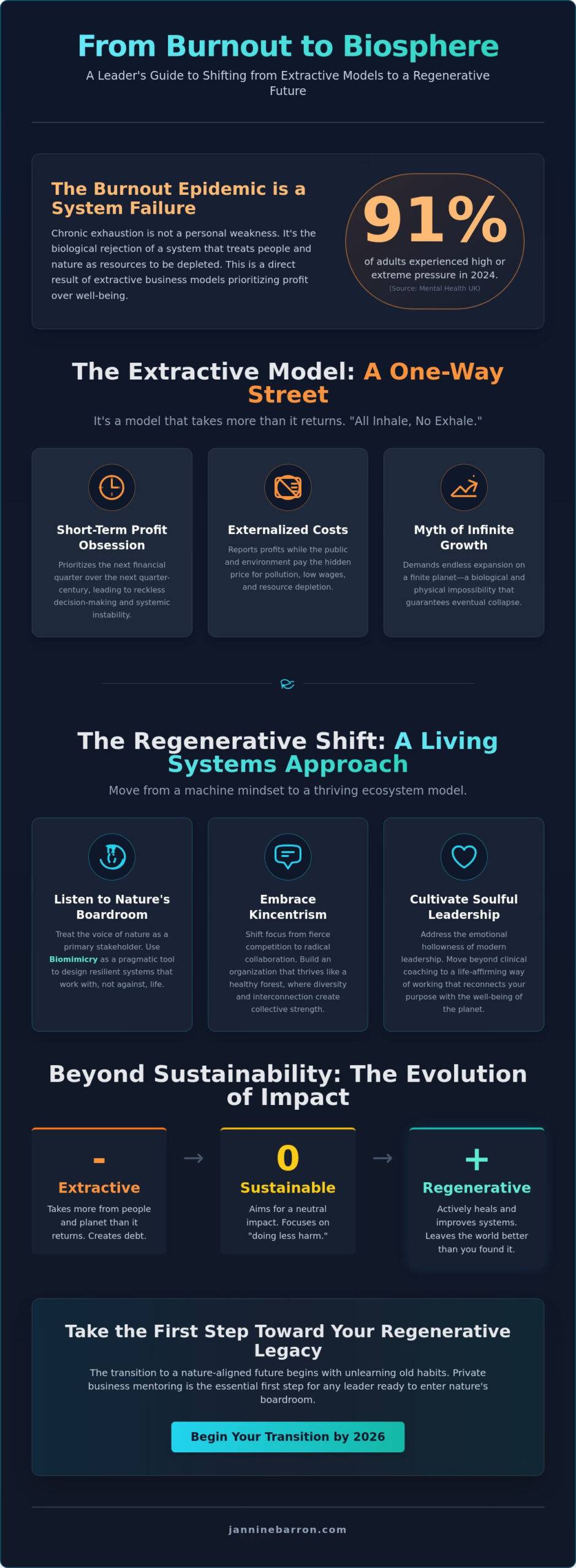
What if the chronic exhaustion you feel at the end of every financial quarter is not a personal failure but a biological rejection of the system you serve? You likely recognise that the relentless pursuit of growth is no longer serving your soul or our planet. In 2024, data from Mental Health UK revealed that 91 percent of adults experienced high or extreme levels of pressure; this is the direct result of the systemic problems with extractive business models that treat people and nature as mere resources to be depleted. You’re tired of feeling like a cog in a machine that only values profit. It’s time to stop the cycle of burnout and reclaim your role as a guardian of life.
We agree that the old way is failing us all. This wayfinder guide offers you a clear map to transition toward a nature aligned regenerative future by 2026. You’ll discover how to step into natures boardroom and listen to the voice of nature as a primary stakeholder in your organisation. We will explore why private business mentoring is your essential first step toward Kincentrism and heart led leadership. This journey provides a roadmap for leaders in the UK and Australia to move beyond guilt and start birthing ventures that truly flourish.
Key Takeaways
- Discover why the inherent problems with extractive business models are causing systemic fragility and emotional burnout for founders across the United Kingdom and Australia.
- Learn to listen to the voice of nature by using biomimicry as a pragmatic tool to redesign your business systems for resilience within the wider ecosystem.
- Shift your focus from competition to collaboration as you explore how Kincentrism can help you build an organisation that thrives like a healthy forest.
- Begin the transition toward a regenerative legacy through private business mentoring which serves as the essential first step for any leader ready to enter natures boardroom.
- Address the emotional hollowness of modern leadership by moving away from clinical coaching toward a soulful and life affirming way of working.
Understanding the Core Problems with Extractive Business Models
We are standing at a threshold where the old ways of commerce no longer serve the living world. To find our way forward, we must first name the shadow. The history and impact of extractive business models reveal a pattern of depletion that spans centuries; a mindset that views the world as a warehouse of parts rather than a web of relationships. At its simplest, extraction is a model that takes more from people and the planet than it ever intends to return. It is the opposite of the breath. It is all inhale, no exhale.
By 2026, the friction between these rigid models and our finite reality has become undeniable. In the UK, we see this in the brittle nature of supply chains and the rising costs of ecological neglect. While the natural world operates in a beautiful, regenerative cycle of life where every waste product becomes food for something else, the extractive model is a dead end. It operates on a logic of exhaustion, eventually leaving the soil, the worker, and the community spent. Private business mentoring is the essential first step to unlearning these habits, allowing leaders to step into natures boardroom and hear a different rhythm.
To better understand this concept, watch this helpful video:
The problems with extractive business models are anchored in three failing pillars. First is the obsession with short term profit, which prioritises the next quarter over the next quarter century. Second is the reliance on externalised costs, where a company reports a profit only because the public or the environment pays the hidden bill for pollution or low wages. Third is the myth of linear growth. In a world with physical limits, the demand for infinite expansion is a biological impossibility. By 2026, these pillars are crumbling under the weight of climate reality and shifting consumer consciousness.
The Mechanics of Wealth Extraction in London and Sydney
In global hubs like London and Sydney, the disconnect from local ecosystems is often most profound. High rise boardrooms can feel insulated from the land, yet their decisions ripple across oceans. Shareholder primacy acts as a structural cage, forcing CEOs to choose dividends over the health of the very communities they inhabit. We must remember that an extractive business is a system that treats life as a resource rather than a relative. Moving toward Kincentrism requires us to invite the voice of nature back into our financial centres, recognising that our wealth is entirely dependent on the health of the biosphere.
Why Sustainability is No Longer Enough for UK Brands
Doing less harm is a noble start, but it’s no longer the destination. Traditional Corporate Social Responsibility (CSR) often acts as a thin veil, masking the underlying problems with extractive business models without changing the core engine. Sustainability aims for a neutral impact, but a neutral impact cannot heal a planet that is already in debt. We need active regeneration. This means designing businesses that leave the world better, richer, and more diverse than they found it. It’s time to move beyond survival and toward true business regeneration, where our work becomes a life affirming force for the UK economy and beyond.
The Erosion of Leadership and the Crisis of Burnout
In the quiet valleys of Wiltshire and the vibrant creative hubs of Somerset, I often sit with founders who have achieved every traditional marker of success yet feel a profound, echoing emptiness. This emotional hollowness is not a personal failure; it is the inevitable harvest of an economy built on exhaustion. One of the most pervasive problems with extractive business models is their refusal to acknowledge biological limits. These systems demand infinite energy from finite human beings, treating leaders as machines rather than living organisms. When we treat our own energy as a resource to be mined, we mirror the very extraction we might claim to oppose in our supply chains.
This crisis of burnout is a systemic signal. It tells us that the current way of working is no longer life sustaining. In my experience as a mentor, I have seen how the pressure to deliver constant quarterly growth creates a disconnect between a leader’s soul and their daily actions. We cannot foster a thriving organisation if the person at the helm is running on empty. True leadership requires a return to the rhythms of the natural world, where periods of rest are as productive as periods of growth. By listening to the voice of nature, we begin to understand that our wellbeing is the foundation upon which any regenerative legacy must be built.
Founder Burnout as a Symptom of a Broken System
Working harder within an extractive model only accelerates the path to exhaustion. The myth of the heroic leader who never rests is a shadow that haunts our boardrooms, suggesting that sacrifice is the only currency of success. In 2023, data from UK mental health organisations indicated that 82 percent of small business owners felt the symptoms of burnout, a figure that highlights a structural rather than individual problem. If you find yourself trapped in this cycle, it is time to reevaluate The Process by which you create and lead. We must stop viewing our bodies as assets to be exploited and start seeing them as ecosystems to be tended.
Reclaiming Your Soul through Leadership Coaching
Transitioning to a nature aligned model requires more than a simple strategy shift; it requires a psychological rebirth. This is why private business mentoring is the essential first step in leadership coaching. It provides the psychological safety needed to unlearn extractive habits and confront the fear that stopping to breathe will lead to failure. By redesigning business models to shift power, we move from being a commander to a wayfinder. This shift allows you to lead from a place of Kincentrism, where the health of the leader is as vital as the health of the soil. If you feel called to lead with more heart and less hustle, you might consider how natures boardroom can provide the clarity you need to restore your spirit and your business.
Systemic Fragility and the Silence of the Voice of Nature
The current economic architecture relies on a dangerous silence. We have treated the natural world as a quiet backdrop for our commerce rather than the living foundation of our existence. This disconnect creates a profound systemic fragility that many leaders are only beginning to feel. When we ignore the voice of nature, we miss the early warning signs of collapse that precede financial instability. In the UK, the 2023 State of Nature report revealed that 16 percent of species are now threatened with extinction. Across the oceans in Australia, the 2021 State of the Environment report described the health of the continent as poor and deteriorating. These are not merely environmental statistics; they are indicators of a failing strategy. One of the primary problems with extractive business models is the failure to account for these ecological feedback loops in long term strategy. We cannot build a resilient legacy on a dying foundation.
Supply Chains and the Hidden Costs of Extraction
Global networks are shivering under the weight of their own exploitation. We have built systems that rely on cheap labour and degraded land, yet we act surprised when these links snap under pressure. Every product is a piece of the earth moved into a boardroom. For a UK business to survive the shifts of 2026, it must begin to listen to the ecosystems it touches. This requires a shift from viewing land as a commodity to seeing it as a living partner. We must look beyond the invoice to see the scarred landscapes and depleted soils that our current models leave behind. Listening to the land is not a luxury; it is a survival skill for the modern leader who seeks to move away from the problems with extractive business models and toward a life affirming economy.
Inviting the Voice of Nature into the Decision Process
True transformation begins when we give nature a seat at the table. This is the essence of Kincentrism. It is a recognition that we are part of a web of life, not the masters of it. In my private business mentoring, I teach leaders that the essential first step to regenerative leadership is deep self reflection. We must move our meetings into natures boardroom to truly hear what the land requires from our organisations. During our retreats in the ancient, chalky landscapes of Wiltshire, we practice listening to the land to guide our strategic choices. We ask what the soil needs to flourish rather than what we can take from it. This shift in perspective turns a cold transaction into a sacred relationship. By acknowledging the voice of nature, we stop being extractors and start being ancestors who care for the future of all species.
Transitioning to Nature Aligned Business Practices
The transition from extraction to regeneration requires more than a simple policy shift; it demands a fundamental rewiring of how we perceive growth. The problems with extractive business models are deeply rooted in a linear logic that treats resources as infinite and waste as someone else’s problem. By 2026, UK legislation has forced a reckoning for those who refuse to adapt. Forward thinking leaders are now turning to biomimicry as a pragmatic tool for redesigning these failing systems. This journey must begin with private business mentoring, which remains the essential first step in leadership coaching to unlearn the habits of extraction. We are moving away from the cold mechanics of the industrial age toward a living systems approach where the business functions as a vital organ within a larger ecological body.
Biomimicry as a Wayfinder Tool for Modern Leaders
Nature offers a blueprint for success that has been refined over 3.8 billion years. Leaders can learn from the forest how to manage growth and decay with equal grace. In a natural system, decay is never a failure; it is the essential precursor to new life. When we apply these natural principles to organisational structure, we stop forcing perpetual expansion and start honouring the cycles of rest and renewal. This shift allows teams to find a rhythm that prevents burnout and fosters genuine innovation. I often invite leaders into Natures Boardroom to listen to these quiet lessons. By observing how a mycelial network distributes nutrients, we can redesign our internal communication to be more collaborative and less siloed. This is the essence of Kincentrism, where we recognise our deep connection to all living things as we build our enterprises.
Principles of a Nature Aligned Organisation
Success within the 2026 economic environment is measured by reciprocity rather than just profit. We must prioritise resilience over efficiency. The obsession with lean operations often leaves companies brittle and unable to withstand the shocks of climate instability or supply chain disruptions. A nature aligned organisation values diversity because a monoculture is always the most vulnerable to disease. This applies to both biological and business systems. By fostering a diverse workforce and a variety of revenue streams, you build a robust ecosystem capable of thriving in uncertainty. Recent data from UK sustainability audits shows that regenerative firms are seeing a 22 percent increase in long term resilience compared to their extractive counterparts. Moving toward circularity means our supply chains must mirror the closed loops of a rainforest where every output becomes an input for another process. This is where the business incubator for ethical brands becomes vital, acting as a nursery for ideas that need protection before they are ready to face the wider market.
Are you ready to stop extracting and start nourishing your business ecosystem?
Taking the First Step Toward a Regenerative Legacy
The systemic problems with extractive business models are no longer just ethical concerns; they’re existential risks for the 2026 economy. We’ve reached a point where the old way of taking without giving back has exhausted the soil, the sea, and the spirit of our workforce. In the United Kingdom and Australia, leaders are waking up to the reality that profit at the expense of life is a hollow victory. True success now requires a shift toward Kincentrism, where we recognise our deep interconnection with all living systems. This transition isn’t just a strategy update; it’s a profound rebirth of how we show up in the world.
Private business mentoring is the essential starting point for this journey. It’s the quiet, sacred space where you can dismantle the old paradigms of growth and begin to listen to the voice of nature. You don’t have to carry the weight of this transformation alone. By seeking out natures boardroom, you allow the wisdom of the forest and the rhythm of the seasons to guide your next strategic shift. This is where we move from being managers of decline to being wayfinders for a new, life affirming economy.
The Growth Experience: A Nine Month Incubator
When a leader commits to a nature aligned path, they enter a period of deep gestation. This nine month incubator is designed to help you shed the layers of extractive thinking that no longer serve your organisation. It’s a journey of unlearning the habits of the industrial age and birthing a business model that nourishes its ecosystem. You’ll find that the transition away from extraction is far more powerful when held within a community of like minded peers. Together, we explore how to tend to supply chains and structures with the same care a gardener gives to their seedlings. You can explore the details of these transformative journeys through The Programmes available for 2026.
Your Invitation to Lead with the Voice of Nature
What legacy will you leave for the generations that follow? In 2026, the mark of a true leader is the health of the systems they leave behind. We’re building a vision for a regenerative UK and Australia where business doesn’t just survive but actively nourishes life. It starts with a single, courageous conversation. You’re invited to book a private mentoring session to begin your leadership coaching. Let’s step into the wilder edges of your potential and ensure your business becomes a force for restoration. The world is waiting for your leadership; it’s time to answer the call of the earth and lead with soul.
Stepping into Natures Boardroom to Cultivate a Regenerative Legacy
We stand at a threshold where old ways of operating no longer serve the living world. The problems with extractive business models have manifested as a documented rise in executive burnout and a profound silence where the voice of nature should be. By 2026, the UK market will demand more than just sustainability; it will require Kincentrism and a deep commitment to systems change within every supply chain. Transitioning from depletion to flourishing requires a rebirth of leadership that listens to the rhythms of the earth.
With over 30 years of experience in ethical business and as a pioneer of regenerative strategy in the UK and Australia, I’ve seen how the Nature Voice methodology transforms fragile organisations into resilient ecosystems. It’s time to move beyond the clinical boardroom to a space where your legacy can truly breathe. Your journey begins with a single, intentional step. Begin your transition with private business mentoring as your essential first step in leadership coaching. You don’t have to navigate this alone; the path to a thriving future is already being written by the land itself.
Frequently Asked Questions
What exactly is an extractive business model?
An extractive business model is a system that prioritises the removal of value from ecosystems and communities to fuel short term financial growth. These models operate like a harvest that never replants; they treat the earth and employees as infinite resources rather than living partners. In the UK, the 2023 Circularity Gap Report highlights that only 7.2 percent of the global economy is circular. This illustrates the massive scale of the problems with extractive business models today.
Why are extractive models failing in the UK and Australia right now?
Extractive models are failing because they cannot survive the rising tide of ecological limits and shifting social values in 2026. In the UK, the Environment Act 2021 has introduced strict targets that make traditional exploitation expensive and risky. Meanwhile, Australian businesses face the 2024 Treasury Laws Amendment for climate disclosures. These regulations mean that taking without giving back is no longer a viable financial strategy; it is a liability that threatens the very life of the organisation.
How does an extractive model contribute to executive burnout?
Extractive models cause executive burnout by demanding relentless growth within a finite human spirit. When you treat your own energy as a commodity to be mined, you eventually reach a state of total depletion. Deloitte reported in 2023 that poor mental health costs UK employers £56 billion annually. This exhaustion is a signal that your leadership has become disconnected from the natural rhythms of rest and renewal that every living system requires to flourish.
What is the first step in moving away from an extractive mindset?
The essential first step in shedding an extractive mindset is engaging in private business mentoring to recalibrate your internal compass. This intimate process allows you to unlearn the habits of command and control while birthing a new way of being. It is the foundation of all leadership coaching; it provides the quiet space needed to face the climate crisis with courage. Through this mentorship, you begin to see your organisation not as a machine, but as a living forest.
How can I listen to the voice of nature in a corporate environment?
You listen to the voice of nature by stepping into natures boardroom and inviting the non human world to have a seat at your table. This involves shifting from a mindset of dominion to one of deep listening and Kincentrism. By observing the patterns of a local woodland or the flow of a river, you can find solutions to complex supply chain issues. Nature has been solving problems for 3.8 billion years; her wisdom is the ultimate guide for a soulful leader.
Is a regenerative business model actually profitable in the long term?
Regenerative models are profoundly profitable because they build resilience and deep loyalty that extractive firms simply cannot match. Companies that focus on life affirming practices often outperform their peers during economic volatility. Research from the University of Oxford in 2023 showed that 80 percent of studies link robust sustainability practices to better investment performance. By investing in the health of your entire ecosystem, you ensure that your business has a fertile ground to grow in for decades.
What is the role of Kincentrism in modern business leadership?
Kincentrism functions as a bridge between human enterprise and the wider web of life by treating all species as our relatives. It replaces the cold logic of the spreadsheet with the warmth of relationship and responsibility. This perspective allows a leader to make decisions that honour the future ancestors of both people and the planet. When you embrace this mindset, your business stops being a predator and starts becoming a vital part of a thriving, interconnected community.
How does natures boardroom differ from a traditional strategy retreat?
Natures boardroom differs from a traditional strategy retreat by replacing fluorescent lights and whiteboards with the living intelligence of the forest. While a standard retreat often focuses on aggressive targets and PowerPoints, this experience is about immersion and sensory awakening. It is a space where the rhythm of the wind helps you find clarity. You aren’t just planning for the next quarter; you are learning how to steward an organisation that breathes in harmony with the earth.