
What if the governance model quietly running your business is the very thing draining the life from it? That question sits at the heart of nature governance, and it’s one that more leaders are asking as burnout deepens and the old extractive playbook stops making sense.
You already sense that something is out of alignment. The relentless pace, the disconnection from the living world, the quiet guilt of building something that costs the earth more than it gives back. These aren’t personal failings. They’re symptoms of a system designed to take rather than to tend.
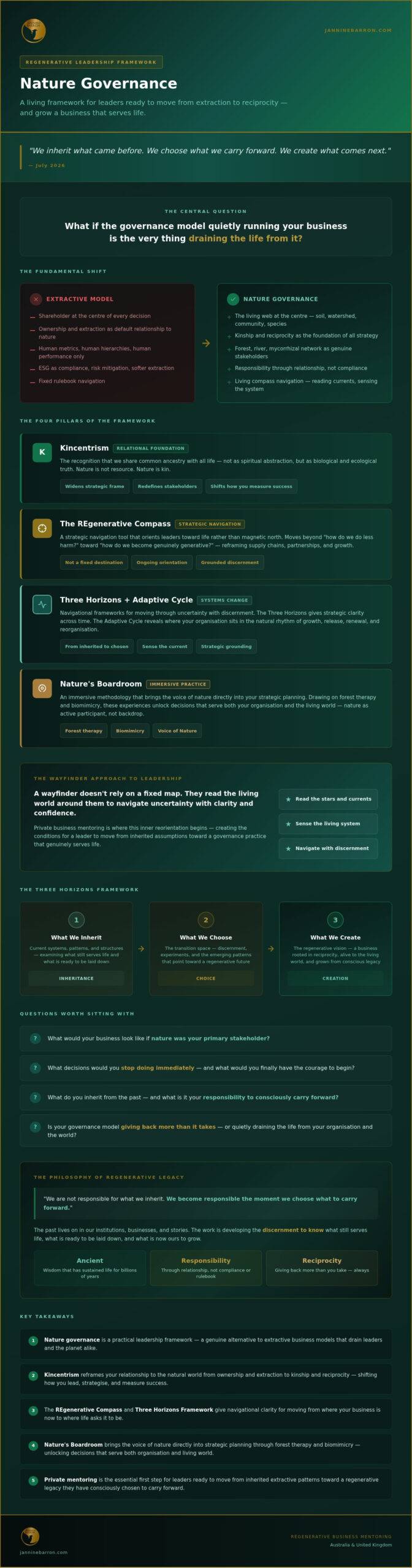
This guide is an invitation to cross a threshold. Drawing on the wisdom of Kincentrism, the navigational clarity of the REgenerative Compass, and the immersive practice of Nature’s Boardroom, you’ll discover a clear framework for decision making that serves life rather than depletes it. We’ll explore how to move through the Adaptive Cycle with discernment, how to honour what you inherit without being bound by it, and how to grow a business model rooted in reciprocity rather than extraction.
We inherit what came before. We choose what we carry forward. We create what comes next.
The path forward begins here.
Key Takeaways
- Nature governance is a practical leadership framework that aligns organisational decision making with the laws of living systems, offering a clear alternative to extractive business models that are quietly draining leaders and the planet alike.
- Kincentrism reframes your relationship to the natural world from one of ownership and extraction to one of kinship and reciprocity, fundamentally shifting how you lead, strategise, and measure success.
- Tools such as the REgenerative Compass and the Three Horizons Framework give you navigational clarity for moving from where your business is now to where life asks it to be, without losing strategic grounding along the way.
- Nature’s Boardroom offers an immersive methodology that brings the voice of nature directly into your strategic planning, drawing on forest therapy and biomimicry to unlock decisions that serve both your organisation and the living world.
- Private mentoring through The Growth Experience incubator is the essential first step for leaders ready to move from inherited extractive patterns toward a regenerative legacy they have consciously chosen to carry forward.
What is Nature Governance and how does it shift leadership?
Nature governance is the practice of aligning your organisational decisions with the laws of living systems rather than the logic of extraction. It asks a deceptively simple question: what if the intelligence that has sustained life on this planet for billions of years could also guide the way you lead, strategise, and grow? Not as metaphor. As method.
This is not another iteration of corporate sustainability. It’s a fundamental reorientation of who gets a seat at the table and whose voice shapes the future of your organisation.
Traditional governance models place the human, specifically the shareholder, at the centre of every decision. Nature governance dissolves that centre and replaces it with a web. The organisation becomes one node in a living system, accountable not only to its investors but to the soil, the watershed, the communities, and the species whose futures are quietly shaped by every strategic choice it makes. Grounded in the same regenerative principles that have transformed how we think about land stewardship, this framework now asks us to apply that same relational intelligence to how we lead.
From Extraction to Kincentrism
Kincentrism is the recognition that we share common ancestry with all life. Not as a spiritual abstraction, but as a biological and ecological truth that carries profound implications for how we govern organisations. Where standard leadership coaching focuses almost exclusively on human performance, human metrics, and human hierarchies, Kincentrism widens the frame entirely. It asks us to consider our kin, the forest, the river, the mycorrhizal network beneath our feet, as genuine stakeholders whose wellbeing is inseparable from our own.
Sit with this for a moment. What would your business look like if nature was your primary stakeholder? What decisions would you make differently? What would you stop doing immediately, and what would you finally have the courage to begin?
This is not soft thinking. It’s arguably the most rigorous governance framework available to a leader in 2026, because it accounts for the full complexity of the systems your organisation actually operates within.
The Role of the Wayfinder in Business
A wayfinder doesn’t rely on a fixed map. They read the stars, the currents, the wind, and the behaviour of living things around them to navigate through uncertainty with clarity and confidence. Nature governance provides exactly these navigational cues for the modern leader. It gives you a living compass rather than a static rulebook.
Developing this quality of discernment takes time and the right kind of accompaniment. Private mentoring is where this inner reorientation begins, creating the conditions for a leader to move from inherited assumptions toward a governance practice that genuinely serves life.
ESG frameworks and sustainability pledges were a beginning. But they were built within the same extractive logic they sought to soften. Responsibility without relationship is just compliance. Nature governance asks for something far more ancient, and far more alive.
Navigating the REgenerative Compass and Living Systems Frameworks
Every wayfinder needs a compass. Not one that points to magnetic north, but one that orients you toward life. The REgenerative Compass is exactly that: a strategic navigation tool designed to help leaders move from where their organisation currently sits to where the living world asks it to be. It doesn’t offer a fixed destination. It offers orientation, the capacity to read your surroundings, sense the current, and adjust your course with both intelligence and care.
Where conventional sustainability frameworks tend to focus on risk mitigation and compliance, the REgenerative Compass asks a fundamentally different question. Not “how do we do less harm?” but “how do we become genuinely generative?” That shift in framing changes everything, from how you assess your supply chain to how you evaluate a new partnership, from how you measure growth to how you decide when something has run its course.
The Three Horizons of Systems Change
The Three Horizons Framework gives shape to the transition many leaders feel but struggle to articulate. Horizon One is the present system, the extractive practices, the inherited structures, the ways of working that still generate revenue but are quietly losing their vitality. This horizon doesn’t collapse overnight. It requires conscious, compassionate management as it declines.
Horizon Two is the turbulent middle ground. This is where innovation lives, and where discomfort is greatest. Old certainties no longer hold, and new ones haven’t yet taken root. Leaders operating in this space often feel the pull of two worlds simultaneously. Nature governance provides the discernment to move through this threshold without retreating to the familiar or grasping prematurely at the new.
Horizon Three is the emerging future, a business model that genuinely serves life. Not as aspiration. As architecture.
Applying the Adaptive Cycle to Your Organisation
Living systems don’t grow in straight lines. They pulse. The Adaptive Cycle, drawn from ecological science, describes four phases that every healthy system moves through: growth, conservation, release, and reorganisation. Businesses are no different.
The growth phase is expansive and energising. Conservation is where things solidify, sometimes too rigidly. Release, the phase most leaders fear, is where what no longer serves is composted back into the system. And reorganisation is the quiet, fertile space before the next growth phase begins. Burnout, so often, is what happens when a leader refuses to honour the release phase, holding on to a project, a model, or an identity that is ready to be laid down.
We are not responsible for what we inherit. We become responsible the moment we choose what to carry forward.
Applying this cycle to your operations and supply chains means learning to ask: what is flourishing, what is stagnating, and what is ready to return to the earth so something more alive can grow in its place? If you’re ready to begin mapping your own cycle with clarity and support, private mentoring is where that discernment is cultivated.
Most strategic planning happens in rooms designed to exclude the living world. We sit in climate controlled boxes, surrounded by static walls and artificial light, then wonder why our solutions feel clinical or disconnected from the reality of our impact. Nature’s Boardroom is a radical departure from this tradition. It is a methodology that invites the Voice of Nature back into the centre of your organisation, transforming strategy from a purely intellectual exercise into a lived experience of relationship.
When we practice Nature’s Boardroom, we aren’t just taking a break from the office. We are engaging in a rigorous process of strategic immersion that uses forest therapy and biomimicry to unlock insights that simply cannot be reached through standard corporate logic. This is where nature governance moves from a concept on a page to a practice in the field, allowing leaders to sense the rhythms of the living systems they are part of.
Strategic Planning in the Wild
The boardroom environment often reinforces the very extractive thinking we are trying to evolve beyond. It encourages a sense of separation and control. In contrast, immersion days in Wiltshire, London, or Somerset provide a different kind of architecture for thought. Here, the complexity of the living world becomes our primary teacher.
How does a forest manage its resources during a drought? How does a mycorrhizal network distribute nutrients to where they are needed most? Nature provides ancient and proven metaphors for solving complex business problems. By stepping into these landscapes, we allow our creative thinking to mirror the resilience and efficiency of the ecosystems we inhabit. We stop trying to force growth and start learning how to cultivate the conditions for it.
Embodying the Voice of Nature
To lead regeneratively, we must move beyond talking about nature as if it were a resource to be managed or a legal checkbox to be ticked. We must learn to listen to it as a sovereign partner. This requires a shift from the noise of constant productivity to the profound intelligence of silence and observation. It is about developing the capacity to speak as part of nature rather than speaking for it.
During an immersion, we practice the art of deep listening. We learn to discern the Voice of Nature in the patterns of growth and decay around us. This isn’t an abstract exercise. It leads to concrete decisions about supply chains, product life cycles, and organisational culture. Leaders often find that a single day in the woods provides more clarity on a difficult choice than months of spreadsheets. It is the practice of developing the discernment to know what still serves life and what is now ready to be composted back into the earth.
Are you ready to hear what the living world has to say to your leadership?
Inheritance and Choice: The Ethics of Regenerative Legacy
Every business carries a history it did not choose. The extractive logic baked into your accounting software, the supplier relationships built on price rather than principle, the growth targets inherited from a previous decade’s assumptions about what success looks like. These are not your failures. They are the sediment of decisions made long before you arrived. But here, in July 2026, with the living world asking more of us than it ever has, a threshold presents itself. And crossing it requires something more demanding than awareness.
It requires choice.
We inherit what came before. We choose what we carry forward. We create what comes next.
This is not a comfortable sequence. It asks you to look clearly at what you’ve been handed, to hold it with honesty rather than defensiveness, and then to make a deliberate decision about what deserves to continue and what is ready to be composted back into the earth. That act of discernment is the ethical heart of nature governance.
The Moment of Responsibility
There is a liberating precision in the philosophy: we are not responsible for what we inherit. The moment responsibility arrives is the moment we choose what to carry forward. That distinction matters enormously, because guilt is paralysing and agency is generative. When leaders stop punishing themselves for the extractive systems they stepped into and start asking what they are now willing to do differently, something shifts. The burden becomes a compass. The weight of the past becomes the clarity of the present.
This is not work that happens in isolation. The regenerative mentor’s role is to sit with you in that threshold space, neither rushing you toward a tidy resolution nor allowing you to retreat into comfortable inaction. Private mentoring creates the conditions for this kind of honest, unhurried discernment, where what still serves life can be named, and what is ready to be laid down can be honoured rather than clung to.
Creating for Future Generations
Ancient cultures measured the wisdom of a decision by asking how it would land seven generations from now. That question feels radical inside a quarterly reporting cycle. But it’s arguably the most practical strategic filter available to a leader in 2026, because the systems we are building now will outlast our tenure, our business models, and perhaps our lifetimes.
What does this mean in practice? It means your supply chain decisions are legacy decisions. Your investment choices are inheritance choices. The culture you cultivate in your organisation is the story your successors will be handed, and they will have to decide what to carry forward from it.
Nature governance gives you the framework to make those choices with intention rather than inertia. It asks you to trace the thread from your current operations to their future consequences, and to tend that thread with the same care a forest tends its oldest trees. Not because it’s profitable in the short term. Because it’s what the living world asks of those who are paying attention.
What will the next generation inherit from the choices you make today?
If that question stirs something in you, begin the conversation that helps you answer it with clarity, courage, and the support of someone who has been walking this threshold for decades.
Transitioning Your Leadership: The Path of Private Mentoring
Understanding nature governance as a philosophy is one thing. Living it inside a real organisation, with real supply chains, real teams, and real quarterly pressures, is another thing entirely. This is precisely where private mentoring becomes not a luxury but a necessity. The gap between a compelling framework and daily operational reality doesn’t close on its own. It closes through relationship, through the patient, skilled accompaniment of someone who has been walking this terrain for decades.
Why Mentoring is the First Step
Regenerative transition asks you to question assumptions that have been rewarded your entire career. That’s not comfortable work, and it shouldn’t be done alone. What’s needed is a safe container, not a coaching programme that simply overlays new language onto old habits, but a genuine space to examine what you’ve inherited, what you’re ready to lay down, and what you’re being called to grow. The frameworks, the REgenerative Compass, the Adaptive Cycle, the Three Horizons, are powerful. But without someone to help you translate them into the specific rhythms of your industry, your team, and your own leadership edge, they remain beautiful ideas rather than living practice.
This is the balance that defines the mentoring work: rigorous technical systems thinking held alongside genuine care. Not one at the expense of the other. Both, simultaneously, in service of something larger than the next financial year.
The Growth Experience: A Nine Month Journey
The Growth Experience incubator is where this transition takes root. Over nine months, leaders move through a structured yet responsive process of inquiry, immersion, and integration. It isn’t a curriculum delivered at you. It’s a living relationship that evolves as you do, tracking the seasons of your organisation and the deeper cycles of your own readiness to lead differently. Each phase builds discernment: the capacity to know what still serves life in your business and what is now composting back into the earth, making space for something more generative to emerge.
Your Invitation to Lead Differently
Whether you’re leading a growing enterprise in Somerset, navigating complex stakeholder relationships in London, or stewarding a business across Australia, the path is available to you. Mentoring is offered both in person and online, meeting you where you are without requiring you to abandon the responsibilities that already hold your attention.
The living world isn’t waiting for the perfect moment. And neither, if you’re honest, are you.
If something in this guide has stirred recognition, that quiet knowing that the way you’ve been leading is costing more than it’s giving, then the next step is simply a conversation. Reach out to begin your discovery call and explore what it would mean to finally lead in a way that serves life, yours and the world’s, in equal measure.
We inherit what came before. We choose what we carry forward. We create what comes next.
The threshold is here. The choice is yours.
Your Living World Is Ready. Are You?
Nature governance isn’t a destination you arrive at. It’s a practice you grow into, season by season, decision by decision, with the right accompaniment alongside you. What this guide has mapped is a living framework: from the relational intelligence of Kincentrism, through the navigational clarity of the REgenerative Compass, to the immersive wisdom of Nature’s Boardroom. Each thread points toward the same invitation. Lead as if life matters, because it does.
The work begins not with a strategy document but with a single, honest question: what am I now willing to carry forward, and what is ready to be laid down? That question, held with courage and care, is where regenerative leadership takes root.
With a Wayfinder methodology cultivated since 2015 and Nature’s Boardroom immersion experiences that bring the Voice of Nature into the centre of your strategy, the support is here when you’re ready.
Book a private mentoring session and begin your nature governance journey today. The living world has been waiting. So, quietly, have you.
Frequently Asked Questions About Nature Governance
What is the difference between Nature Governance and traditional ESG?
ESG frameworks ask organisations to measure and reduce their negative impact, which is a meaningful beginning. Nature governance goes further by asking a different question entirely: not “how do we do less harm?” but “how do we become genuinely generative?” Where ESG operates largely within the existing logic of extraction, nature governance dissolves that logic at its root, replacing compliance with relationship and reporting with reciprocity.
The practical difference is significant. ESG can be satisfied with a spreadsheet. Nature governance asks you to change who you consider a stakeholder, how you define growth, and what you’re ultimately building the organisation for. It’s the difference between softening an extractive system and choosing to grow something fundamentally different in its place.
How can a small business implement Nature Governance without a large budget?
Nature governance doesn’t require a sustainability department or a six-figure consultancy. It begins with a shift in the questions you ask before making decisions: who else is affected by this choice, and what does the living world lose or gain from it? That reorientation costs nothing and changes everything. A small business can start by mapping one supply chain relationship through the lens of reciprocity and asking honestly whether it serves life or depletes it.
From there, private mentoring offers a proportionate entry point, working with the specific scale and rhythms of your organisation rather than applying a corporate template. The REgenerative Compass is a navigational tool, not a bureaucratic system, and it scales to the size of the hand that holds it.
What does it mean to give nature a voice in a boardroom?
It means treating the living world as a sovereign stakeholder rather than a backdrop to your operations. In practice, this can take several forms: asking “what would the watershed say about this decision?” as a genuine strategic filter, designating a role in meetings to speak on behalf of non-human systems, or using immersive experiences like Nature’s Boardroom to bring the intelligence of living ecosystems directly into your planning process.
This isn’t symbolic. When leaders practice listening to the Voice of Nature as part of their strategic process, they consistently report decisions that are more resilient, more honest about long-term consequences, and more aligned with the actual complexity of the systems their organisations operate within. The forest has been solving resource distribution problems for millions of years. It has something worth hearing.
Is Kincentrism applicable to tech or digital businesses?
Kincentrism is arguably most urgently needed in digital and tech businesses, precisely because those sectors can feel most insulated from the living world. The servers running your platform consume energy from a physical grid. The rare earth materials in every device your product runs on were extracted from a specific piece of earth. The attention economy your business participates in shapes the inner lives of human beings who are themselves part of nature. The distance is an illusion, not a fact.
Kincentrism asks a tech founder the same question it asks anyone else: what is your relationship to the living systems your work touches, and are you willing to treat them as kin rather than resources? The answer changes product design, data ethics, energy sourcing decisions, and the culture you build around your team. The digital world is not separate from the living one. It never was.
How does nature immersion actually help with business strategy?
The immersive methodology of Nature’s Boardroom works because it removes the cognitive architecture that keeps extractive thinking in place. Climate-controlled offices, artificial light, and back-to-back screens reinforce a particular kind of thinking: linear, controlled, and oriented toward short-term outputs. Stepping into a living landscape interrupts that pattern and activates a different quality of perception, one that’s more attuned to complexity, interdependence, and the kind of slow intelligence that produces durable decisions.
Leaders who spend a day in genuine immersion, practising deep listening and observing how a forest manages scarcity or distributes resources, often find that a strategic problem they’ve been circling for months resolves with unexpected clarity. It’s not mystical. It’s what happens when you consult a system that has been refining its answers for far longer than any business school has existed.
What is the Three Horizons Framework and how do I use it?
The Three Horizons Framework is a systems change tool that maps the transition from your current business model toward a genuinely regenerative one. Horizon One is your present operation, the structures and revenue streams that still function but are losing vitality. Horizon Three is the emerging future you’re building toward, a model that genuinely serves life. Horizon Two is the turbulent middle ground where the old and the new coexist uneasily, and where most of the real leadership work happens.
To use it practically, map your current activities across all three horizons honestly. Identify what belongs to Horizon One that you’re still over-investing in out of habit or fear. Notice what Horizon Three possibilities you’re already sensing but haven’t yet given permission to grow. The framework doesn’t tell you what to do. It shows you where you actually are, which is the only honest place to navigate from.
Can Nature Governance help prevent founder burnout?
Yes, and it does so by addressing burnout at its structural root rather than its symptomatic surface. Burnout in founders is frequently the result of refusing to honour the release phase of the Adaptive Cycle, holding on to a model, an identity, or a pace that the living system of the organisation is ready to shed. Nature governance gives you a framework for recognising that moment and responding with discernment rather than depletion.
There’s also something deeper at work. Many founders burn out not just from overwork but from a quiet grief: the sense that what they’re building costs the world more than it gives back. When your governance model genuinely aligns with your values and with the health of living systems, that grief lifts. You’re no longer fighting yourself. That shift alone changes the energetic quality of the work entirely.
How do I start a regenerative transition if my supply chain is extractive?
You start by choosing to look clearly at what you’ve inherited rather than defending it. Most extractive supply chains weren’t designed with malice; they were built within an extractive system that rewarded speed and cost above all else. The moment of responsibility, as the philosophy at the heart of this work holds, arrives not when you inherited those relationships but when you choose what to carry forward from them. That’s where your agency lives.
In practice, this means beginning with one relationship, one supplier, one material, and asking whether it could be redesigned around reciprocity rather than extraction. You don’t need to transform everything simultaneously. A regenerative transition is a living process, not a single event. Private mentoring provides the support to map that process honestly within your specific industry, tracing the thread from your current operations toward a supply chain that you’d be willing to name as part of your legacy.