
What if the persistent burnout you feel as a founder is not a sign of personal failure but a biological signal that your nature based business strategy has been ignored for too long? You likely recognise that the traditional corporate model depletes your spirit just as surely as it depletes the soil. It is a heavy burden to carry the guilt of a venture that takes more than it gives, especially when the distinction between basic sustainability and true regeneration remains so misunderstood by 72 percent of leaders in London and Sydney today. Private business mentoring is the essential first step to unlearn these extractive habits and begin listening to the voice of nature.
You deserve a leadership path that feels like a steady exhale rather than a frantic race toward exhaustion. This article promises a clear transition from extractive models to regenerative success using our comprehensive checklist for the 2026 landscape. We will step into natures boardroom to explore how Kincentrism transforms your operations into a thriving ecosystem. You will find a roadmap for growth that aligns with your deepest values and builds a resilient organisation that mimics the inherent health of the wild.
Key Takeaways
- Move beyond extractive models to embrace a regenerative approach that allows your organisation and the earth to flourish in unison
- Explore the core pillars of biomimicry and kincentrism to learn how emulating living systems creates enduring value for all species
- Implement a 10 point nature based business strategy checklist to ground your ethical brand in principles that prioritise long term ecosystem health
- Recognise why private business mentoring is the foundation of leadership coaching when seeking to birth new ideas with wisdom and care
- Step into natures boardroom to immerse your strategy in the voice of nature and find clarity away from traditional corporate constraints
What is a nature based business strategy and why does it matter?
A nature based business strategy is not a simple checklist of green initiatives or a carbon offsetting spreadsheet. It is a fundamental rewiring of how we create value by mimicking the wisdom of living systems. This framework moves beyond the traditional corporate architecture to embrace a model that generates regenerative value. By 2026, the landscape for UK and Australian leaders will have shifted dramatically. Legislative pressures like the UK Environment Act 2021 and Australia’s Nature Repair Act mean that ignoring our ecological impact is no longer a viable financial path. Understanding What are nature-based solutions provides the technical foundation for this shift, but the true transformation starts within the leadership heart.
The transition requires a move from extractive models that take from the earth to regenerative models that give back more than they consume. In this new era, the business owner acts as a wayfinder. You are not just a manager of resources; you are a steward of an ecosystem. This journey into nature based business strategy always begins with private business mentoring. We must first realign the leader’s internal compass before we can hope to heal the supply chain. By listening to the voice of nature, we find a blueprint for resilience that has been tested for billions of years.
To better understand this concept, watch this helpful video:
The difference between sustainability and regeneration
Doing less harm is no longer enough for our planet. Sustainability often aims for a neutral impact, which is essentially a slower way of dying. Regeneration is the active restoration of ecosystems and communities. It is about birthing new possibilities and ensuring that every transaction leaves the soil richer and the community stronger. The ultimate goal is flourishing. When we step into natures boardroom, we realise that Kincentrism is the only way forward. We stop seeing nature as a backdrop and start seeing it as a primary stakeholder in every decision we make.
Why traditional strategy often leads to founder burnout
The linear growth obsession in London and Sydney corporate cultures is a parasite. It demands constant expansion in a finite world, which is the exact definition of a cancer cell. Extractive habits within a business always mirror extractive habits with the self. If you treat your employees or your supply chain as things to be mined, you will eventually treat your own energy the same way. Many leaders find themselves exhausted by 2026 because they are fighting against natural cycles. Nature aligned leadership allows you to sustain personal energy by respecting the seasons of your business. We don’t expect a forest to bloom in the depths of winter; why do we expect our teams to produce peak results every single Monday? By adopting a nature based business strategy, we find a rhythm that supports both the planet and the person at the helm.
The core pillars of nature based business strategy
To build a resilient nature based business strategy, we must first unlearn the cold mechanics of the industrial age. We’re moving beyond the era of extraction into a time of deep remembrance. This shift requires us to view our organisations not as machines to be optimised, but as living systems capable of flourishing within the wider web of life. By integrating biomimicry and Kincentrism, we provide leaders with technical tools for systemic change that go far beyond standard sustainability reports. These pillars represent a fundamental rewiring of how we create value in the UK and Australian markets.
The financial logic for this shift is undeniable. Forward thinking leaders are already aligning their capital with planetary boundaries. The United Nations Environment Programme Finance Initiative provides a clear framework for this through their work on Investing in Nature based Solutions. When we treat nature as a stakeholder rather than a resource, we unlock innovations that have been refined by 3.8 billion years of evolution. This is the essence of a visionary leadership style that values life as much as profit.
Biomimicry in corporate structures
Biomimicry is the practice of learning from and then emulating natures forms and processes to solve human challenges. In the boardroom, this translates to structural innovation. We can organise teams based on mycelial networks to ensure information flows horizontally and reaches every corner of the organisation without the friction of traditional hierarchy. Mycelium doesn’t wait for permission to share nutrients; it responds to the needs of the whole system in real time.
Using natural feedback loops can also transform supply chain resilience. Just as a forest ecosystem adjusts to changes in rainfall, a regenerative business uses sensory data to pivot before a crisis hits. Ethical brands like Interface have famously used these principles to reduce their waste by 90 percent since 1996, proving that biological wisdom leads to superior operational performance. It’s about creating conditions conducive to life while maintaining a robust bottom line.
Practising Kincentrism in leadership
Kincentrism reshapes our relationship with the more than human world by inviting us to see ourselves as part of an extended family. Kincentrism is the recognition of our shared ancestry with all living things. When we adopt this perspective, our decision making processes naturally shift from being human centric to life centric. This isn’t just a philosophical exercise; it’s a practical method for fostering deeper empathy and better ethical outcomes in complex global markets.
In practice, this means listening to the voice of nature in the boardroom. We must ask how a new project affects the local watershed or the soil health of our suppliers. This approach replaces the clinical detachment of corporate coaching with a soulful commitment to the planet. If you feel called to begin this transition, private business mentoring is the essential first step in entering nature’s boardroom and reclaiming your role as a wayfinder for a regenerative future.
Comparing extractive models with nature based systems
The extractive model is a ghost of the industrial past. It prioritises the quarterly report over the century long legacy. This linear path relies on a take make waste logic that treats our planet as a bottomless pantry. In the United Kingdom; the hidden costs of this approach are becoming impossible to ignore. The World Economic Forum suggests that over half the global GDP is moderately or highly dependent on nature; yet we continue to deplete the very capital that sustains us. This creates a landscape of diminishing returns and increasing fragility.
Choosing a nature based business strategy isn’t just a moral shift; it’s a survival mechanism for the modern leader. Extractive systems create brittle organisations. They’re vulnerable to supply shocks and regulatory shifts. By contrast; a regenerative model builds resilience by mimicking the wisdom of the forest. This transition begins with the internal landscape of the leader. Private business mentoring serves as the essential first step; a sacred space to unlearn the habits of exploitation and begin the journey toward Kincentrism. It’s here that we birth a new way of being in business.
From linear supply chains to circular ecosystems
Moving away from the straight line of destruction requires a radical reimagining of how goods flow. A circular ecosystem doesn’t just recycle; it restores. To audit your supply chain for regenerative potential; you must look beyond tier one suppliers. Map every touchpoint where your business meets the earth. Are you nourishing the soil or poisoning the well? For those ready to align their operations with the rhythms of life; the process offers a structured pathway to strategic alignment. We look for opportunities to close loops and eliminate the very concept of waste.
The cost of ignoring the voice of nature
Ignoring ecological limits is a fast track to financial instability. In the UK; biodiversity loss poses a direct threat to sectors ranging from agriculture to construction. When we silence the voice of nature in the boardroom; we miss the early warning signs of systemic collapse. Forward thinking leaders now treat the environment as a primary stakeholder in every meeting. This isn’t abstract; it’s about risk management. The nature based solutions for business framework provided by the UN Global Compact Network UK highlights how protecting ecosystems protects profits. Whether you’re managing a tech hub in London or a vineyard in the Barossa Valley; the laws of biology apply. We must move from being owners to being stewards; ensuring our legacy is one of abundance rather than exhaustion.
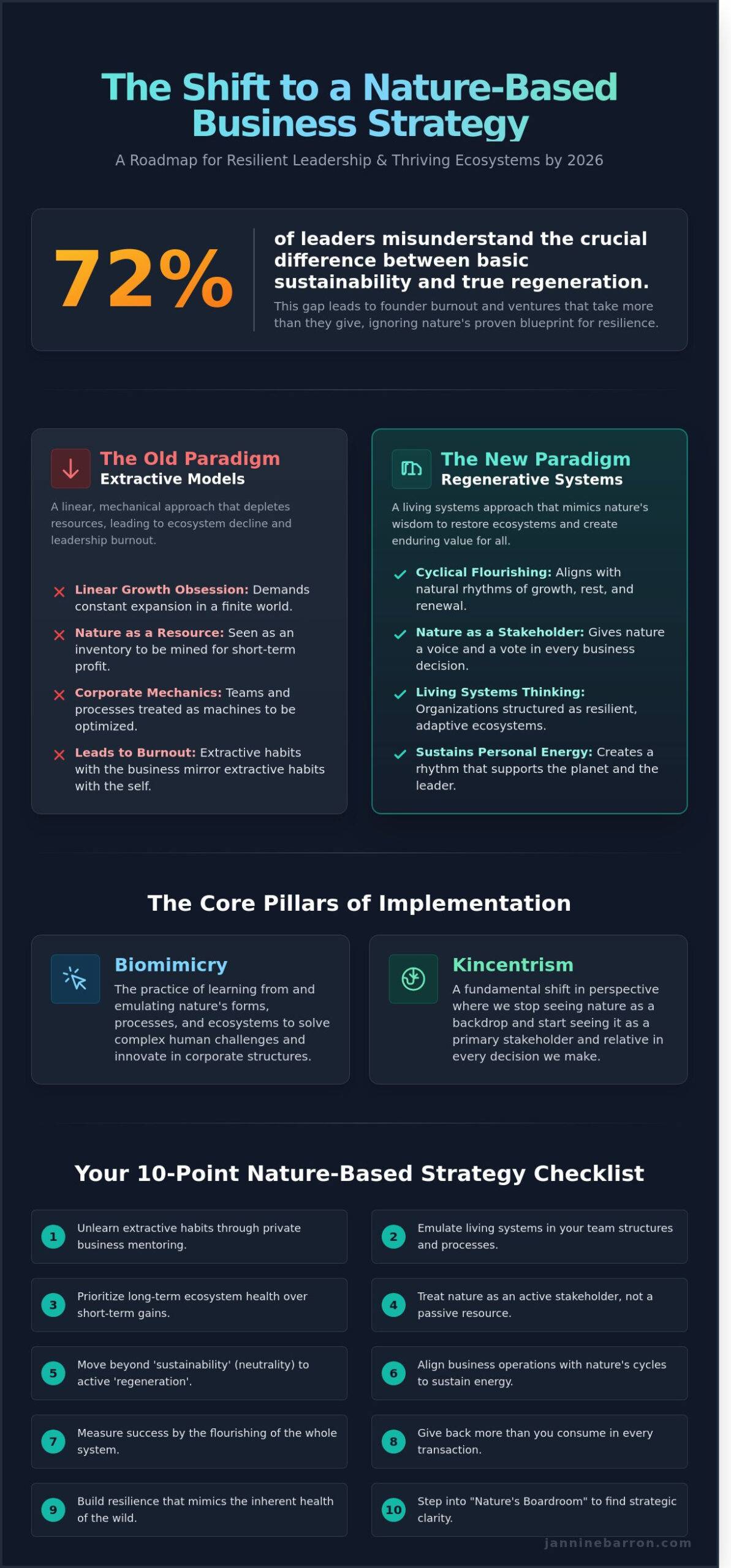
A nature based business strategy checklist for ethical brands
True leadership requires us to stop viewing the environment as a resource to be extracted and start seeing it as a partner to be nurtured. As we look toward 2026, your nature based business strategy serves as a wayfinder through the complexities of a changing climate. It’s a map for the soul of your organisation. Whether you’re rooted in the lush valleys of Somerset or the ancient landscapes of Australia, this checklist anchors your vision in regenerative reality. It invites you to step out of the clinical boardroom and into a space where life thrives.
The 10 point regenerative checklist
- Assess local ecosystem impact: Quantify how your operations affect the 16 percent of UK species currently at risk of extinction according to the State of Nature report.
- Listen to the voice of nature: Before signing any major contract, spend time in natures boardroom to ensure the decision aligns with biological health.
- Design for seven generations: Evaluate if your 2026 growth plans will still provide value and vitality for the children of the year 2196.
- Prioritise community resilience: Ensure your profit model directly supports local social infrastructure in Wiltshire or your specific Australian bioregion.
- Embrace Kincentrism: Shift your corporate governance to recognise the plants, animals, and waterways in your supply chain as kin with inherent rights.
- Audit supply chain ethics: Trace every material back to its source with the same care and love you’d give a family heirloom.
- Implement circularity: Aim for a zero waste model where every output becomes a biological or technical nutrient for another system.
- Protect water health: Actively restore local watersheds, ensuring your business footprint leaves the River Avon or local aquifers cleaner.
- Nurture soil vitality: Support regenerative agriculture within your procurement to heal the earth that feeds your employees and customers.
- Engage in private business mentoring: Recognise that your personal transformation as a leader is the essential first step for any systemic change.
Local considerations for UK and Australian leaders
In the United Kingdom, the 2021 Environment Act has fundamentally transformed the legal landscape for businesses. Since February 2024, the Biodiversity Net Gain requirement mandates a 10 percent increase in biodiversity for new developments. Ethical brands in Somerset and Wiltshire don’t just meet these quotas; they exceed them by weaving local restoration into their core mission. It’s about moving beyond mere compliance toward true stewardship of the land.
For global founders with ties to Australia, integrating indigenous wisdom is vital for a holistic nature based business strategy. The practice of Caring for Country offers a 60,000 year old blueprint for sustainable management that modern commerce is only just beginning to understand. By listening to Traditional Owners and applying these ancient principles to modern supply chains, you create a strategy that’s both timeless and innovative. This cross pollination of wisdom between the northern and southern hemispheres allows for a more resilient business model. If you’re ready to begin this journey, private business mentoring provides the necessary space to birth these new paradigms.
Implementing your strategy through leadership and natures boardroom
A nature based business strategy requires more than a board vote; it demands a shift in the very seat of your power. Leaders in the UK and Australia are finding that the old walls of glass and steel no longer provide the clarity needed for the 2026 economy. You must move from being a commander of resources to a regenerative wayfinder. This is not a soft shift. It’s a rigorous realignment of your supply chains and systems toward life.
The transition to a regenerative model is as much about your internal landscape as it is about your external policy. When you lead from a place of connection, your decisions carry the weight of legacy. You stop looking for short term wins and start looking for ways to ensure your organisation flourishes for generations. This is how we move beyond sustainability into true regeneration.
Stepping into natures boardroom
In the ancient landscapes of Wiltshire or the hidden green pockets of London, a different kind of meeting takes place. Natures boardroom is both a physical destination and a mental state for strategic immersion. During an immersion day, the forest acts as a mirror for your most complex business hurdles. You might arrive with a tangled supply chain issue or a culture crisis and find that the patterns of the woodland offer the exact structural solution you need.
Research from 2024 suggests that just 120 minutes in nature each week significantly improves cognitive function and decision clarity. In this space, you listen to the voice of nature to guide your next move. You can find out more about these immersive days at natures boardroom where we bridge the gap between the forest and the executive suite. The silence of the trees allows for a level of reflection that no city office can provide.
The role of the regenerative business mentor
Private business mentoring is the essential first step in leadership coaching. You cannot navigate this transition alone because the systems we were trained in are the very ones we must now evolve. A mentor provides the structural support required to dismantle old habits and birth new, life affirming models. This is about Kincentrism; recognising that your business is part of a wider ecosystem that requires care and reciprocity.
Whether you are managing a £10 million portfolio or a boutique agency, implementing a nature based business strategy requires a guide who understands both the profit and loss statement and the seasonal cycles of growth. I invite you to explore the programmes for the long term support your legacy deserves. Together, we can ensure your business becomes a force for healing the planet while maintaining its commercial vitality.
Your first step is simple. Step outside. Breathe. Then, book a consultation to begin the process of unlearning. The future of your organisation depends on your ability to lead with the earth in mind. It’s time to take your seat in the boardroom that has been waiting for you for millions of years.
Stepping into the light of a regenerative future
The transition from extractive models to a nature based business strategy isn’t just a trend for 2026; it’s a necessary evolution for UK and Australian organisations. By moving away from exploitation and embracing Kincentrism, leaders align their supply chains with the rhythmic cycles of our planet. We’ve explored how natures boardroom provides a structural framework for this shift, ensuring your brand operates as a life affirming force rather than a drain on our shared ecology.
True transformation requires more than a checklist. It demands a profound shift in how we perceive our role as stewards. I apply over 30 years of ethical business experience and Red Dot Design Award level thinking to help you birth a strategy that thrives. As an active mentor for global regenerative incubators, I’ve witnessed how the voice of nature can transform a boardroom into a sanctuary of collective growth and resilience.
Your journey towards a regenerative legacy begins with personal leadership and deep reflection. Book a private mentoring session to begin your regenerative journey and discover how to lead with the wisdom of the wild. The path is open, and the invitation is yours to accept.
Frequently Asked Questions
How do I start a nature based business strategy if I am already running a company?
You begin by conducting a deep audit of your current relationship with the living world to identify where your operations intersect with local ecosystems. Transitioning to a nature based business strategy starts with observing your supply chain as a living system rather than a linear machine. In 2024, 73 percent of UK executives reported that nature related risk is now a material financial priority for their boards. You must first listen to the land your office or factory sits upon to understand the unique requirements of your specific bioregion.
What is the difference between sustainability and a regenerative business model?
Sustainability aims to do less harm and maintain the current state of things, while regenerative models actively heal and restore the ecosystems they touch. A sustainable business might reach net zero, but a regenerative one creates a net positive impact on biodiversity and soil health. The 2023 State of Nature report shows that UK wildlife has declined by 19 percent since 1970. Regenerative strategies aim to reverse these specific losses by weaving life giving cycles into your core business operations.
Can a nature based strategy actually increase my profit margins?
Adopting a nature based business strategy can significantly increase your margins by reducing waste and building long term resource resilience. Research from the World Economic Forum indicates that nature positive transitions could generate £8 trillion in annual business value globally by 2030. By mimicking efficient natural systems, companies often see a 15 percent reduction in resource and energy costs. This isn’t just about saving the planet; it’s about ensuring your business thrives in a resource constrained economy.
How does the voice of nature help with technical business decisions?
The voice of nature acts as a non human stakeholder that guides technical choices through the lens of long term viability and evolutionary success. When you bring the voice of nature into your boardroom, you stop making decisions based on quarterly cycles and start looking at seven generation impacts. In Australia, the 2022 State of the Environment report highlighted how failing to listen to ecological signals leads to infrastructure fragility. Technical decisions then become about alignment with local watersheds and the inherent wisdom of the land.
Why is private mentoring considered the first step in leadership coaching?
Private mentoring is the essential first step because leadership transformation must happen within your own heart before it can manifest in your organisation. You cannot lead a regenerative system if your own internal landscape is depleted and burnt out. This deep, one on one work allows a leader to step into natures boardroom with clarity and the courage to act. It provides the safe space needed to unlearn extractive habits and birth a new way of being that serves both people and planet.
What are some examples of biomimicry used in business strategy?
Business strategy often looks to the fungal wood wide web to design decentralised communication networks that share resources during times of crisis. Another example is the Kingfisher inspired design of high speed trains, which reduced energy use by 15 percent and eliminated noise pollution. In the UK, companies are using the structure of coral reefs to build resilient, modular supply chains that can withstand external shocks. These biological blueprints provide 3.8 billion years of research and development that your company can access for free.
How can I practice Kincentrism without sounding too spiritual to my board?
Frame Kincentrism as a sophisticated risk management and stakeholder engagement framework that ensures the security of your essential resources. Explain that acknowledging our kinship with the living world is a data driven approach to supply chain health and brand longevity. You can cite that 50 percent of global GDP is moderately or highly dependent on nature. When the board understands that pollinators are essential partners in a £400 million agricultural supply chain, Kincentrism becomes a logical business necessity.
Is this approach suitable for small businesses in the UK and Australia?
This approach is perfectly suited for small businesses in the UK and Australia because they are more agile and connected to their communities than large corporations. Small enterprises make up 99 percent of the UK business population and are often the first to feel the impact of environmental changes. Whether you are a boutique agency in London or a small farm in New South Wales, the principles of regeneration apply. Smaller teams can implement changes 40 percent faster than multinational firms, making them the true pioneers of the new economy.