
It’s time to step into natures boardroom and listen to the voice of nature. By adopting the voice of nature in your organisation, you can move beyond mere sustainability as a strategy and into true regeneration. This guide offers a wayfinder’s path to realigning your business with the intelligence of living systems. We’ll start with the essential first step of private business mentoring to ground your personal transformation. You’ll discover a pragmatic framework to shift from a mindset of scarcity to one of ecosystemic belonging. This journey will transform your business into a biological force that allows your legacy to flourish.
Key Takeaways
- Regenerative business goes beyond sustainability
It is not just about reducing harm, but actively contributing to the health and renewal of living systems.
- The voice of nature is the next step
The shift is from seeing nature as a resource to recognising it as a participant in decision making and governance.
- This changes how decisions are made
Including nature leads to longer term thinking, more resilient strategies, and a move away from extractive growth.
- Regenerative leadership requires a different way of listening
Clarity comes from tuning into patterns, timing, and relationships, not just data and plans.
- Small shifts create real change
Simple practices like slowing down, considering ecosystem impact, and designing for renewal begin to reshape business at its core.
What is the voice of nature and why does it matter for modern business?
For decades, business has been designed around human needs, human timelines, and human measures of success. Even in purpose driven and sustainable models, nature has largely been treated as a resource to manage, protect, or minimise harm to.
That is now changing.
A new frontier is emerging in regenerative business. One that moves beyond sustainability and into relationship. One that asks a far more fundamental question:
What would it mean for nature to have a voice in business?
From Sustainability to Regenerative Business
Traditional sustainability focuses on reducing negative impact. It aims to do less harm.
Regenerative business goes further. It asks how business can actively contribute to the health of living systems. It sees organisations not as machines, but as part of a wider ecological system.
This shift is already influencing future fit business models, regenerative leadership, and nature aligned strategy. But many organisations are still approaching regeneration through human interpretation alone.
The next step is more radical.
It is to include nature not just as context, but as participant.
The Voice of Nature in Business
The idea of the voice of nature is gaining traction across progressive organisations, legal frameworks, and leadership spaces.
It can take many forms:
- Nature represented in governance structures
- Decision making informed by ecosystems and place
- Leadership practices rooted in ecological awareness
- Direct practices that listen to land, cycles, and living systems
This is not symbolic. It is a practical evolution in how decisions are made.
When nature is given a voice, businesses begin to:
- Make longer term, more resilient decisions
- Shift from extractive growth to regenerative growth
- Align strategy with natural cycles rather than constant output
- Build deeper trust with communities and stakeholders
This is where regenerative business strategy becomes truly differentiated.
Why This Is the Next Frontier
We are living through overlapping crises, ecological, economic, and social. Many business owners are already sensing that existing strategies no longer hold.
Planning harder is not the answer.
What is needed is a different orientation.
Including the voice of nature introduces:
- A wider intelligence beyond human bias
- A grounding in reality rather than abstraction
- A way to navigate uncertainty through relationship, not control
This is why many are now exploring nature led business, ecological governance, and business as a living system.
Because the old maps no longer match the territory.
Regenerative Leadership and Listening to Nature
At the heart of this shift is regenerative leadership.
This is not about adding another framework. It is about developing the capacity to listen differently.
To listen:
- Beyond data, into patterns
- Beyond urgency, into timing
- Beyond strategy, into relationship
Practices such as immersion in natural environments, reflective decision making, and collective sensing are becoming part of how leaders access this intelligence.
This is where clarity emerges.
Not from doing more, but from seeing more clearly.
Bringing Nature into Business Practice
For small businesses and founders, this does not need to be complex.
It can begin with simple but profound shifts:
- Slowing decision making to allow deeper insight
- Considering the impact of choices on the wider ecosystem
- Designing business models that support renewal, not depletion
- Creating space to listen to what is emerging, not just what is planned
This is how regenerative business models take shape in real terms.
Not through theory, but through practice.
A Different Future for Business
The integration of nature is not a trend.
It is a return.
A return to seeing business as part of life, not separate from it.
As more organisations begin to include the voice of nature, we will see a shift from control to participation, from extraction to reciprocity, from short term gain to long term vitality.
This is the next frontier of regenerative business.
And those who begin now will not only adapt more effectively, they will help shape what comes next.
This leadership style aligns closely with the philosophy of Deep ecology, which argues that all life forms have intrinsic value. When we embrace this, our business mentoring moves beyond simple profit margins. It becomes a sacred practice of stewardship. We start to see that a healthy bottom line is impossible on a dying planet. By honouring the inherent worth of the more than human world, we find more resilient ways to grow. We stop trying to dominate the market and start trying to nourish the soil in which we all stand. It is a path of radical empathy and deep responsibility.
The core principles of kinship in an organisational context
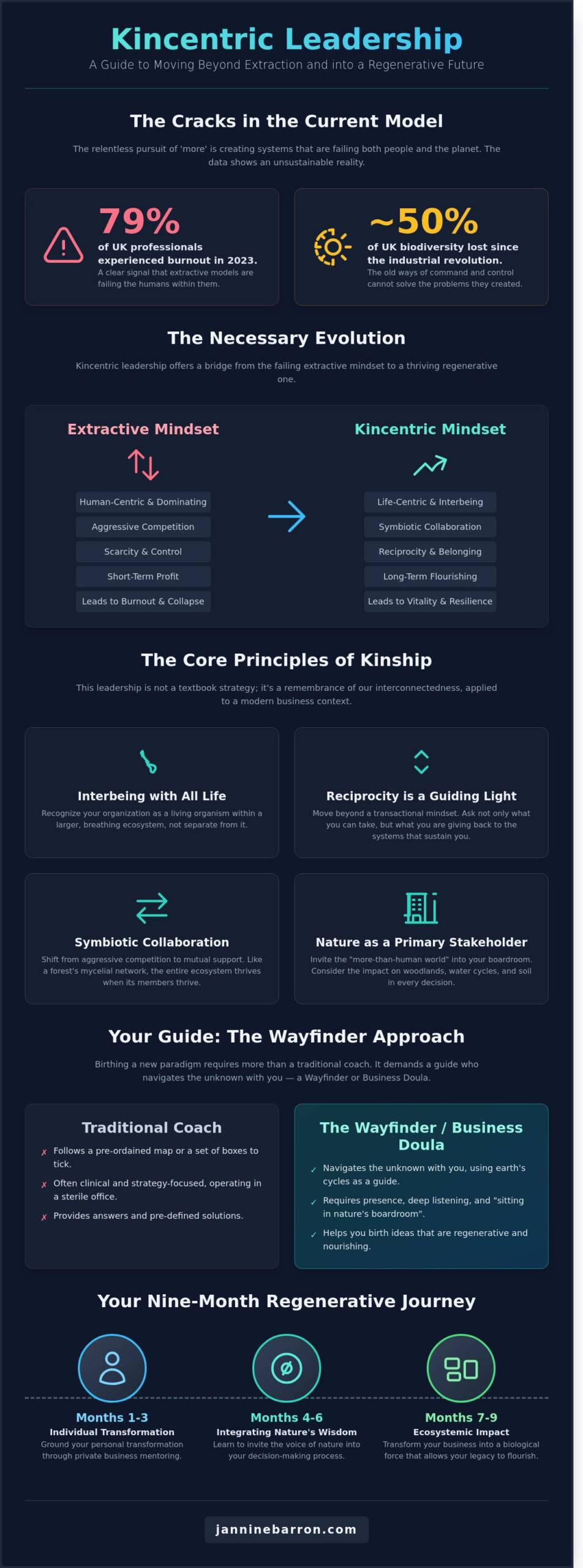
In a kincentric framework, we recognise the more than human world as a primary stakeholder. This means considering the impact of a new UK warehouse on local ancient woodlands or water cycles. We move from aggressive competition to symbiotic collaboration. Much like the mycelial networks in an old growth forest, businesses thrive when they support the health of their neighbours. Reciprocity becomes our guiding light. We ask what we are giving back to the ecosystems that sustain our operations. This is the foundation of a truly ethical business ecosystem. Kincentrism is one of The 13 Wisdoms and you can download your copy of that here.
From extraction to regeneration: A necessary evolution
Extractive models are a primary cause of founder burnout. When we treat ourselves and the earth as mere resources to be mined, we eventually run dry. In Australia, Aboriginal and Torres Strait Islander people have practised kincentric stewardship for over 60,000 years, viewing Country as a relative rather than a commodity. We must learn from this wisdom. A regenerative future is one where business actively heals the damage of the past. It is about birthing ideas that allow both people and the planet to flourish. Kincentricity acts as the vital bridge between ancient wisdom and the future of business.
The Wayfinder approach: Navigating leadership with a business doula
Traditional business coaching often feels clinical; it’s a series of boxes to tick in a sterile office. Kincentrism offers a different companion. It requires a wayfinder. This isn’t about following a preordained map. It’s about navigating the unknown with a mentor who understands the rhythmic cycles of the earth. I step into the role of a business doula because birthing a new paradigm requires more than just strategy; it requires presence. You aren’t just managing a team; you’re tending a living ecosystem.
Mentoring as the foundational first step
Private mentoring is the essential first step because it creates a sanctuary for unlearning. You cannot lead a regenerative organisation while still clinging to extractive habits developed in old corporate structures. This phase integrates personal healing with professional growth; it’s a realisation that the leader’s internal state dictates the health of the entire company. In the UK, where over 2,000 companies have now certified as B Corps as of early 2024, the shift toward purpose is clear. However, certification is only the surface. Deep change requires the process of transitioning to nature aligned leadership through consistent, soulful guidance. We look at your legacy not in years, but in generations. This is where we deconstruct the pressure of quarterly growth to find a more natural, sustainable pace.
Poetic pragmatism in the corporate world
We must balance soulful inquiry with hard business metrics. This is what I call poetic pragmatism. It’s the ability to look at a balance sheet and a forest with the same level of reverence. You can talk about supply chains with love. When we view a supply chain as a web of relationships rather than a series of transactions, the quality of our engagement changes. We begin to see that regenerative agriculture isn’t just a farming technique; it’s a blueprint for how we can structure our businesses to give back more than they take. This perspective is particularly resonant in Australia, where indigenous wayfinding has long taught that we don’t own the land; we belong to it. Applying this to a UK corporate context means creating a culture of care that extends to every courier, every supplier, and every customer.
Creating this culture isn’t a soft option. It’s a rigorous commitment to excellence and empathy. By early 2025, it’s estimated that ethical consumer spending in the UK will exceed £100 billion. This isn’t just a trend; it’s a fundamental shift in how people want to interact with the economy. If you feel the call to lead from a place of deep connection, you might find that regenerative business mentoring provides the clarity you need to begin this transformation. We don’t just plan for the next financial year; we plant seeds for a future where all life can thrive.
Hearing the voice of nature in your boardroom
Imagine the boardroom table stretching beyond four walls to include the rustle of leaves and the steady pulse of the soil. This isn’t a retreat from reality; it’s a deep dive into the most sophisticated intelligence system on Earth. When we practice kincentrism and the voice of nature, we acknowledge that nature is a silent partner in every transaction and every strategy. We stop viewing the environment as a resource to be extracted and start seeing it as a mentor to be consulted. This shift requires us to invite the more than human world into our decision making processes, treating the health of a local river or the biodiversity of a forest with the same gravity as our quarterly profit margins.
To hear this voice, leaders must first cultivate a radical form of listening. It begins with private business mentoring that prioritises the internal landscape of the leader. Before you can hear the forest, you must quiet the noise of the traditional corporate ego. Many executives I work with find that their best ideas don’t arrive behind a screen; they emerge when they allow the landscape to speak back to them. This approach mirrors Indigenous leadership principles in practice, where stewardship and kinship form the bedrock of governance. By honouring these ancient wisdoms, we move from being exploiters to being ancestors in training.
Natures boardroom: Strategy sessions in the wild
Traditional indoor meetings often trap us in linear thinking and repetitive patterns. Stepping into the wild landscapes of Wiltshire or the rolling hills of Somerset breaks these mental circuits. These immersion days aren’t simple walks; they’re structured encounters with the living world. A 2022 study by the University of Exeter showed that spending 120 minutes a week in nature significantly boosts cognitive flexibility. When we take a team into natures boardroom, we unlock creative problem solving that remains dormant in sterile environments. In these spaces, the scale of an ancient oak or the flow of a stream provides a physical metaphor for organisational health. It allows for a level of honesty and self reflection that modern office culture rarely permits. We don’t just talk about sustainability; we feel the weight of our responsibility to the land beneath our boots.
Biomimicry as a leadership tool
Nature has had 3.8 billion years to perfect its R&D department. Our businesses can learn everything they need to know about resilience and efficiency from natural ecosystems. Consider the mycelium networks that connect a forest; they distribute nutrients where they’re needed most, ensuring the whole system thrives rather than just a few dominant trees. Applying this forest intelligence to team dynamics transforms how we view competition and collaboration. Instead of silos, we create interconnected webs of support.
- Natural Cycles: Use the seasons to inform product development. Winter is for rest and gestation; Spring is for the birth of new ideas.
- Resource Efficiency: In nature, waste is always food for another process. We must design our supply chains to mimic this circularity.
- Resilience: Look to the Australian bush, where many species require the heat of fire to release their seeds. This teaches us how to use crisis as a catalyst for regeneration.
By adopting **kincentrism as part of a regenerative business outlook **we stop fighting against the natural order and start flowing with it. One UK based textile company recently reported a 22% increase in staff retention after integrating nature based strategy sessions into their annual planning. They didn’t just change their policies; they changed their relationship with the world around them. This is the path of the wayfinder: leading with a heart that beats in time with the earth.
Practising kincentricity in the UK and Australia
Leaders manage global supply chains from glass towers while the living world calls for a deeper, more visceral response. Kincentrism requires us to stop viewing the land as a mere backdrop for profit and start seeing it as our primary stakeholder. In the UK, the 2023 State of Nature report revealed that 1 in 6 species face extinction. This is not just an ecological statistic; it’s a boardroom crisis. Our organisations cannot thrive on a dying planet. By bringing the voice of nature into our strategic planning, we move from extractive models to regenerative ones that honour our shared ancestry with the earth. This shift requires a wayfinder’s heart and a strategist’s mind.
Local immersion: From Salisbury to Glastonbury
Place based leadership in the UK begins with the soil beneath our feet. The ancient ley lines stretching from the chalk ridges of Salisbury to the mystical heights of Glastonbury Tor offer more than just scenery. They provide a historical blueprint for resilience. Walking these paths allows a leader to ground their global strategy in something permanent. A 2024 survey showed that 40% of UK business leaders feel disconnected from their core purpose. Stepping into natures boardroom among the ancient oaks of the West Country restores that vital connection. It turns a cold business plan into a living legacy. These landscapes teach us about cycles, seasons, and the patience required to grow something that lasts centuries. We learn to lead with the rhythm of the land rather than the frantic pace of the stock market.
Australian perspectives on kincentrism
The Australian ecosystem offers a different set of lessons, primarily rooted in fire and incredible endurance. While the UK forest whispers of slow growth, the Australian bush speaks of radical renewal. Indigenous wisdom, spanning over 65,000 years, provides the ultimate framework for kincentric leadership. It teaches us that we belong to the land; the land does not belong to us. Australian businesses within the B Corp community, which grew by 30% in 2022, are increasingly integrating these ancient land connections. They use the "bushfire" as a metaphor for clearing away stagnant corporate structures to make room for new growth. This parallel between the damp English woodland and the sun scorched Australian scrub creates a global network of regenerative leaders. We learn that whether we are in a London office or a Sydney studio, our duty of care remains the same. We are all bábáskodás, or midwifing, a new way of being in business.
The challenges of the climate crisis demand that we build a global network of leaders who are not afraid to love the world they seek to change. This connection across hemispheres strengthens our collective resilience. It allows us to share lessons from the fire and the frost, ensuring our businesses are as adaptable as the ecosystems we inhabit. When we lead from this place of deep connection, our decisions carry more weight and our impact reaches further. We become leaders who don’t just survive the future but actively create a world where all life can flourish.
Your journey toward becoming a regenerative leader starts with a single, intentional conversation. If you feel ready to invite the voice of nature into your business, explore my private business mentoring to begin your transformation.
Your journey toward a regenerative future
Transformation is not a linear sprint; it is a seasonal cycle that requires a dedicated container to hold the weight of change. The nine month incubator serves as this sacred vessel. It allows you to move beyond the frantic pace of traditional corporate growth and enter a rhythm that mirrors the natural world. This duration is intentional. Just as it takes 270 days for a human life to prepare for birth, this period allows for the gestation of a new kind of leadership. You learn to stop acting as a solitary force and start behaving as a vital node within a living web. This shift from individual ego to ecosystemic presence is the heart of kincentric leadership.
In the United Kingdom, the 2023 State of Nature report highlighted that one in six species is at risk of extinction. This reality demands that business leaders stop viewing the environment as an external resource and start seeing it as family. When you adopt this perspective, your strategic goals realign with the health of the biosphere. You begin to invite the voice of nature into your decision making processes, ensuring that every pound of profit contributes to the restoration of the commons. This transition creates long term benefits that extend far beyond the balance sheet. It fosters a culture of deep belonging and psychological safety within your organisation, which is essential when 72 percent of UK workers now seek employers with strong environmental values according to 2023 Deloitte data.
My approach often draws from the resilient landscapes of Australia, where the ancient wisdom of the First Nations people teaches us about the interconnectedness of all things. By weaving these "deep time" perspectives into our modern business context, I help you find your footing as a wayfinder. This isn’t about following a prepackaged map; it’s about learning to read the terrain of the future with clarity and heart.
Taking the first step with private mentoring
The evolution of your business can only go as far as your own personal growth allows. Private mentoring serves as the foundational first step because it creates a direct channel to your inner wisdom and the voice of nature. We often hold our sessions in nature’s boardroom, where the distractions of the digital world fade and the clarity of the forest or the coast takes over. This nature aligned mentoring has an immediate impact on your wellbeing, reducing cortisol levels and opening the mind to creative problem solving that is impossible within the confines of a grey office. By 2025, the UK requirement for Biodiversity Net Gain will make these ecological insights a competitive necessity for every forward thinking director. I invite you to book a discovery call today to begin your wayfinder journey and step into your role as a guardian of the future.
Stepping into your role as a good ancestor
The boardroom is no longer a place for isolated decisions. It’s time to invite the voice of nature into your strategy sessions to ensure every choice nourishes the whole. With 30 years of experience in ethical business and a background as a featured speaker on regenerative strategy, I’ve seen how the shift from extraction to restoration creates a legacy that truly breathes. Embracing kincentrism means recognising that your organisation is a living system rather than a cold machine.
Whether we’re walking the ancient landscapes of Somerset and Wiltshire during a Natures Boardroom immersion or navigating the specific ecological challenges of the Australian market, the path remains the same. You need a wayfinder to help you birth these new paradigms. Your business has the potential to be a biological force for good. It starts with a single, intentional conversation to realign your leadership with the rhythm of the earth.
Begin your journey with private business mentoring as the foundational first step toward a thriving future. You aren’t just building a company; you’re nurturing a world where life can flourish for generations to come.
Frequently Asked Questions
What exactly is kincentrism in a business context?
Kincentric leadership is the practice of treating every element of your business ecosystem as a respected relative rather than a mere resource. It shifts the focus from extractive profit to a regenerative model where the voice of nature has a seat at the boardroom table. This approach acknowledges that 100 percent of our economic activity relies on the health of our planet. By adopting this mindset, you begin to lead with a deep sense of care for the community and the soil that sustains us.
Do I need to be in nature to practice kincentric leadership?
You do not need to be standing in a forest to practice kincentric leadership, although immersion in natures boardroom certainly accelerates the shift. Kincentricity is a state of mind that you carry into every video call and spreadsheet. It is about asking how a decision affects the next seven generations while you are sitting in a concrete office in London. However, spending time outdoors helps you hear the voice of nature more clearly and grounds your leadership in the reality of the living world.
How long does it take to transition to a regenerative business model?
A full transition typically takes between 3 and 5 years to move from extractive habits to truly regenerative ones. The first 12 months are usually dedicated to unlearning the old paradigms of growth at any cost. You will start seeing shifts in team culture and engagement within the first 90 days of our work together. It is a steady process of rewilding your corporate structures. Patience is essential because you are growing an ecosystem, not just building a product.
Is this approach suitable for startups or only established brands?
Regenerative Business is ideal for both because startups can bake these values into their DNA from day one. Established brands often face more complexity, but 2023 B Corp data shows that purpose led companies grow 28 percent faster than the UK national average. Starting with kincentric principles saves you the pain of retrofitting your values later. Whether you are a solo founder or leading a team of 50, the path remains the same. It is about how you choose to show up in the world.
How can I join a natures boardroom immersion day in the UK?
You can join a natures boardroom immersion day by booking a discovery call to see if our energies align for this deep work. These sessions are held in ancient woodlands across the UK, typically costing around £400 per person for a full day of guided reflection and strategy. The experience can be richer when combining this with some private regenerative business mentoring or coaching to assist your transformation and packages start at £2000 It is a powerful way to experience the kincentric approach first hand and many leaders find this the most transformative day of their professional year.