
What if the most vital evidence of your organisation’s success cannot be found on a spreadsheet? You likely feel the weight of complex reporting frameworks pressing down on your daily operations, yet there is a nagging sense that the true heartbeat of your work remains uncaptured. When we look through the lens of the principles of regenerative business, we begin to see that impact is not a static number to be harvested but a living relationship to be tended. It’s time to ask if your metrics are feeding the soul of your mission or simply filling a box.
I know the exhaustion that comes from trying to quantify the unquantifiable. It’s easy to feel a disconnection between your long term legacy and the clinical metrics demanded by traditional systems. This article invites you to step into a different rhythm, one where we listen to the Voice of Nature to discern the true inheritance of your work through the lens of Kincentrism. You’ll discover how to move beyond rigid data and align your growth with the wisdom of natural systems. We’ll explore how tools like the REgenerative Compass can help you find clarity on what to carry forward. As I noted in July 2026, we inherit what came before. We choose what we carry forward. We create what comes next. Let’s develop the discernment to know what still serves life.
Key Takeaways
- Learn to move beyond the spreadsheet to define social impact as a life affirming practice that serves the whole ecosystem.
- Explore how to embed the Voice of Nature into your strategy through Nature Governance for deeper accountability and wisdom.
- Master the principles of regenerative business by using the REgenerative Compass to balance immediate needs with your vision for the future.
- Cultivate the discernment to choose what you carry forward as you create the lasting legacy of your organisation.
- Understand why private mentoring provides the necessary foundation for leaders to listen and lead with a sense of ancient responsibility.
Beyond the spreadsheet: What is regenerative social impact?
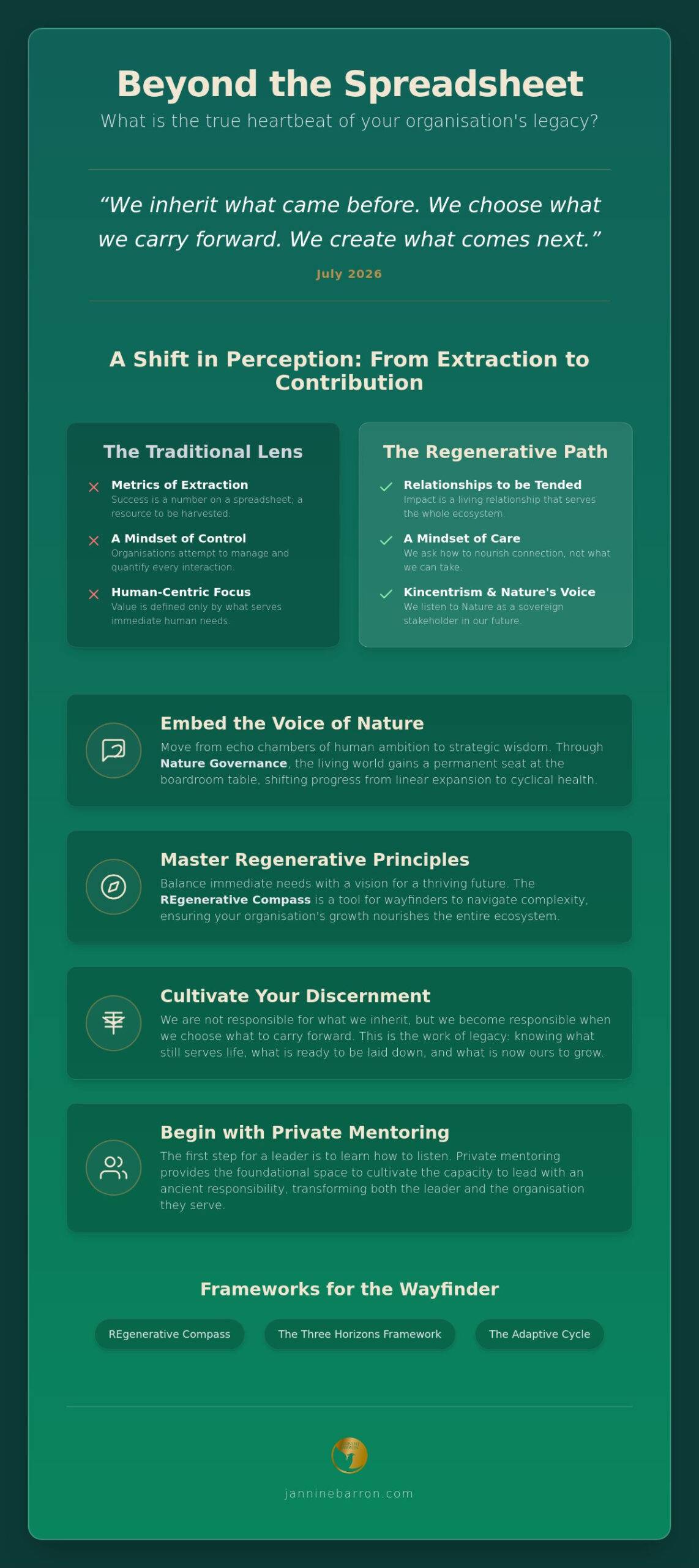
What does it mean to leave a trace that heals rather than a scar that remains? For a wayfinder, social impact isn’t a figure at the bottom of a ledger. It’s a living legacy. When we apply the principles of regenerative business, we shift our gaze from extraction to contribution. We stop asking what we can take from a community and start asking how we can nourish the soil of human connection. Impact is an ancient responsibility. It’s the quiet understanding that our actions today are seeds for a forest we’ll never walk in. This requires us to look beyond the immediate and consider the inheritance we are preparing for those who follow.
Traditional business models view the world as a collection of resources to be managed. This perspective is fundamentally extractive. It seeks to quantify every breath and every interaction to prove value to shareholders. By grounding our work in regenerative economic principles, we recognise that the health of our organisation is inseparable from the health of the living systems that sustain us. It requires a delicate balance of technical systems change and a deep, abiding love for the world. We must move from a mindset of control to one of care.
To better understand how these ideas manifest in the corporate world, watch this helpful video:
The limitations of traditional social return on investment
Why do we try to force the complexity of human life into a financial proxy? In the UK, we’ve seen how impact often becomes a performance of numbers that masks a lack of true connection. Traditional SROI can lead to overclaiming, where a business takes credit for changes it didn’t truly nurture. We must move beyond turning social impact into just another corporate KPI. True measurement requires radical transparency and the courage to admit when we don’t have all the answers. It’s about honesty, not just accounting. We need to ask ourselves if our metrics are capturing the true vitality of the communities we serve.
Embracing Kincentrism in our measurement models
We are not separate from the world. Kincentrism is the profound recognition that our lives are woven into the lives of all beings, from the birds in the hedgerows of Somerset to the microbes in the earth. This perspective fundamentally changes what we choose to measure. Instead of human centric metrics that only value what serves our immediate needs, we look for nature aligned indicators. How does our supply chain affect the water table? Are our operations creating space for local biodiversity to thrive? When we listen to the Voice of Nature, our measurement models become acts of care. This is a core part of the process of becoming a truly life affirming organisation.
As I reflect in July 2026, the work of a leader is a work of discernment. We inherit what came before. We choose what we carry forward. We create what comes next. This is the heart of the principles of regenerative business. It’s about developing the wisdom to know what still serves life and what is ready to be laid down.
Listening to the Voice of Nature: A new way to track progress
How do we move from counting to listening? Most boardrooms remain echo chambers of human ambition, where the only data that matters is that which can be captured in a cell. To truly embody the principles of regenerative business, we must invite a non human perspective into our strategic heart. This is the essence of Nature Governance. It is the practice of ensuring that the living world has a permanent seat at your table, acting as a sovereign stakeholder rather than a resource to be managed. When we stop talking about nature and start listening to the Voice of Nature, our understanding of progress shifts from linear expansion to cyclical health.
Growth is often a shadow of true success. In the natural world, perpetual growth without rest is the hallmark of a system in distress. Vitality, however, is the pulse of a healthy ecosystem. By using biomimicry as a lens, we can assess whether our organisation functions like an ancient woodland. Do we cycle nutrients and wisdom? Do we create conditions conducive to the life of our employees and the wider community? This shift from measuring scale to measuring vitality is a profound choice that requires us to look at the Adaptive Cycle of our work, recognising when it is time to grow and when it is time to release.
Natures Boardroom as a space for impact reflection
Strategic discernment rarely happens behind a glass wall in a city centre. The power of nature immersion allows us to quiet the noise of traditional business coaching and hear the deeper truths of our legacy. Whether we gather for Nature’s Boardroom experiences in the wild meadows of Somerset or find a pocket of green in London, the environment dictates the depth of our thinking. A Somerset retreat can reveal impact gaps that a clinical office simply cannot. It allows us to use forest therapy principles to ground our goals in the reality of the earth.
Qualitative indicators that signal regenerative health
How do we track the unquantifiable? We look for the depth of relationships within our supply chain. We measure the resilience of our team, not by their output, but by their capacity to adapt and care for one another. True systems change is found in the stories that emerge from our work. These qualitative indicators are the true evidence of our social impact. They show how the past lives on in our stories and how we are developing the discernment to know what still serves life. As I reflected in July 2026, we inherit what came before. We choose what we carry forward. We create what comes next. This creation begins with the stories we choose to tell today.
Frameworks for the wayfinder: REgenerative Compass and Three Horizons
How do we find our way when the old maps no longer lead to life? To truly embody the principles of regenerative business, we need tools that respect the complexity of the living world. Linear checklists often fail because they ignore the natural rhythms of change. As a wayfinder, your role is to navigate the tension between the systems we are leaving behind and the life affirming future we are calling in. This requires a shift from rigid management to intuitive guidance, grounded in frameworks that breathe with the earth. It’s about finding a rhythm that allows your organisation to thrive without exhausting the very systems it depends on.
Navigating with the REgenerative Compass
The REgenerative Compass is a tool I created to help leaders discern their path through four essential directions: inheritance, choice, creation, and responsibility. In your quarterly impact reviews, this compass asks you to look back at what you’ve received and forward to what you are birthing. It’s about developing the discernment to know what still serves life and what is ready to be laid down. You can learn more about the REgenerative Compass to see how it might ground your strategic choices in a deeper sense of ancient responsibility. By using this tool, you ensure that every choice is an act of creation that honours your shared life with all beings.
The Three Horizons of social impact
The Three Horizons Framework offers a way to balance the immediate needs of your business with your long term vision. Horizon One represents the current extractive systems we must still manage to survive. Horizon Three is the vision of a fully regenerative future where your business acts as a voice for nature. Horizon Two is the most critical for the wayfinder; it is the bridge of transition and innovation where we experiment with new ways of being. By identifying which horizon your initiatives belong to, you can ensure that today’s growth doesn’t sacrifice tomorrow’s vitality. This framework helps you move beyond the pressure to quantify the unquantifiable by showing the narrative arc of your progress.
Finally, the Adaptive Cycle reminds us that nature does not bloom all year round. In the UK, we might use the quiet of winter for deep reflection and strategic pruning, while our colleagues in Australia navigate the high energy of summer. Aligning your business rhythms with these natural seasons allows for necessary periods of release and renewal. We are not responsible for what we inherit. We become responsible the moment we choose what to carry forward. As I wrote in July 2026, we inherit what came before. We choose what we carry forward. We create what comes next. By respecting these cycles, you ensure your social impact is a sustainable contribution to the whole.
Discerning your legacy: What do we carry forward?
What lives in the shadows of your organisation’s history? Legacy is often spoken of as something that happens at the end of a career, a final tally of achievements. For a wayfinder, legacy is a living presence. It is the weight of the past meeting the potential of the future in the choices we make today. We must ask ourselves what we are actually feeding with our daily work. Are we nourishing a system that values life, or are we merely keeping an extractive engine running? Impact is the discernment of what serves life.
By applying the principles of regenerative business, we begin to see that our operations are not just transactions but threads in a larger tapestry of shared life. This requires a deep audit of our inheritance. We carry stories, habits, and supply chain structures that were built in a different era, often one that did not value the Voice of Nature. To move forward, we must develop the courage to lay down what is no longer serving the whole. This is not just a technical task. It is a spiritual and emotional one that requires us to look at our business with both love and clarity.
The power of choice and creation
We are not responsible for what we inherit. We become responsible the moment we choose what to carry forward. This distinction is the foundation of Kincentrism. It allows us to acknowledge the past without being trapped by it. As I wrote in July 2026: “We inherit what came before. We choose what we carry forward. We create what comes next.”
When you involve your stakeholders in this process of legacy creation, you move from a top down directive to a collective act of birthing. Ask your team, your suppliers, and your local community: what do we want to grow together? This collaborative discernment ensures that your impact is rooted in the reality of those you serve. If you feel ready to explore this deeper responsibility, my private mentoring offers a space to navigate these complex choices with a trusted guide.
Practical steps for an impact audit
An impact audit through a regenerative lens is different from a traditional audit. It starts by identifying the extractive stories still living in your organisation. Do you still talk about “capturing” markets or “leveraging” people? These words carry the energy of extraction. To protect natural resources and human dignity, you must create a stop doing list. This list is often more important than your goals. It identifies the practices that must be composted to make room for new growth. Prioritising actions that build long term community wealth ensures that your business becomes a fountain of vitality rather than a drain on the ecosystem. We create what comes next by being intentional about what we stop today.
Cultivating impact through private mentoring and immersion
Why do we often look to software or rigid spreadsheets to solve challenges that are fundamentally rooted in the human heart? True social impact is not a technical problem to be solved with a new platform; it’s a leadership journey that requires deep, personal discernment. To truly embody the principles of regenerative business, a leader must first find their own rhythm within the living world. This is why private mentoring is the essential foundation for any impact strategy. It provides the quiet sanctuary needed to look at your inheritance with honesty and decide, with love, what you are ready to carry forward into the future.
Transitioning from a traditional business coach to a regenerative mentor is a shift from seeking efficiency to seeking vitality. While a coach might focus on linear growth and “capturing” markets, a mentor acts as a wayfinder, helping you listen to the Voice of Nature within your own organisation. This process is about more than just strategy. It’s about developing the capacity to see your business as a living system. You can explore our private mentoring programmes to begin this transformation, moving away from extractive habits and toward a legacy that truly serves life.
Sometimes, the most profound strategic shifts happen when we leave the office behind. A Nature’s Boardroom experience, whether held in the ancient landscapes of Wiltshire or the hidden green pockets of London, offers a radical departure from the clinical atmosphere of a city boardroom. In these spaces, we use nature immersion to ground your business goals. We move beyond the pressure to quantify the unquantifiable and instead focus on the quality of relationships and the resilience of your systems. It’s an opportunity to practice Nature Governance in real time, allowing the environment to guide your strategic discernment.
The Growth Experience: A nine month journey
Deep systems change cannot be rushed. It follows the natural cycles of birth and maturation. The Growth Experience is a nine month incubator designed to support you as you move from theory to practice. In this space, we don’t just talk about regeneration; we live it. By working within a long term framework, you have the time to compost old patterns and nurture new, life affirming initiatives. The role of community is vital here, as you’ll be surrounded by other leaders who are also navigating the tension between today’s needs and tomorrow’s vision. This is where your regenerative strategy takes root and begins to flourish.
Your next step as a regenerative leader
Are you ready to ask the vital questions that lead to genuine transformation? Transformation begins when we stop looking for answers in the past and start creating them for the future. As I reflected in July 2026, we inherit what came before. We choose what we carry forward. We create what comes next. This is your moment of choice. Whether you feel called to a private mentoring relationship or a deep immersion day in the wild, the first step is simply to begin the conversation. You are invited to contact Jannine to begin your wayfinder journey and discover how your organisation can become a true force for life in the world.
Step into your role as a wayfinder for life
How will you choose to be remembered by the generations that follow? Measuring social impact is not an end point but a continuous act of listening. By integrating the principles of regenerative business, you move from a clinical assessment of data to a soulful stewardship of vitality. We’ve explored how Nature Governance and the REgenerative Compass can guide your discernment. We’ve seen that your legacy is built in the moments you choose what to carry forward and what to lay down to make room for new growth.
With over 30 years of experience in ethical business and a deep commitment to Kincentrism, I act as a voice for nature to help you navigate this transition. Whether through Nature’s Boardroom experiences or deep strategic reflection, the path to a life affirming organisation is open to you. As I noted in July 2026, we inherit what came before. We choose what we carry forward. We create what comes next. Your responsibility begins the moment you decide which seeds to water. Begin your journey with a private mentoring session today and discover the true legacy of your work.
Frequently Asked Questions
How do I start measuring social impact if my business is still small?
Begin by observing the quality of your immediate relationships rather than looking for large scale data sets. Even for a micro business in the UK, you can use the REgenerative Compass to audit your inheritance and daily choices. Focus on the stories of change within your local community or supply chain. These small acts of creation are the seeds of systemic shifts, and private mentoring can help you find this focus early.
Can I measure social impact without using complex financial formulas?
You can absolutely move beyond rigid financial proxies and spreadsheets to find a more meaningful way to track progress. While traditional models like SROI use monetary values, a regenerative approach values qualitative indicators like the resilience of your team and the depth of trust in your partnerships. Measuring vitality is about sensing the health of the whole system. We look for signs that life is thriving, which often cannot be captured by a pound sign alone.
What is the difference between social impact and regenerative business?
Social impact is often seen as a specific result or a project to “give back,” whereas the principles of regenerative business represent a fundamental shift in how the entire organisation exists. Regeneration is about being life affirming in every operation, not just in isolated initiatives. It involves moving from a human centric view to Kincentrism, where the business acts as a supportive and integrated part of the wider living ecosystem.
How often should a business review its social impact metrics?
Reviewing your impact should follow the natural rhythms of the seasons rather than just the fiscal calendar. I recommend a deep reflection every quarter, using the Adaptive Cycle to understand if you are in a phase of growth, release, or renewal. This quarterly rhythm allows you to listen to the Voice of Nature and adjust your strategy before old, extractive patterns take root again. It ensures your business breathes with the world.
Is it possible to measure the Voice of Nature in a corporate setting?
It is possible through the practice of Nature Governance. This involves ensuring the living world has a sovereign seat at your boardroom table, either through a representative or a specific framework. You measure this by tracking indicators like biodiversity health or the ecological footprint of your supply chain. It requires a shift from viewing nature as a resource to treating it as a stakeholder with its own needs and wisdom.
What are the best frameworks for UK businesses to track social value?
While many UK firms use the Social Value Portal, wayfinders often find more depth in the Three Horizons Framework and the REgenerative Compass. These tools help you balance today’s operational needs with a vision for a life affirming future. They allow you to navigate the specific regulatory landscape of the UK while staying grounded in the ancient responsibility we hold toward the future of our local landscapes and communities.
How does Kincentrism help me become a better leader?
Kincentrism shifts your perspective from being a manager of resources to being a relative of the living world. This recognition of our shared life with all beings fosters a deeper empathy and a more nuanced understanding of systems change. It helps you lead with care and love, making choices that benefit the whole ecosystem rather than just the bottom line. It transforms leadership into an act of stewardship for all life.
Can nature immersion days really improve my business strategy?
Nature immersion days provide the silence and space needed for true strategic discernment. Stepping into Nature’s Boardroom, whether in Somerset or a London park, clears the mental noise of traditional business coaching. It allows you to ground your goals in the reality of natural systems. Many leaders find that a single day in the wild reveals impact gaps and creative solutions that months in a city office could not reach.