
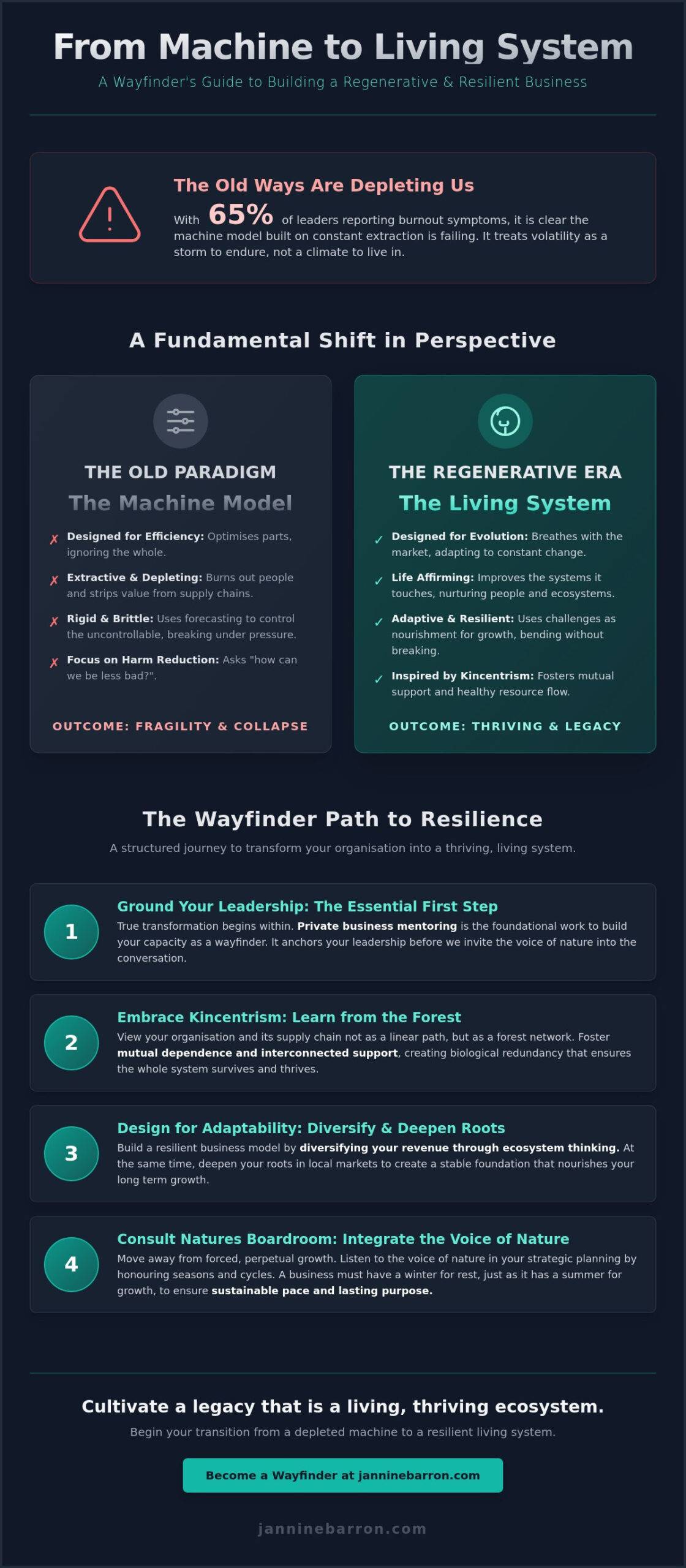
What if your business was never meant to be a machine designed for efficiency but a living organism designed for evolution? With 65 percent of leaders reporting symptoms of burnout according to recent 2026 data, it’s clear that the old ways of working are depleting our internal reserves. You likely feel the weight of a world that refuses to stand still; market volatility is no longer a storm to wait out but the climate we live in. You’re searching for how to build a resilient business model, yet the traditional tools of rigid forecasting and clinical strategy often fail to provide the breath of life your organisation needs.
It’s time to move beyond simple survival by aligning your leadership with the adaptive wisdom of natural systems. This article provides a pathway to transform your operations into a thriving ecosystem through the lens of Kincentrism. We’ll explore how private mentoring serves as the vital first step in this transformation, grounding your leadership before we invite the voice of nature into the conversation. By stepping into nature’s boardroom, you’ll gain a clear framework for adaptive growth that restores your energy and ensures your business thrives as a resilient living system.
Key Takeaways
- Redefine your understanding of stability by viewing resilience as a living process that allows your organisation to thrive through constant change.
- Apply the principles of Kincentrism to your operations, using the wisdom of forest networks to create mutual support and healthy resource flow.
- Discover how to build a resilient business model by diversifying your revenue through ecosystem thinking while deepening your roots in local markets.
- Embrace private business mentoring as the fundamental first step in transitioning your leadership style toward a facilitative wayfinder mindset.
- Integrate the voice of nature into your annual strategic planning to ensure your brand remains aligned with its original purpose and long term legacy.
What is a resilient business model in the regenerative era?
Resilience is often whispered about as if it were a fortress. We imagine a wall built to withstand the wind or a shield designed to deflect the blows of a volatile market. But in a world where the wind never stops blowing, even the strongest walls eventually crumble. True resilience isn’t a static shield; it’s a living process. It’s the ability of an organisation to breathe with the market, to bend without breaking, and to find nourishment in the very challenges that would starve a rigid structure. Traditional risk management often fails because it tries to control the uncontrollable. It treats the future like a math problem rather than a shifting landscape that requires a different kind of presence.
To understand how to build a resilient business model, we must first look at the soil from which our enterprises grow. For decades, the dominant paradigm of corporate sustainability focused on harm reduction. It asked how we could be less bad. In the regenerative era, that’s no longer enough. We’re moving toward a model where the business actually improves the systems it touches. This is the path of the wayfinder. It’s a leadership style that doesn’t just manage change but navigates systemic shifts with the grace of a navigator on the open sea. You aren’t just following a map; you’re reading the stars and the currents to find a way forward that serves the whole.
To better understand this concept, watch this helpful video:
From extractive to life affirming structures
Many current models are built on depletion. They exhaust the founder, burn out the team, and strip value from the supply chain until there is nothing left to give. You can feel it when the numbers look good but the energy in the room feels hollow. Thriving isn’t about surviving the storm; it’s about becoming the kind of organisation that uses the rain to grow. Many UK leaders are now looking toward circular and regenerative models to ensure their legacy isn’t just a balance sheet but a healthy ecosystem. This transition requires a deep look at regenerative business strategy and a willingness to let go of extractive habits that no longer serve the living world.
The voice of nature as a strategic guide
Nature doesn’t rush. It follows seasons, cycles, and rhythms that have sustained life for billions of years. When we move away from the machine metaphor, we stop seeing our businesses as assemblies of parts to be optimised. Instead, we see them as living organisms. This shift allows us to listen to the voice of nature as a strategic guide. Does your business have a winter? A time for rest and consolidation? Or are you forcing a perpetual summer of growth that leads to inevitable collapse? By aligning with natural timing, you create a pace that is both productive and sustainable. Learning how to build a resilient business model means honouring these cycles, ensuring your brand stays connected to its original purpose while remaining flexible enough to evolve.
Learning from the forest: The principles of Kincentrism in business
The forest does not view a drought as a solo struggle. Beneath the soil, a silent mycelial network acts as a communal bank, shifting nutrients from the strong to the weak to ensure the entire system survives. This is Kincentrism in action. It’s a framework of mutual dependence where every part of the system is recognised as family. When you’re considering how to build a resilient business model, you must look beyond your own walls. You must ask how your organisation can function like a forest. It’s about moving from a mindset of competition to one of deep, interconnected support.
In a traditional model, supply chains are often lean to the point of fragility. One break in the link causes a total collapse. Nature chooses a different path through biological redundancy. It creates multiple pathways for energy and resources. If one species fails, another steps in to fill the niche. By treating your suppliers, partners, and even customers as kin, you create a web of support that can withstand shocks that would destroy a siloed enterprise. This shift requires a profound level of empathy and a commitment to the health of the whole system rather than just the individual parts.
Biomimicry and structural adaptability
Nature based design offers a blueprint for solving our most complex organisational problems. Australian ecosystems provide a profound lesson in this area. Consider the way certain native flora, like the Banksia or the Eucalypt, have evolved to interact with fire. Some species require the intense heat of a bushfire to release their seeds, while others use epicormic buds to sprout new life from charred trunks. They have evolved to see crisis as a catalyst for regrowth. Your business structure should mirror this decentralized resilience. When authority and resource management are distributed rather than concentrated at the top, the system cannot be taken down by a single point of failure. This is how you build a resilient business model that doesn’t just survive the heat but uses it to regenerate and evolve.
Feedback loops and the voice of nature
Resilient systems are those that listen most deeply. In the wild, every leaf and root acts as a sensor, signalling a need for change long before a crisis becomes visible. You can cultivate this same sensitivity within your brand. Creating rapid response systems based on real time data allows you to pivot with the seasons rather than fighting against them. This sensitivity ensures that you aren’t caught off guard by shifts in the market or the environment.
This level of awareness starts with a shift in perspective. It requires moving from a command and control mindset to one that honours the voice of nature in every decision. When you invite your team to participate in natures boardroom, you open the door to a collective intelligence that a machine model can never replicate. You begin to see your business not as a project to be managed, but as a life force to be nurtured. Every part of the organisation must feel empowered to signal when the soil is dry or when the sun is too bright. This is the essence of a life affirming structure that grows stronger with every cycle.
Designing for adaptability: 5 ways to build a resilient business model
Designing for the unknown requires a profound shift in how we perceive the value of our organisations. It’s no longer sufficient to build a structure that merely resists change; we must create one that is nourished by it. To understand how to build a resilient business model, we must move away from the rigid frameworks of the past and look toward the fluid adaptability of the living world. This journey begins with private mentoring, which serves as the essential first step in leadership coaching. Before you can transform your supply chains or your revenue streams, you must first transform the inner landscape of your leadership. Only then can you act as a true wayfinder for your organisation.
Consider these five pillars of adaptive design as you evolve your brand:
- Human sustainability: With 79 percent of employees experiencing work related stress and 65 percent of leaders reporting burnout, your primary engine of adaptability is under threat. Resilience starts with the health of your people.
- Long term health over extraction: Move away from short term profit cycles that deplete your internal culture and external ecosystems.
- Ecosystem revenue: Diversify how you create value by looking at your business as part of a wider web of mutual support.
- Ethical supply chains: Build transparent networks that are rooted in trust and Kincentrism, ensuring they can withstand global shocks.
- Technological integration with soul: While 88 percent of organisations now use AI in at least one function, the resilient leader ensures technology serves the voice of nature rather than silencing it.
Diversification beyond simple products
True resilience is found in the depth of your relationships. When you view your business through the lens of ecosystem thinking, you realise that revenue is just one form of energy exchange. You can create multiple layers of value by fostering community and social capital. This might mean offering natures boardroom sessions to your partners or creating collaborative workshops that solve shared problems. Many UK brands have successfully pivoted by embracing these regenerative principles, moving from selling a single product to providing a platform for systemic health. This approach ensures that even if one revenue stream is blocked, the organisation continues to thrive through other channels of exchange.
Localised resilience for global impact
Your strength on the global stage is found in the depth of your local roots. Whether your base is in Wiltshire, London, or Sydney, your commitment to your specific geography is what makes you a good ancestor. In Australia, local partnerships are becoming vital for mitigating the risks associated with global logistics. By building deep connections within your immediate community, you create a buffer against international volatility. This localised focus allows you to listen more closely to the voice of nature in your own backyard, ensuring your strategic decisions are grounded in the reality of the land. When you invest in The Growth Experience, you learn to balance this local presence with a global vision, creating a model that is both deeply rooted and expansively adaptive.
The wayfinder path: Transitioning your leadership for resilience
The most sophisticated strategy is a fragile thing if the person holding it is exhausted. When we discuss how to build a resilient business model, we often look at spreadsheets and supply chains, yet we ignore the most critical variable: the leader’s own energy. Founder burnout is not just a personal struggle. It’s a systemic risk that can destabilise an entire organisation. A leader who operates from a place of depletion cannot see the subtle shifts in the market or the quiet signals from their team. They become reactive, clinging to old paradigms of command and control because they lack the internal space to embrace uncertainty.
Transitioning to a regenerative model requires a move toward a facilitative wayfinder mindset. This is a leadership style rooted in emotional depth and empathy. It’s about recognising that your business is a living system that requires care, not a machine that needs to be fixed. By cultivating this inner resilience, you ensure that your organisation remains flexible and responsive to the world around it. This shift is not merely professional; it’s a deeply personal evolution that requires you to look at your own patterns with honesty and love.
Private mentoring as a foundational tool
Before you can heal your organisation, you must attend to your own leadership. Private business mentoring is the essential first step in leadership coaching because it provides the sanctuary needed for radical reflection. One on one strategy sessions reveal the hidden extractive patterns that you might be inadvertently imposing on your brand. A mentor holds the space for these radical model shifts, helping you to untangle your identity from the frantic pace of traditional corporate culture. Personal resilience is the absolute prerequisite for organisational resilience. You cannot breathe life into a business if you are struggling to catch your own breath.
If you are ready to explore this deeper alignment, you can begin the process of reclaiming your visionary power today.
Leading through systems change
Leading through systems change is an art of observation. It’s the transition from being a boss who demands results to being a steward who creates the conditions for growth. This requires developing the capacity to see patterns before they become crises. In the Australian bush, a seasoned ranger knows the signs of a changing season long before the first leaf falls. They listen to the voice of nature. As a leader, you can ground yourself through practical exercises that reconnect you with the earth. Whether it’s walking barefoot on the soil or simply sitting in silence to observe natural cycles, these moments of grounding are essential. They remind you that you are part of a larger, resilient whole, allowing you to lead with a calm authority that inspires your entire team to embrace the wisdom of Kincentrism.
Cultivating your legacy: The first step toward a resilient future
Legacy is not a distant destination or a plaque on a wall; it is the living trail you leave with every decision you make today. As we have explored the structural and emotional layers of your brand, it becomes clear that knowing how to build a resilient business model is ultimately an act of devotion to the future. Your business model is a testament to the world you want to see. It is a blueprint for an economy that gives back more than it takes. This transition doesn’t happen in a fluorescent lit office under the pressure of a ticking clock. It happens when you step away from the noise and allow the voice of nature to speak to the original purpose of your brand.
The journey toward resilience is a process of unlearning the machine metaphors that have exhausted us. It requires a return to the soil and the cycles that have sustained life for eons. By choosing to align your organisation with the wisdom of Kincentrism, you aren’t just building a company that can withstand a crisis. You are cultivating an ecosystem that nourishes everyone it touches. This is the path of the wayfinder, a leader who understands that true strength is found in mutual dependence and the courage to evolve.
Natures boardroom and strategic immersion
Strategic planning often feels like a clinical exercise in data management, yet the most profound insights rarely come from a spreadsheet. What happens when you take your board meetings into the wild settings of Somerset or the ancient, breathing landscapes of Australia? Nature based environments unlock a level of creative problem solving that a digital screen can never replicate. In natures boardroom, the air is fresh and the perspective is wide. You move your strategy from the digital realm into the living world, allowing the rhythms of the land to inform your timing and your growth. A single nature immersion day can be the catalyst for a radical shift in how you perceive your role as a leader, grounding your visionary concepts in the practical reality of the earth.
Committing to the regenerative journey
For those who feel a deep call to evolve their entire structure, The Growth Experience provides a nine month incubator specifically designed for ethical brands. It is a sacred container for model evolution where you join a community of like minded wayfinders. This is not about traditional business coaching that focuses on aggressive expansion. It is a journey into the heart of what it means to be a regenerative leader. The long term impact of this collective work is a business that feels like an extension of your soul rather than a burden on your spirit.
The path forward is clear, yet it requires a courageous first step. Before you can lead a systemic movement, you must lead yourself with empathy and depth. This is why private mentoring remains the essential foundation for everything we build together. It is the quiet, supportive space where we plant the seeds of your resilient future. Take this moment to reflect on the legacy you are currently calling into being. Is it time to listen more deeply to the world around you?
Stepping into your role as a regenerative wayfinder
True resilience is found when you stop fighting the current and start reading the water. We have explored how moving toward Kincentrism and adopting the facilitative mindset of a wayfinder allows your organisation to breathe. By understanding how to build a resilient business model through these life affirming principles, you transform your brand from a source of depletion into a source of life. You have learned that your leadership health is the soil for your company’s growth and that nature’s boardroom offers a clarity that no clinical office can match.
With over 30 years of experience in ethical business and a background in Red Dot level design thinking, I bridge the gap between London boardrooms and the wisdom of natural living systems. This is not just about strategy; it is about a deep, structural evolution of your purpose. The path is open for those ready to lead with soul and technical precision. Begin your journey with private business mentoring to build a model that thrives and reclaim your energy for the work ahead. Your legacy is waiting to be nurtured.
Frequently Asked Questions
What is the difference between a sustainable and a resilient business model?
Sustainability often seeks to maintain the status quo by reducing harm. Resilience is the living capacity of your organisation to evolve and thrive amidst volatility. While a sustainable model might focus on efficiency, a resilient one prioritises the ability to bounce forward. It is about moving away from rigid structures toward a model that breathes with the market. This shift ensures your brand remains a life affirming force even during periods of deep systemic change.
How can I make my business resilient without a large cash reserve?
You can build resilience through the strength of your social capital and ecosystem networks. Financial buffers are helpful, but true security comes from deep local roots and mutual support. In places like Sydney or London, businesses are finding strength by collaborating with neighbours to share resources and logistics. Understanding how to build a resilient business model involves looking at your relationships as your primary asset. You create a web of kin who support you when the soil is dry.
Why is private mentoring considered the first step in leadership coaching for resilience?
Private mentoring is the essential first step because the resilience of the organisation is a direct reflection of the leader. You cannot guide a system through change if your own internal landscape is depleted. One on one strategy sessions allow you to identify extractive habits before they become systemic failures. This foundational work ensures you have the emotional depth and clarity needed to act as a wayfinder for your entire team. It is the necessary ground for all future growth.
What does Kincentrism mean in a professional business context?
Kincentrism is a framework where every stakeholder is treated as a member of a wider family. In a professional context, this means moving beyond transactional relationships with suppliers and customers. You begin to see your business as part of a larger living system. This perspective fosters a culture of care and mutual dependence. It ensures that every decision you make considers the long term health of the whole ecosystem rather than just immediate profit or extraction.
How do I involve my team in building a nature aligned business model?
Introduce your team to the voice of nature through shared strategic immersions. You can take your planning sessions into natures boardroom to unlock collective intelligence. This process encourages every member of the organisation to act as a sensor for the system. When your team learns to observe natural cycles together, they become more adept at identifying opportunities for growth and adaptation. It builds a shared commitment to a model that is truly life affirming and deeply rooted.
Can a traditional service based business become regenerative?
Every business can transition to a regenerative model by shifting its core value exchange. A traditional service provider becomes regenerative when they focus on nourishing the client and the community rather than just extracting a fee. This involves redesigning your offerings to create positive ripples across your entire supply chain. It is about ensuring that your presence in the market leaves the world stronger and more vibrant than you found it. The service becomes an act of care.
How often should a resilient business review its core model?
You should review your core model in alignment with natural seasonal cycles. A resilient business does not wait for a crisis to adapt; it listens to real time feedback loops. Quarterly reflections in natures boardroom allow you to prune what is no longer serving the system. This rhythmic approach ensures that your strategy remains fluid and responsive. It prevents the rigidity that often leads to systemic collapse in traditional corporate structures that only look at annual data.
What are the first signs that a business model is becoming extractive and brittle?
The first signs of a brittle model are often found in the health of the people. High levels of burnout and a sense of disconnection from the original purpose are clear indicators of extractive patterns. When your organisation feels like a machine that requires constant forcing rather than a living system that flows, it has become brittle. Recognising these signals early is a vital part of learning how to build a resilient business model that regenerates rather than depletes your internal spirit.