
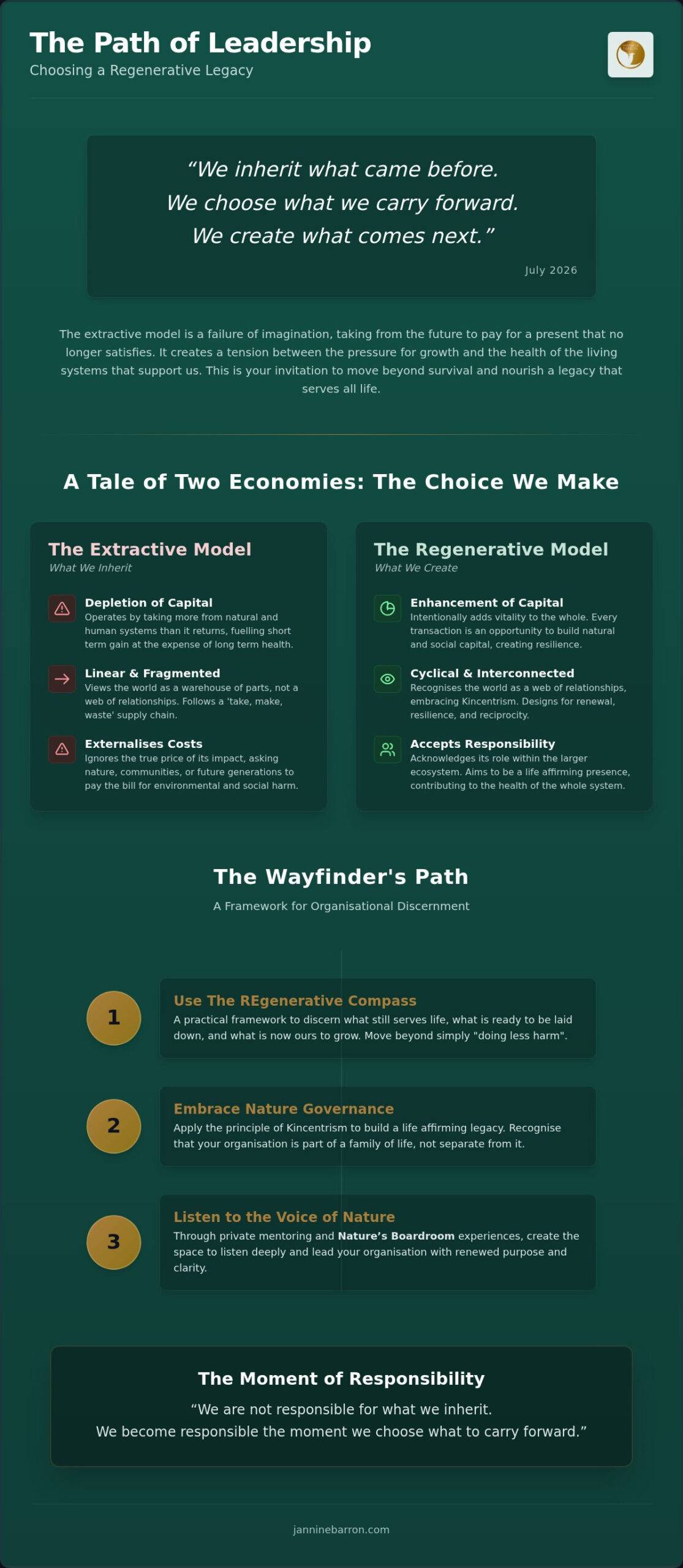
The extractive model is a failure of imagination where we take from the future to pay for a present that no longer satisfies us. You likely feel this tension every day. The pressure for constant growth leads to burnout while the environmental footprint of your supply chain weighs heavy on your conscience. You know that simply doing less harm is no longer the goal. You are seeking a way to lead that feels as natural and resilient as an ancient forest. To find that path, we must understand the deep mechanics of the extractive vs regenerative economy and recognise where our choices have led us astray.
As a wayfinder, I often remind leaders of a simple truth: We inherit what came before. We choose what we carry forward. We create what comes next. This guide is your framework for that choice. You will discover how to identify extractive patterns and use tools like the REgenerative Compass to begin your transition. Through private mentoring and the restorative space of Nature’s Boardroom, we will explore how Kincentrism can reshape your leadership. This is your invitation to move beyond survival and start nourishing a legacy that truly serves all life.
Key Takeaways
- Recognise that while we inherit what came before, we become responsible the moment we choose what to carry forward and what we create next (July 2026).
- Deepen your understanding of the extractive vs regenerative economy to identify where your supply chain may be depleting natural capital for short term gains.
- Use the REgenerative Compass as a framework for organisational discernment, moving your business beyond the “do less harm” approach of traditional sustainability.
- Explore how Nature Governance and the principle of Kincentrism can help you build an ancient, life affirming legacy that truly belongs to the earth.
- Discover how private mentoring and Nature’s Boardroom experiences provide the space to listen to the Voice of Nature and lead with renewed purpose.
Defining the Extractive Business Model: What We Inherit
We find ourselves standing in the middle of structures we did not build. For decades, the measure of a successful enterprise was its ability to take; to harvest resources, to command labour, and to convert the vitality of the earth into shareholder dividends. An extractive business model is one that operates on this fundamental imbalance, taking more from the system than it ever intends to return. It relies on the depletion of natural capital and the exhaustion of human energy to fuel short term gain. This is the inheritance of the modern leader. Most of us were taught to optimise for this extraction in traditional business schools, often without a second thought for the living systems that support us.
When we explore the shift toward regenerative economics, we begin to see that the tension between an extractive vs regenerative economy is not just about balance sheets. It’s about the very soul of our organisations. We have been conditioned to view the world as a warehouse of parts rather than a web of relationships. This mindset is an unconscious inheritance, a story of separation that we carry into our boardrooms every day. As a wayfinder for leaders, I often return to this core truth: We inherit what came before. We choose what we carry forward. We create what comes next. (July 2026).
The Paradigm of Taking Without Giving
The extractive model is rooted in a frontier mentality. It’s a psychological state that views the horizon as something to be conquered and the earth as a bottomless well. This creates a profound disconnect between profit and planetary health. When we stop to listen to the Voice of Nature, we realise that our modern structures are often built on ancient stories of dominance. Does your leadership style rely on the constant pressure of growth, or do you allow space for the natural cycles of rest and renewal? Recognising these signs is the first step in our private mentoring journey together.
Capital vs Life: The Fundamental Conflict
In a purely financial world, we are taught to protect our capital. Yet, in an extractive model, we do the opposite. We degrade the very capital assets, the soil, the water, the climate, and the people, that make our businesses possible. This is fundamentally poor business strategy. Living systems growth is different from financial growth; it’s about complexity, health, and resilience. By embracing Kincentrism, we recognise that we are part of a family of life. We must ask ourselves: What am I choosing to carry forward? Is it a legacy of depletion, or a commitment to life affirming creation?
The Mechanics of Extraction in Modern Supply Chains
The machinery of modern business often feels like a vast, invisible web. In this tangle of global logistics, extraction is rarely a deliberate act of malice; it’s a structural default. Most leaders feel a growing sense of unease about their supply chains, a quiet suspicion that their profit is being subsidised by the unseen depletion of distant ecosystems or the exhaustion of workers they will never meet. This is the reality of externalising costs. When a business model ignores the true price of its impact, it’s essentially asking nature or future generations to foot the bill. Nature is the ultimate creditor, and the debt is coming due.
To transition from an extractive vs regenerative economy, we must develop the eyes to see these hidden mechanics. It’s not just about resource depletion. It’s about the pressure on wages and the erosion of community resilience. We inherit these institutional choices, the contracts, the vendor relationships, and the logistical routes, but we are not bound by them forever. The past lives on in our current choices until we choose to breathe life into something new. This shift is at the heart of building a regenerative economy where every transaction adds vitality to the whole rather than merely stripping it away.
Identifying Hidden Extraction Points
True discernment requires us to look past the spreadsheets. We must ask: Where is my business taking without consent? In the United Kingdom, this might look like supply chains that ignore the degradation of local biodiversity or the long term health of our agricultural lands. In Australia, it could be the unconscious extraction of water from fragile river systems. Moving from exploitation to responsibility isn’t about guilt; it’s about reclaiming your power as a creator. It’s about choosing to carry forward only that which serves life. It’s about developing the wisdom to know what is ready to be laid down.
The Adaptive Cycle and Systems Change
Nature teaches us that every system moves through the Adaptive Cycle: growth, conservation, release, and reorganisation. Many extractive models have reached the brittle conservation phase. They are rigid, over-optimised, and vulnerable to collapse. Recognising when a model is ready to be laid down is an act of courage. This is the moment of choice. It’s the point where you stop being a passenger to your inheritance and start acting as a wayfinder for a new era. If you feel the call to reimagine your strategy within a living system, exploring Nature’s Boardroom can provide the clarity needed for this release and reorganisation.
Why Sustainability is Not Enough to End Extraction
Many leaders feel a sense of accomplishment when they reach the plateau of sustainability. They’ve reduced their plastic use, audited their carbon, and perhaps achieved a net zero certification. While these are necessary steps, we must be honest about their limitations. If our goal is merely to slow down the rate at which we deplete the earth, we are still participating in the mechanics of extraction. Sustainability often acts as a maintenance plan for an ancient, failing paradigm. It seeks to sustain a status quo that was never designed to support the flourishing of all life. To truly bridge the gap in the extractive vs regenerative economy, we must move beyond the “do less harm” mindset and enter the realm of active contribution.
This shift requires a fundamental change in identity. We must move from being managers of resources to being wayfinders for life. A manager asks how to keep a system stable; a wayfinder asks what the system needs to thrive. We inherit what came before. We choose what we carry forward. We create what comes next (July 2026). This is the work of developing discernment, knowing which parts of our inheritance are ready to be laid down so that new, life affirming structures can grow in their place.
The Trap of Doing Less Harm
Net zero has become a convenient mask for continued extraction. In the frantic hustle culture of London or Sydney, it’s easy to treat carbon offsets as a mathematical escape hatch that allows us to bypass deep systems change. Efficiency is often a tool of the extractive model; it asks how we can take more with less effort. Nature, however, prioritises resilience over efficiency. A forest is not “efficient” in the corporate sense, but it is incredibly resilient because it invests in the health of every member. Are your business goals focused on lean optimisation, or are you building the systemic health required to weather the coming storms?
Transitioning Through The Three Horizons Framework
To navigate this transition, I often guide leaders through The Three Horizons Framework. This tool allows us to see the landscape of change with clarity and compassion.
- Horizon One: This is the extractive system as it exists today. We don’t abandon it overnight; we manage its decline with responsibility, ensuring we don’t cause unnecessary collapse while we transition.
- Horizon Two: This is the bridge. It’s the space of innovation, unlearning, and private mentoring. Here, we experiment with new ways of working that prioritise life over capital.
- Horizon Three: This is the regenerative future. It’s where the business acts as a vital organ within its ecosystem, governed by the principles of Kincentrism and the Voice of Nature.
You might ask: Can we really afford to be regenerative? In a world of increasing resource scarcity and shifting regulations, the truly expensive path is the one that destroys its own foundation. Transitioning to a regenerative model isn’t just a moral choice; it’s the only way to ensure your business has a place in the future we are all creating together.
Using the REgenerative Compass to Change Your Model
The path out of extraction is not found in a textbook; it’s carved through the quiet work of discernment. To navigate the complex landscape of the extractive vs regenerative economy, we need more than just new data. We need a new orientation. I created the REgenerative Compass to serve as a guide for this very purpose. It’s a tool designed to help you look at your organisation not as a machine to be optimised, but as a living system to be nourished. This shift begins with the individual leader. Private mentoring is often the essential first step in this journey because unlearning extractive habits is a deeply personal process. It requires us to face the guilt of our social and environmental footprints and transform it into the fuel for a new creation.
A regenerative audit isn’t about ticking boxes. It’s about listening to the Voice of Nature within your own operations. Are your supply chains aligned with the flow of natural systems, or are they dams blocking the path of vitality? When we use the Compass, we aren’t just looking for efficiency. We are looking for reciprocity. A living supply chain doesn’t just deliver goods; it feeds the soil of the communities it touches, a concept that even specialty chemical providers like JAS Global Industries, found at jasind.com, are beginning to embrace through responsible fertilizer and water solutions. This is how we move beyond the mechanical and into the organic, ensuring that every choice we make is an investment in the health of the whole.
Audit Your Inheritance
We start by identifying the parts of our business model that were inherited from traditions of dominance. These are the ancient stories of the frontier that tell us more is always better. Ask yourself: What is no longer mine to grow? Perhaps it’s a specific product line that relies on non renewable extraction, or a management style that causes burnout in your team. We are not responsible for what we inherit. We become responsible the moment we choose what to carry forward. This is how you begin to shape a legacy that future generations will thank you for. It’s about having the courage to lay down what no longer serves life.
Choose Your Creation
Once we have cleared the space, we can begin to life call new strategies. Biomimicry offers a practical path here. It asks how nature would solve a logistical problem or a governance challenge. In the restorative silence of Nature’s Boardroom, we step away from the noise of the market to find clarity in the wild. Here, the strategy isn’t forced; it emerges from the wisdom of the ecosystem. We move beyond the conflict of capital vs life and start creating new stories where profit is a byproduct of systemic health. If you are ready to begin this unlearning, enquire about private mentoring to start your transition today.
Nature Governance: Leading with the Voice of Nature
Traditional business structures often resemble a pyramid of control, where power flows from the apex and resources are pulled from the base. This is the architectural blueprint of the extractive model. Nature Governance offers a different shape; it’s a living circle where the leader acts as a steward rather than a commander. This is the final, vital piece in understanding the shift from an extractive vs regenerative economy. When we transform our governance, we move from the clinical management of human resources to the soulful tending of a living system. For UK employers seeking practical advice on this evolution, an HR consultancy Hove can provide the strategic support needed to redesign workplace cultures. We stop trying to dominate the market and start learning how to belong to the world.
Leading with the Voice of Nature requires us to listen to the silent wisdom of the ecosystems we inhabit. It asks us to look at our boardroom decisions through the lens of deep time and ancient resilience. Are our policies creating health, or are they merely delaying depletion? By moving away from extractive hierarchies, we allow for a more organic flow of ideas and energy. This isn’t about losing control; it’s about gaining the kind of magisterial authority that comes from being in right relationship with the living world. It’s about choosing a path that nourishes the whole while ensuring the longevity of the enterprise.
Embracing Kincentrism
Kincentrism is the heartbeat of this transformation. It’s the profound recognition that your organisation is part of a wider family of life. Every being, the soil that provides your raw materials, the water that flows through your processes, and the communities that support your workers, is a stakeholder with a seat at the table. This is a radical departure from human centric leadership. It’s about moving toward life centricity. When you embrace Kincentrism, your team culture shifts. Burnout is replaced by resilience because you are no longer trying to force infinite growth on a finite system. You are building a business that belongs to the earth, one that breathes with the cycles of the living world.
The Path Forward
The journey toward a regenerative future is a path of unlearning and creation. We inherit what came before. We choose what we carry forward. We create what comes next (July 2026). The moment you decide to invite the Voice of Nature into your strategic planning, you step into the role of the wayfinder. You are no longer responsible for the extractive legacy you inherited, but you are responsible for what you choose to grow now. This is why private mentoring is the essential first step. It provides the protected space to develop the discernment needed for such a deep transition. You move beyond the noise of traditional consultancy and into a space of deep listening. For those seeking a radical reimagining of their strategy, our Nature’s Boardroom immersion days provide the ancient silence needed to hear the solutions that already exist in the organic world. This is your invitation to lead for all life.
Creating a Legacy that Nourishes All Life
The journey through the extractive vs regenerative economy is a profound act of unlearning. You have explored how to recognise the hidden mechanics of extraction and why traditional sustainability is no longer enough to support a living world. By using the REgenerative Compass and embracing Nature Governance, you are choosing to step out of the cycle of depletion and into a rhythm of reciprocity. This is the path of the wayfinder; a leader who knows that every boardroom decision is an opportunity to nourish the web of life.
With over 30 years of experience in ethical business and as the creator of the Growth Experience incubator, I provide a nature aligned methodology to support your evolution. We inherit what came before. We choose what we carry forward. We create what comes next (July 2026). Your responsibility begins the moment you decide which stories are still worth growing. It is time to listen to the Voice of Nature and lead with a balance of care and technical precision.
Begin your transition with private mentoring and start the work of building an ancient, life affirming legacy today.
Frequently Asked Questions
What is the simplest definition of an extractive business model?
An extractive business model is one that operates by taking more from the system than it returns. It relies on the depletion of natural capital and human energy to fuel short term financial gains. This model treats the earth and its people as a warehouse of parts to be used up rather than a living web of relationships to be nourished.
How do I know if my business is being extractive?
You are likely operating an extractive model if your profit relies on externalising costs where nature or local communities pay the price for your margins. Common signs include chronic burnout within your team, a feeling of disconnection from your supply chain impact, or a growth strategy that requires the constant consumption of non renewable resources without reciprocity.
Is a circular economy the same as a regenerative business model?
A circular economy is a vital step that focuses on resource efficiency and closing technical loops to reduce waste. However, a regenerative business model goes deeper by actively restoring and renewing the health of living systems. While circularity seeks to do less harm, regeneration seeks to create the conditions for all life to flourish within the extractive vs regenerative economy.
Why does Jannine Barron emphasise the moment of choice?
Choice is the bridge between the inheritance we were handed and the legacy we wish to leave. I believe we aren’t responsible for the extractive systems we inherit, but we become responsible the moment we choose what to carry forward. As my signature quote states: We inherit what came before. We choose what we carry forward. We create what comes next (July 2026).
How can Kincentrism help me move away from extraction?
Kincentrism reframes your organisation as a member of a wider family of life rather than a separate entity. By recognising all beings as stakeholders, you shift from human centric control to life centric Nature Governance. This perspective transforms your team culture from one of high pressure hustle to one of deep resilience and mutual care.
What is the role of biomimicry in stopping extraction?
Biomimicry provides the ancient blueprints needed to life call strategies that align with natural laws. Nature has already solved the challenges of logistics, energy, and waste through billions of years of evolution. By mimicking these organic processes, we can design business systems that create value for the whole ecosystem rather than merely stripping it away.
Can an extractive business really become regenerative?
Every business can begin the transition toward regeneration through a committed journey of unlearning. This deep transition often starts with private mentoring to identify which parts of the model are ready to be laid down. By using the Three Horizons Framework, you can manage the decline of extractive habits while building bridges to a life affirming future.
What is the REgenerative Compass and how do I use it?
The REgenerative Compass is a tool I created for organisational discernment. It helps leaders navigate the complexities of the extractive vs regenerative economy by auditing their current inheritance and orienting their strategy toward creation. You use it to listen to the Voice of Nature within your operations, ensuring your business choices contribute to systemic health and long term vitality.