
What if an executive retreat could do more than interrupt the working week? An experienced executive retreat facilitator UK leaders can work with creates room for conversations that routine and pressure keep at the edges, so a team can face its real choices and decide what to carry forward.
It’s understandable to want more than a few inspiring days away. If familiar voices dominate, decisions stay unresolved or good intentions fade on Monday, what has really changed? Reflection in nature can be meaningful, but it also needs to find its way into everyday business practice: relationships, supply chains, systems and responsibility.
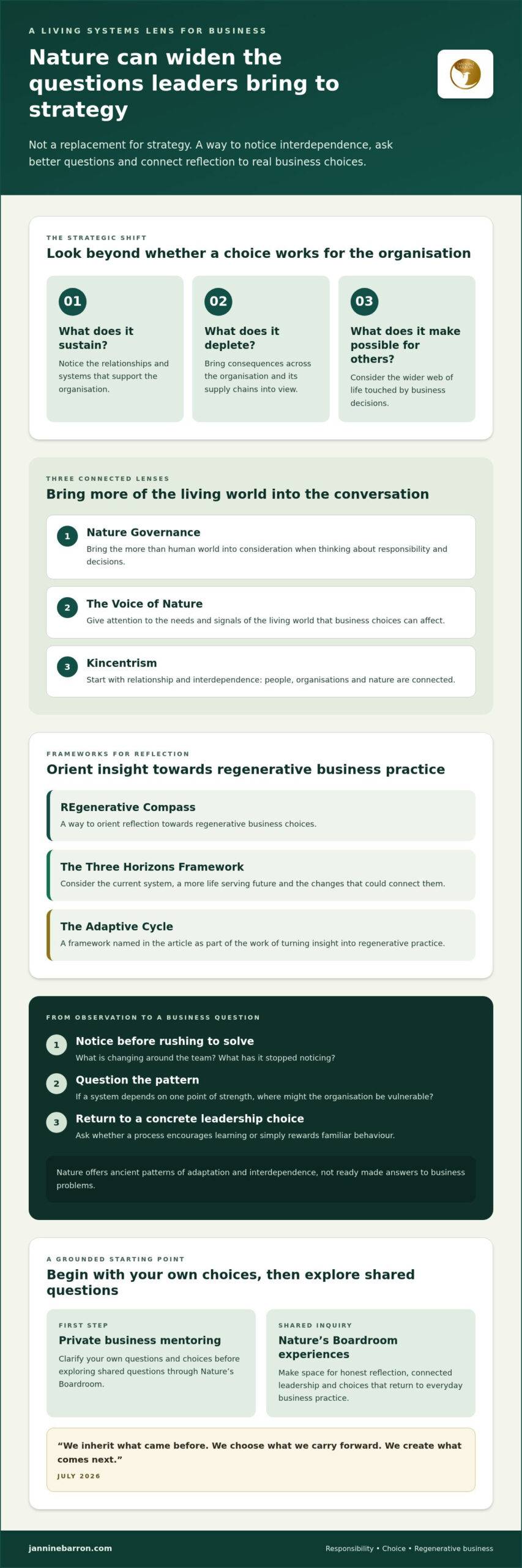
This article explores how Jannine Barron’s private business mentoring offers a first step in a leadership journey, with Nature’s Boardroom experiences creating space for honest reflection and connected leadership. You’ll see how Nature Governance and the Voice of Nature can inform strategic choices, and how the REgenerative Compass, The Three Horizons Framework, The Adaptive Cycle and Kincentrism can help turn insight into regenerative practice. As the guiding words for July 2026 remind us: “We inherit what came before. We choose what we carry forward. We create what comes next.”
Key Takeaways
- An executive retreat facilitator UK leaders work with can help a team move beyond familiar conversations and make space for considered decisions.
- Reflection informed by nature can strengthen strategic thinking by bringing systems, supply chains and responsibility into view.
- Nature Governance, the Voice of Nature and Kincentrism can connect leadership questions with the wider web of life.
- Prepare for more meaningful conversations by noticing inherited assumptions, unresolved tensions and the question your team most needs to face.
- Private business mentoring offers a first step to clarify your own choices before exploring shared questions through Nature’s Boardroom.
Why an Executive Retreat Facilitator in the UK Can Help Leaders See Differently
Leaders step away from the office, but familiar questions often travel with them. The same pressures shape the conversation; the same assumptions guide decisions. A change of setting alone won’t shift the pattern. What might become visible if the team had room to pause, listen and look at its work from another vantage point?
An executive retreat facilitator UK leadership teams can work with helps shape that room. Rather than dictate answers, the facilitator designs purposeful reflection and conversation around questions that matter to the organisation. This is different from event logistics. A useful introduction to the role of a facilitator describes how facilitation helps a group work towards its objectives. In a retreat, that means supporting people to explore, question and decide together.
What an executive retreat facilitator contributes
Some questions are difficult because they touch power, trust or the history of a decision. A skilled facilitator doesn’t rush to smooth over discomfort or supply a preferred answer. They hold a considered space where different perspectives can be heard, including the ones usually set aside. That care makes honest discussion more possible, not less rigorous.
Good structure helps a group move between quiet reflection, open dialogue and practical choices. Leaders might first notice where agreement is being assumed, then explore what different perspectives reveal, and finally identify what needs a decision or further attention. The purpose isn’t to fill every moment. It’s to help the conversation reach somewhere the team couldn’t get to by repeating its usual meeting pattern.
Why UK leadership teams may need a different kind of space
Leadership choices rarely sit within one department. They can reach through an organisation and into supply chains, relationships with communities and the living systems those relationships depend on. Yet the pace of everyday work can make these connections hard to see. What does the team treat as fixed? Which inherited assumptions still serve life, and which are ready to be laid down?
Jannine Barron’s in person retreat work includes Wiltshire and London. Different settings can offer a shift in perspective while the inquiry stays connected to real leadership questions. Through Nature’s Boardroom experiences, reflection can draw on the more than human world without losing sight of organisational realities. The invitation is to notice relationships and interdependence, then consider what those observations mean for business practice. For leaders in Australia, online mentoring offers a way to explore their own questions and choices across distance.
A retreat needn’t resolve every tension in one gathering. It can help a team see where familiar ways of working narrow the conversation, and where a different question might open new possibilities. What would your leadership team notice if it made space to look beyond the answers it already knows?
How Nature Informs an Executive Retreat Without Losing Strategic Focus
Nature can be more than a calming backdrop to business conversation. It can offer a different lens on how systems adapt, depend on one another and respond to change. The point isn’t to replace strategy with metaphor. It’s to widen the questions leaders bring to strategy: what sustains this organisation, which relationships does it rely on, and what consequences travel through its supply chains?
For an executive retreat facilitator UK leaders work with, the task is to connect observation to choices the organisation can actually make. Nature offers ancient patterns of adaptation and interdependence, not ready made answers to business problems. A pattern in a woodland can prompt a useful question. If a system depends on one point of strength, where might the organisation be vulnerable? If growth has reached its limits, what needs renewing rather than expanding?
From observation to leadership insight
Biomimicry invites people to learn from how living systems meet challenges, while forest therapy brings attention to the experience of being present in a natural setting. In a facilitated retreat, these approaches can create space to notice before rushing to solve. What is changing around the team? What has it stopped noticing? Reflection becomes useful when it returns to a concrete leadership question, such as whether a process encourages learning or simply rewards familiar behaviour.
Nature Governance brings the more than human world into consideration when leaders think about responsibility and decisions. The Voice of Nature gives attention to the needs and signals of the living world that business choices can affect. Kincentrism begins with relationship and interdependence: people, organisations and nature are connected, not separate interests to weigh in isolation. Together, these ideas can help a team examine who or what is missing from its usual account of value.
A living systems lens helps leaders ask not only whether a choice works for the organisation, but what it sustains, what it depletes and what it makes possible for others.
The REgenerative Compass can help orient reflection towards regenerative business choices. The Three Horizons Framework offers a way to consider the current system, a more life serving future and the changes that could connect them. The Adaptive Cycle can help leaders reflect on growth, stability, release and renewal. These frameworks give a team language for change without pretending complex transitions follow a straight line.
A facilitated journey from reflection to shared direction
A Nature’s Boardroom experience can move through a simple rhythm: arrive, observe, reflect, discuss and identify possible choices. The facilitator helps the group make meaning together, holding space for differing perspectives rather than forcing quick agreement. The result is not a nature walk followed by unrelated planning. It is a deliberate return from observation to the leadership questions, relationships and business systems under discussion.
For leaders who want to clarify their own role before bringing questions to a wider group, private business mentoring is the first step. Explore the regenerative mentoring process to consider how individual reflection can develop into shared direction.
Can a Nature Led Executive Retreat Deliver Serious Business Outcomes?
Yes, when the work connects to decisions the organisation genuinely needs to face. Reflection in nature doesn’t make a retreat less rigorous. Rigour comes from asking clear questions, hearing what is difficult to hear and examining what the answers might mean for how the business operates. An executive retreat facilitator UK leadership teams work with can hold that inquiry without deciding in advance what the team should conclude.
What makes reflection relevant to business
Unstructured time away may offer rest, but it doesn’t necessarily change how a leadership team sees its work. Facilitated inquiry starts with a live question and follows its threads into practice. A discussion about supply chains, for example, might explore what the organisation values, whose needs shape purchasing choices and where responsibility becomes hard to see. A conversation about organisational habits might ask whose voices are routinely heard and which perspectives are absent.
These questions aren’t an invitation to discard everything inherited. Practices, relationships and knowledge passed down through a business may still serve life. The work is to discern what to keep tending, what has become harmful or limiting, and what is ready to grow. What does the organisation’s history make possible? What does it make difficult? Where does today’s choice carry consequences for people and living systems beyond the leadership team?
We are not responsible for what we inherit. We become responsible the moment we choose what to carry forward. That distinction invites leaders to meet their inheritance with care and discernment, rather than rejecting it wholesale or accepting it without question.
How to recognise useful outcomes without reducing the work to metrics
A retreat can end with more than a strong feeling of connection. The group can record decisions made, questions that remain open and responsibilities participants have agreed to carry forward. It can also note what needs to change in a process, relationship or supply chain, and who will continue the conversation. These records create a bridge between reflection and the work waiting back at the organisation.
Evidence of change is found in what people practise afterwards, not simply in how uplifting the event felt. Are decisions being made with a wider view of their effects? Are unresolved questions being revisited? Are agreed responsibilities shaping everyday choices? These observations don’t promise a particular financial, cultural or environmental result. They help leaders notice whether insight is taking root in practice.
For another perspective on nature informed leadership, explore Corporate Nature Retreat UK: Leading with the Voice of Nature in 2026. The deeper question remains: what will this team choose to carry forward, and what is it ready to create?
How to Prepare for an Executive Retreat and Carry the Work Forward
A retreat begins before anyone arrives. It begins with the question the leadership team most needs to face, not a list of topics that could be handled in any meeting. What decision keeps circling without resolution? What tension is shaping the team’s choices, even when nobody names it? Starting here gives the gathering a clear purpose while leaving room for what may emerge.
Questions to bring into the room
Preparation is not about scripting answers. It is about noticing what leaders might otherwise carry into the room unquestioned. Each participant can reflect on inherited assumptions, unresolved tensions and the connections between the organisation and the systems it depends on. An executive retreat facilitator UK teams work with can use these reflections to help the group meet its central question with more openness and discernment.
Consider bringing questions such as:
- What has the organisation inherited, and which parts still serve life?
- Which decisions affect people, place, supply chains and future generations?
- What are we uncertain about, and what choice are we ready to make now?
- What might we need to lay down, protect or grow?
Invite participants to bring observations, not only positions. One leader may see a policy as reliable because it has endured; another may notice how its effects travel through supplier relationships or staff experience. Both perspectives matter. The purpose is not to condemn inherited practices or preserve them unquestioned, but to understand what they make possible and what they constrain.
Turning retreat insight into ongoing responsibility
Before the group leaves, capture a small number of commitments in words participants can return to. For each one, record the decision or question, who will carry it forward and where the group will review progress. Keep the language specific enough to guide action, but open enough to reflect learning still unfolding. If uncertainty remains, name it rather than disguising it as agreement.
Connect those commitments to existing meetings and decision processes. A question about purchasing can return to the relevant supply chain discussion; a change in how the team listens can be revisited in its regular leadership conversation. This keeps the work rooted in the organisation’s actual rhythms instead of creating another layer of activity that competes for attention.
Responsibility begins with what leaders choose to carry forward. What will they keep tending, and what will they now create together? A Nature’s Boardroom experience can make space for this reflection, while private business mentoring offers a first step for leaders clarifying their own role and choices. Explore the regenerative mentoring process to consider how personal discernment can support responsibility in practice.
Begin with Private Mentoring, Then Explore Nature’s Boardroom
A leadership journey can begin with one person taking time to examine their own choices. Before asking a whole team to change direction, a leader may need space to notice what they are carrying into the work: an inherited belief about success, a relationship that needs attention or a responsibility they have not yet named. Private business mentoring offers that first space for reflection.
Why begin with private business mentoring
In a private mentoring conversation, there is room to explore the leader’s intentions without needing to represent the whole organisation. What do they want their leadership to make possible? Which patterns are they repeating, and which are ready to change? What responsibilities come with the decisions they influence across people, place and supply chains?
These questions are personal, but not separate from strategy. A leader’s assumptions and choices can shape organisational priorities, relationships and the systems through which work gets done. Regenerative business strategy asks how those choices might support conditions for life while staying grounded in the realities of the organisation. This is not a formula for predetermined answers. It is a way to develop discernment about what to sustain, what to release and what to nurture next.
As a wayfinder and regenerative business mentor, Jannine Barron helps leaders explore their role before deciding what questions belong to the wider team. The private mentoring and programmes offer a view of the wider pathway for leaders considering how individual reflection can connect with their development and business practice. Online mentoring can support leaders in both the UK and Australia.
When Nature’s Boardroom can help a leadership team
When a question belongs to the group, Nature’s Boardroom experiences offer a facilitated immersion in nature for collective reflection and strategic conversation. The setting creates a different context for listening and inquiry. It doesn’t supply an instant answer or ask leaders to leave business realities at the door. Instead, the team can bring its live questions into relationship with the more than human world and consider how its choices affect interconnected systems.
That may mean examining how an organisational habit influences a supplier relationship, or whether a familiar measure of success recognises the needs of people and place. Nature Governance, the Voice of Nature and Kincentrism can widen the conversation about whose interests and relationships shape a decision. The focus remains on what this particular team needs to understand and choose, not on promising a predetermined transformation. Nature’s Boardroom experiences create space for this shared exploration.
Private mentoring can clarify a leader’s own questions; a facilitated team experience can bring those questions into conversation with other perspectives and make them shared inquiry. If you’re ready to explore your own role and choices, begin a conversation about private mentoring.
Choose the Next Step That Serves Life
What could shift if your next leadership decision began with a different question: not only what will move the organisation forward, but what kind of future are its choices helping to create? The work of an executive retreat facilitator UK leaders can work with is ultimately about making room for that discernment, then letting it shape how people lead and work together.
Jannine Barron brings regenerative business strategy into conversation with practice informed by nature. Through private mentoring and Nature’s Boardroom immersion days, leaders can explore their choices with Nature Governance, the Voice of Nature and Kincentrism in view. Not as abstract ideals, but as ways to consider relationship, responsibility and the life their decisions sustain.
The next step needn’t be a team retreat. It can begin with your own questions: what are you ready to carry forward, and what might you now help bring to life? Begin with a private mentoring conversation, and give that inquiry room to take root.
Frequently Asked Questions
What does an executive retreat facilitator do?
An executive retreat facilitator UK leaders work with helps a leadership group make progress on questions that routine meetings leave unresolved. They shape the conversation, support balanced participation and help the group clarify what needs deciding. Jannine Barron works with leaders in the UK and Australia, bringing regenerative business perspectives into facilitation. The facilitator guides the process, while the team remains responsible for its choices and actions.
Can an executive retreat facilitator help with strategic planning?
Yes. A facilitator can help leaders examine a strategic choice from several angles before settling on a direction. For example, a proposed change to sourcing could be explored alongside its implications for supplier relationships, organisational priorities and long term resilience. The facilitator doesn’t make the decision for the team. They help clarify assumptions, identify tensions and distinguish what the group can decide now from what needs further inquiry.
How is a nature based executive retreat different from a conventional away day?
A nature based retreat uses the living setting as part of the inquiry, rather than treating it only as a pleasant backdrop. Participants might notice how conditions change, what supports resilience or where different forms of life depend on one another, then connect those observations to a current leadership challenge. The value lies in the guided connection between attention, reflection and business choices, not simply in holding a meeting outdoors.
Can executive retreat facilitation support conversations about supply chains and systems change?
Yes. Facilitation can help a team trace how a decision travels beyond its immediate purpose. A discussion about procurement, for instance, might consider how purchasing criteria shape supplier relationships and what those relationships mean for people and place. This wider view can reveal where a business process reinforces an old pattern or opens room for change. Leaders can then identify which part of the system they have influence to address.
What should leaders bring to an executive retreat?
Bring one live question the team is genuinely willing to examine, along with relevant examples or decisions that make the issue tangible. It can also help to notice your own assumptions: what do you believe is fixed, and what evidence might challenge that belief? Leaders don’t need to arrive with polished answers. Naming what feels uncertain can help the group distinguish a real point of disagreement from a question that has not yet been explored.
How can a leadership team carry retreat decisions into everyday work?
Make each decision visible in the place where related work is already reviewed. A commitment about supplier relationships, for example, can be revisited during an existing procurement discussion, with the team checking whether its choices reflect the intention agreed. If circumstances change, treat that as information for the next decision, not a reason to abandon the commitment automatically. This keeps learning connected to practice and gives responsibility a place in the working rhythm.
Can private mentoring be a useful first step before a leadership retreat?
Yes. Private mentoring gives a leader space to explore their own role before bringing a question to colleagues. They might clarify where they have influence, what responsibility they hold and how their assumptions could affect the team’s discussion. That preparation can help them contribute with greater intention, without arriving with a fixed answer the group is expected to accept. It is a grounded starting point for a wider leadership journey.