
The right mentoring begins with fit, not grand promises. Executive mentoring for female founders in the UK can create space to work through strategic decisions, strengthen leadership and build confidence in your business direction. The Female Founders programme requires applicants to have generated consistent sales revenue during the previous three years.
It is reasonable to expect more than encouragement: useful support should meet the realities of leading a business, from growth choices to the personal weight of responsibility. This article explains what mentoring can involve, the outcomes it may support and how eligibility criteria can help you assess which UK programme suits your stage.
It also considers what changes when leadership is viewed through nature governance and the voice of Nature, asking not only what a business can grow, but what it chooses to carry forward. “We inherit what came before. We choose what we carry forward. We create what comes next.” This July 2026 principle offers a grounded way to think about the next chapter.
Key Takeaways
- Use mentoring to think through strategic choices, strengthen leadership and build a more useful network of support.
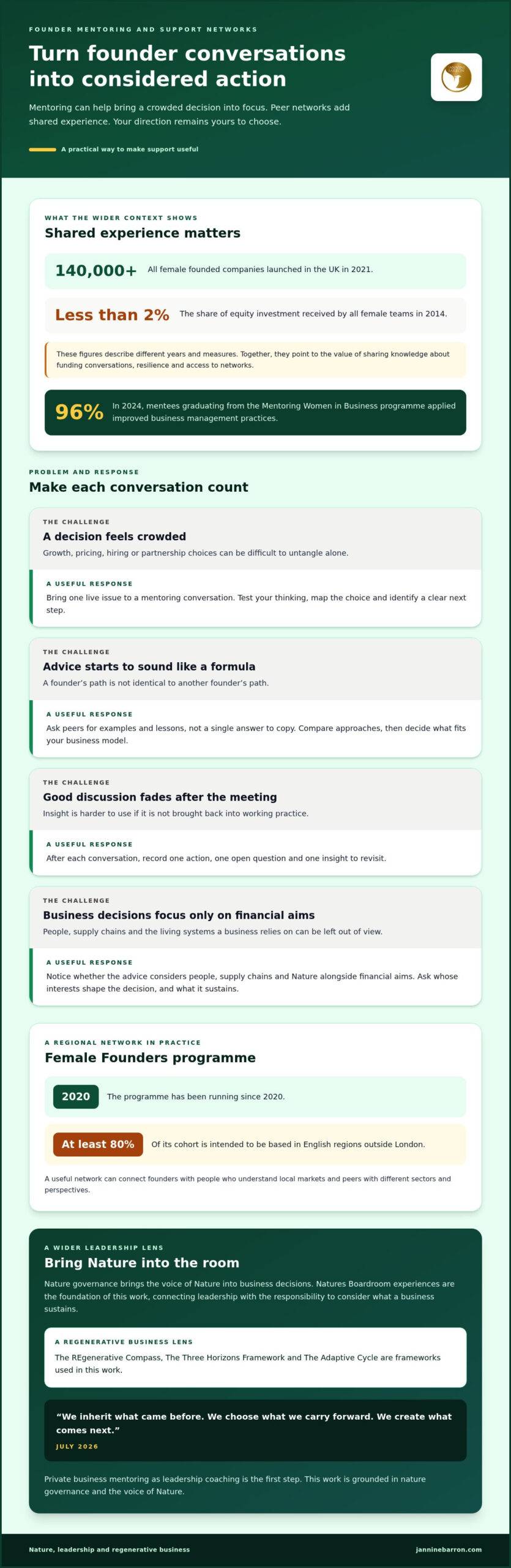
- Look beyond confidence: in 2024, 96% of mentees graduating from the Mentoring Women in Business programme applied improved business management practices.
- Compare programme formats, including online workshops, in person sessions and how mentors are matched to your goals and practical needs.
- Assess a mentor’s relevant experience, listening skills and ability to challenge your thinking while respecting your direction as a founder.
- Bring Nature into the leadership conversation by considering how nature governance and the voice of Nature can inform business decisions and long term responsibility.
Benefits of mentoring and support networks
For a founder, good mentoring can turn a crowded decision into a clear next step. A mentor can help you test a growth plan, prepare for a difficult conversation or consider whether your business model serves its purpose. Strong discussions connect commercial choices with leadership, relationships and nature. This wider view brings nature governance into the room: whose interests shape a decision, and what does it sustain?
Peer networks add something different: founders compare experience without assuming every business follows the same path. More than 140,000 all female founded companies launched in the UK in 2021. Yet in 2014, all female teams received less than 2% of equity investment. Those figures describe different years and measures, but they make a practical case for sharing knowledge about funding conversations, business resilience and access to networks.
Peer learning works best when discussion has a clear purpose. Bring one live issue, such as deciding whether to hire or refining a supply chain, and ask how others approached it. A founder who has faced a similar decision can offer useful questions, while you remain responsible for your choice. A group can also reveal recurring barriers that feel individual until several founders describe them.
Networks can widen the circle beyond a founder’s immediate contacts. The Female Founders programme has been running since 2020, and at least 80% of its cohort is intended to be based in English regions outside London. That regional focus matters for founders building relationships away from the capital. A useful network includes people who understand local markets, as well as peers with different sectors and perspectives.
Online networking can make connections easier to maintain across distance. Take a focused approach: choose one relevant founder community, attend a session, then follow up with a specific question or an offer to share experience. An online discussion about supplier choices, for example, can lead to a practical exchange about responsible sourcing. Set clear boundaries and protect confidential details when discussing customers, staff or finances.
What risks or red flags should female founders look for when choosing a mentor? Be cautious if someone guarantees results, pressures you to follow their approach or treats your business information casually. A mentor should explain their role, listen to your priorities and welcome questions about confidentiality and boundaries.
To make mentoring and peer support useful, try these steps:
- Set one decision to explore before each meeting, such as pricing, hiring or partnership choices.
- Ask peers for examples and lessons, not a single formula to copy.
- After each conversation, record one action, one open question and one insight to revisit.
- Notice whether the advice considers people, supply chains and Nature alongside financial aims.
Support becomes more valuable when reflection leads to considered action. A founder network can offer belonging and shared experience; mentoring can create space to examine assumptions and choose a direction. Together, they can strengthen leadership that recognises interdependence, including the living systems businesses rely on.
Mentee business and personal development outcomes
Mentoring can turn a broad ambition into a decision you can act on. A founder preparing to hire, for example, can map the role, timing and impact on cash flow. A conversation can also bring the personal side into view: what responsibility to delegate, which boundaries to protect and how to lead through uncertainty. The value lies in clearer judgement, not in someone else making the choice.
One-to-one mentoring gives a founder dedicated space to examine a live business challenge. Business coaching may use structured questions and agreed goals to support action and reflection, while services like YESS Life Coaching highlight how focusing on mindset transformation and personal empowerment can strengthen broader leadership capability. The terms can overlap, so focus on the work itself: will sessions address your decisions, leadership habits and business context? Ask how progress will be reviewed, and bring a specific issue rather than expecting a ready-made formula.
There is evidence of practical outcomes. In 2024, 96% of mentees graduating from the Mentoring Women in Business programme applied improved business management practices. That measure points to a useful test for any support: what will change in your working practice? You might set a clearer review rhythm, improve how you assess risk or make responsibilities easier to see across your team.
Women’s business networks and communities can complement private reflection with shared experience. A founder considering expansion, for instance, can learn how peers approached supplier capacity, hiring or customer demand. Use a community to compare approaches, then decide what fits your business model. A strong network welcomes honest questions and different stages of growth instead of treating every founder’s path as identical.
Monthly business webinars can provide a regular prompt for learning, especially when travel or location makes in-person events difficult. Choose a session tied to a current need, such as cash flow planning or preparing for a partnership conversation. Before attending, write down a question. Afterwards, identify one action to test and one idea to consider further. This keeps online learning connected to decisions.
When planning business growth and scaling, distinguish the desire to expand from the capacity to do so well. Examine demand, team readiness, supplier relationships and the effect of growth on quality. For founders seeking to strengthen internal capabilities, consultancies such as Humanise Solutions offer bespoke programmes to nurture leadership and foster team excellence. A founder planning a new product line could map existing capabilities and identify what needs developing. This makes growth a sequence of choices, not a race towards expansion for its own sake.
- Set one business goal and one personal leadership goal for the next mentoring conversation.
- Track a visible practice, such as clearer delegation or a regular review of priorities.
- Use a peer community to gather perspectives, then choose what fits your circumstances.
- After a webinar, record one practical action and when you will revisit it.
Personal development also means noticing what your leadership serves. Nature governance invites founders to consider the living systems connected to business decisions, including people, place and supply chains. Ask what a proposed growth step sustains and what it may put under strain. That question can help align commercial progress with responsibility, care and the voice of nature.
UK mentoring and support programmes for female entrepreneurs
UK programmes differ in their eligibility, application process and level of support. Female Founders is one example, with applications scheduled to close on Wednesday 8th July 2026. Its programme is scheduled to run from September 2026 to April 2027. These dates help founders assess whether a programme fits their plans and timing.
Eligibility can depend on business stage and trading history, not just a founder’s ambition. Female Founders applicants must have generated consistent sales revenue during the previous three years. Before applying, set out when sales began and how revenue developed. This gives you a clear basis for describing your business against the programme’s stated criteria.
The Female Founders schedule combines online learning with in-person connection. It includes eight half-day online workshops and four in-person and networking sessions. This mix offers structured learning alongside opportunities to build relationships. Consider whether the workshop format suits your commitments and whether you can attend the in-person sessions in the locations provided.
Are mentoring schemes available by UK region, including Scotland, Wales and Northern Ireland? Programme reach and eligibility vary, so a regional cohort does not automatically mean nationwide access. At least 80% of the Female Founders cohort is intended to be based in English regions outside London; that target does not establish equivalent regional coverage elsewhere in the UK.
Onboarding gives selected participants a practical start. Female Founders participants complete online training that takes around 1.5 hours. Use that time to understand the programme’s structure and prepare for taking part. Before beginning, gather a concise account of your business, its current priorities and the questions you want mentoring to help you explore.
Mentor matching can shape the value of the relationship. The Female Founders process considers alignment between topics and skills, as well as practical factors such as complementary time zones. Write down the challenges where relevant experience would help, then separate them from questions you want to explore with fresh perspective. Clear priorities make it easier to judge whether a proposed match supports your development.
Compare programmes using a short list of practical questions:
- Does your business stage meet the stated eligibility criteria?
- Can you take part in the online workshops and in person sessions?
- Does the mentoring address your priorities and relevant business topics?
- Does the programme’s regional focus fit where you are based?
Programme support is most useful when learning connects with decisions in your business. Bring a workshop insight to a mentoring conversation, for example, then identify one change to test in your planning or leadership. Keep a brief record of actions and questions between sessions. This helps you carry useful learning forward while remaining responsible for the choices shaping your business and its relationship with nature.
Female founder eligibility
Eligibility is programme-specific, so distinguish formal entry criteria from whether the support suits your business. Female Founders applicants must have generated consistent sales revenue during the previous three years. This is a trading-history requirement, not simply a statement of future ambition. The practical task is to show how your business has earned revenue across that period.
Prepare a clear account before completing an application. Map the previous three years in sequence, noting when sales began and how trading continued. For example, explain a seasonal pattern or a period when your business model changed. This provides context without suggesting that every month or product must have performed identically.
Keep sales revenue distinct from other measures. A business may have a compelling purpose, a promising product or strong customer interest, yet still need to demonstrate the required revenue history. Before applying to Female Founders, make sure your description addresses consistent sales revenue directly. Use plain language and connect each statement to the relevant trading period.
Eligibility is only the first question. Consider whether the programme’s learning and mentoring address your business’s current needs. A founder preparing to strengthen operations, for instance, may want structured input on management, while an earlier-stage venture may focus on testing its offer. Write down the decision you want support with, then compare it with the programme’s stated purpose.
Preparing an application can also sharpen your thinking. Draft a concise summary of what the business offers, who it serves and how trading has developed over the previous three years. Add an example of a challenge you want to work through. A concrete example, such as a change in customer demand or a new route to market, gives a clearer picture than broad claims about growth.
Use this short preparation sequence before submitting an application:
- Set out the previous three years of trading in chronological order.
- Describe how sales revenue has been consistent across that period.
- Explain any seasonal changes or shifts in the business model with context.
- Identify one current business decision that mentoring could help you examine.
- Match your goals to the programme’s stated eligibility and support focus.
These steps help you make a grounded assessment rather than applying on identity or ambition alone. They can also support a more thoughtful conversation about leadership. How might the next stage of your business serve people, place and nature? Consider that question alongside your trading history to connect eligibility with responsibility and the kind of regenerative business you choose to grow.
What qualifications and experience should a mentor for a female founder have?
A useful mentor brings relevant experience, sound judgement and the ability to listen. For a founder preparing to enter a new market, experience with similar decisions may matter more than a general business title. Ask what the mentor has learned from comparable situations and how they adapt that knowledge to your company rather than prescribing a copied solution.
Qualifications can help explain a mentor’s approach, but they are only part of the picture. Ask about training in mentoring, leadership or a relevant professional field, then explore how it informs their sessions. A credential alone cannot show whether someone listens well. Ask for a practical example of how they would help you weigh a hiring decision without taking ownership of it.
Experience should connect with the challenge you want to address. If your immediate question concerns team growth, look for familiarity with delegation, organisational change or building leadership capacity. If it concerns supply chains, ask how the mentor approaches supplier relationships and long-term resilience. Relevant experience need not be identical; it means the mentor can offer useful questions and a grounded perspective.
For executive mentoring for female founders in the UK, context matters as much as a polished biography. Ask how a mentor understands the pressures female founders may face and whether they can discuss them without reducing your business to gender. A strong conversation makes room for your priorities, whether they involve investment decisions, confidence in a boardroom or balancing growth with care for your team.
Use an introductory conversation to assess fit. Bring a live example, such as deciding whether to expand a product line, and notice how the mentor responds. Do they ask about customers, capacity and consequences, or jump straight to advice? Do they explain their boundaries and treat sensitive business information respectfully? These are practical signs of what the working relationship may feel like.
Before choosing, consider these points:
- Relevant experience: can they discuss a business challenge close to yours?
- Approach: do they ask questions and explain how sessions support your thinking?
- Context: can they understand your sector, stage and leadership responsibilities?
- Boundaries: are confidentiality, expectations and the mentor’s role discussed clearly?
- Fit: can you disagree, reflect and still retain responsibility for your decisions?
Qualifications and experience are most valuable when they support your agency as a founder. Nature governance can widen the questions a mentor helps you consider: how might a decision affect people, place and the living systems connected to your business? A mentor need not claim to speak for nature; they should be willing to help you listen more carefully and examine consequences.
Explore a reflective mentoring process to consider how your leadership questions can meet the needs of a regenerative business.
Jannine Barron: Private Mentoring
Jannine Barron’s Private Mentoring begins with leadership coaching as the first step: a space to examine how you lead, what your business needs and which choices are yours to make. The REgenerative Compass can help orient that reflection, while The Three Horizons Framework and The Adaptive Cycle offer ways to consider change, transition and what may come next.
Grounded in Nature’s Boardroom experiences, this approach connects regenerative business with nature governance and the voice of Nature. It can help you look beyond immediate pressures and consider how your decisions shape relationships with people, place and living systems. If you want to explore whether this reflective work fits your current leadership questions, you can contact Jannine Barron.
Choose the kind of growth you want to create
Executive mentoring for female founders in the UK can create space to question not only how your business grows, but what that growth is for. Start by naming the decision you are carrying: a direction to test, a pattern to change or a responsibility you are ready to hold differently.
Nature governance offers a wider lens. It asks leaders to consider the living systems connected to their choices, including people, place and supply chains. What might change if the voice of nature had a place in setting your priorities? This is not about rejecting everything inherited. It is about discerning what still serves life and choosing what to grow next.
“We inherit what came before. We choose what we carry forward. We create what comes next.” This July 2026 reflection can be a starting point for your own leadership choices, not a demand for instant certainty.
If you are ready to explore what thoughtful mentoring could make possible, contact Jannine Barron to discuss mentoring. Your next step can begin with one honest question, and a willingness to listen for what wants to change.
Frequently Asked Questions
What is involved?
Executive mentoring involves focused conversations about your leadership and business decisions, followed by reflection and practical action. You might bring a decision about delegation, a partnership or changing priorities. The mentor helps you examine assumptions and consequences, while you remain responsible for deciding what to do. Sessions work best when you arrive with a specific challenge and leave with a question or action to carry into your working week.
What executive mentoring programmes are available for female founders in the UK?
Options include cohort programmes such as Female Founders and Mentoring Women in Business, alongside individual mentoring. Cohort formats can combine shared learning with mentor support, while private mentoring centres on your own business questions. Compare each option with your current needs. A founder seeking varied peer perspectives, for example, may prefer a cohort, while a sensitive leadership decision may call for one-to-one reflection.
Which UK organisations offer mentoring specifically for women entrepreneurs and founders?
Female Founders and Mentoring Women in Business are named programmes for women in business or founding roles. Jannine Barron also offers Private Mentoring for founders seeking individual support. The options differ in format and focus, so consider whether you want a cohort experience, dedicated mentoring or both. Look for a clear connection between the mentor’s approach and the business questions you need to work through.
Are there free or subsidised mentoring programmes for female founders in the UK?
Some mentoring places may be supported through programme funding, while other routes may involve a fee. The funding model depends on how a programme is delivered and who supports its places. Before choosing, distinguish mentoring from related workshops, events or wider business support, as these may have separate arrangements. If cost matters, include affordability and any funding conditions in your comparison from the outset.
How can UK female founders apply for mentoring programmes, and what are the eligibility rules?
Start by matching your business stage and goals to the programme’s published criteria, then prepare a clear account of your trading history and priorities. Female Founders requires applicants to show consistent sales revenue across the previous three years. Other schemes may use different entry conditions or selection processes. In your application, explain your business plainly and identify the decisions you want support to explore.
What should founders expect from a mentoring relationship, and how often should sessions happen?
Expect a confidential, purposeful conversation where you set the agenda, explore options and agree what to consider next. Session frequency should reflect your priorities, the mentoring arrangement and the time you can give to follow through. A founder facing a major decision may need a different rhythm from someone reviewing longer-term leadership habits. Agree expectations, preparation and boundaries early, then review whether the cadence remains useful.
Do UK mentoring programmes support fundraising, scaling, leadership and work life balance?
Programme focus varies. Mentoring may help you prepare questions about fundraising, assess the capacity needed for scaling, or examine leadership choices and boundaries between work and home. Support means structured thinking, not a promise of investment or a particular result. You can also widen the discussion through nature governance: how might a growth decision affect your team, supply relationships and nature, as well as commercial aims?