
Most business founders begin in the same place: with an idea, a desire to make a living, and the hope that their work will contribute something meaningful to the world. The usual guidance is familiar. Write a business plan. Find your market. Grow quickly. Scale if you can.
For decades this model has shaped how we are taught to build companies. Yet many thoughtful founders quietly feel the tension inside it. The faster a business grows, the more pressure there can be to compromise values, relationships, or the living systems that ultimately support the economy itself.
This is where a different question begins to emerge. If business is part of a living world, should it not be designed more like one?
Discover how a nature aligned business incubator curriculum replaces extractive growth with regenerative systems. Traditional accelerators, with their relentless focus on speed and scale, can feel alienating, forcing a choice between your values and your venture’s viability.
But what if there was a different path? A curriculum designed not like a factory assembly line, but like a vibrant, inspiring ecosystem. Knowledge that nurtures resilience, strengthens interconnection, and supports systems that are inherently life affirming. The qualities that are vital for a future-fit company.
This guide explores the essential components of a regenerative business incubator curriculum, a framework designed for ethical founders ready to build enterprises that heal, connect, and flourish. You can also jump straight to our Process Page to get to know The Regenerative Business Compass
Beyond the Pitch Deck: Why Traditional Business Incubator Curricula Fail Ethical Brands
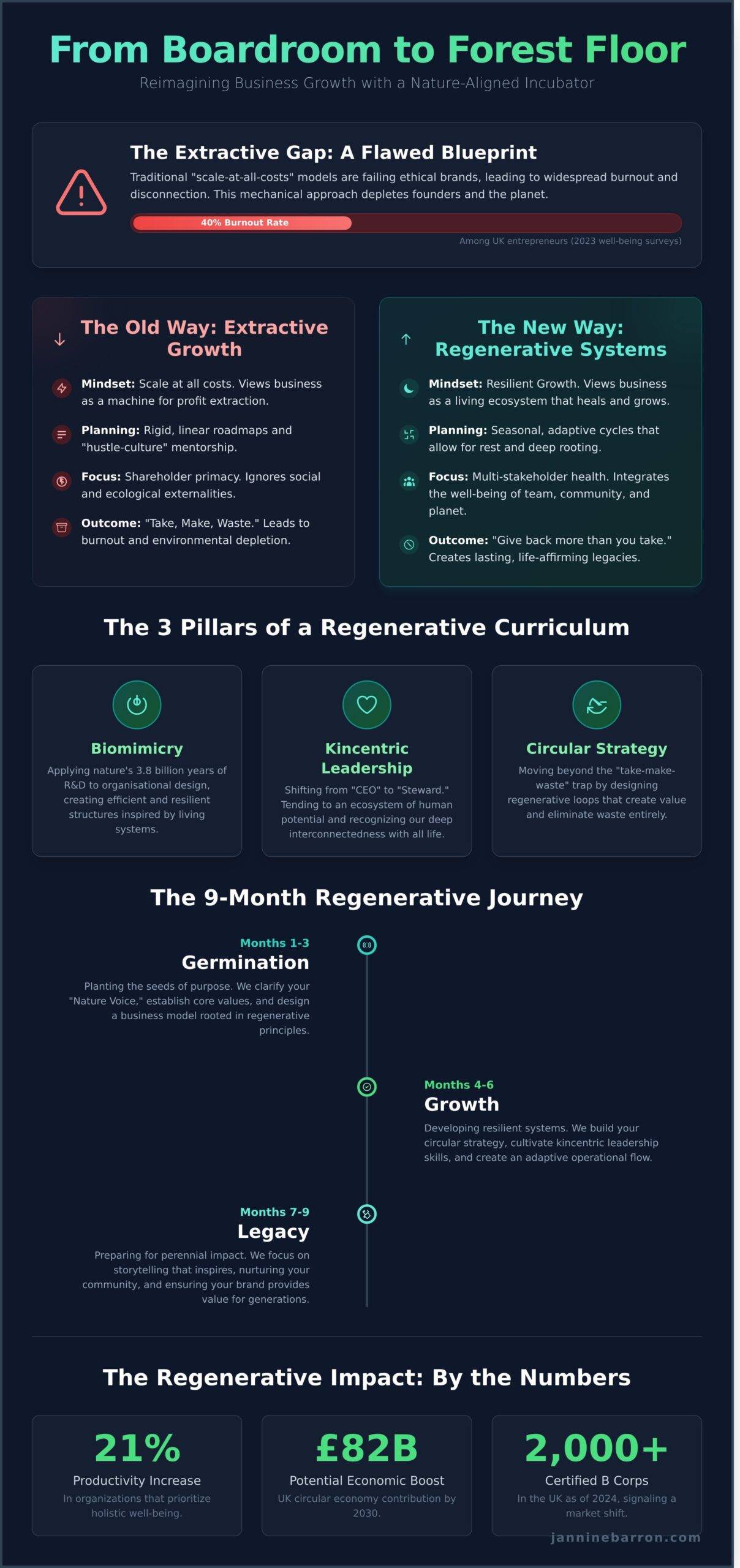
For too long, business education has operated with a significant blind spot: the “Extractive Gap”. This is the chasm between conventional models of success, measured purely in financial terms, and the true, holistic health of a business and its environment. A traditional business incubator curriculum often widens this gap, championing a “scale at all costs” mentality that ignores the ecological and social consequences of rapid, unchecked expansion.
As we navigate the complex challenges of the coming years, it’s clear this model is not just unethical; it is unsustainable. The shift toward regenerative business is no longer a niche preference but a strategic necessity for any brand hoping to remain relevant and resilient.
The Limitations of Linear Growth Models
Conventional business curricula often treat enterprises like machines: input, output, efficiency. This mechanical worldview leads to linear growth models that demand perpetual, exponential expansion, a pattern that is simply not found in healthy, living systems. The result is a cycle of burnout for founders and extraction from the planet. Mentorship within this framework often defaults to a “hustle culture” narrative that depletes the very life force of the entrepreneur.
Regenerative incubation, in contrast, is the practice of carefully birthing and nurturing life affirming enterprises that contribute to the health of the whole system. It sees a business not as a machine to be optimised, but as an organism to be stewarded.
The Rise of the Conscious Founder
A new generation of founders is emerging, leaders who feel a profound disconnect between their personal values and the corporate strategies they are taught. These entrepreneurs recognise that to build a truly ethical brand, they need a “Nature Voice” embedded in their foundational training. In the UK startup ecosystem and beyond, there is a growing demand for a different kind of leadership, one that is rooted in connection, responsibility, and a deep sense of kinship with the world we inhabit.
The 4 Pillars of a Regenerative Business Incubator Curriculum
To build a business that is truly fit for the future, its educational foundations must rest on principles that honour life. A regenerative business incubator curriculum is built upon four interconnected pillars that shift the focus from extraction to stewardship.
-
Biomimicry: Using nature’s 3.8 billion years of research and development for organisational design.
-
Kincentric Leadership: Shifting from the mindset of a “CEO” to that of a “Steward” responsible for an entire ecosystem.
-
Circular Strategy: Moving beyond the passive goal of sustainability to the active work of restoration.
-
The Living Economy: Redefining profit and success through the lens of thriving, interconnected systems.
Biomimicry in Business Strategy
Why invent new solutions when the most successful models are all around us? By applying the principles of forest ecology, a business can learn to understand market positioning not as a battle for dominance, but as finding a niche within a diverse ecosystem. We can learn from the collaborative, modular growth of mycelial networks as an alternative to aggressive viral expansion. A core part of this curriculum involves practical exercises for founders, guiding them to observe and learn from natural systems as the ultimate strategists.
Kincentric Leadership and Team Culture
The old command and control hierarchy is brittle and inefficient. A regenerative approach fosters a move from hierarchy to holarchy, creating self organising teams that are more resilient and adaptive. This requires leaders to cultivate deep empathy and to make decisions in consultation with a “Nature’s Boardroom”—a practice of considering the impact of choices on all stakeholders, including the non human. This fosters a culture of “Gondozás” (a Hungarian term for deep, intentional nurturing) within a high performance team.
Linear vs. Regenerative: Comparing Curriculum Frameworks for 2026
The difference between a traditional and a regenerative business incubator curriculum is not merely semantic; it is a fundamental divergence in worldview, strategy, and the very definition of success. The table below illustrates this critical distinction.
| Aspect | Linear Curriculum (Traditional) | Regenerative Curriculum (Nature Aligned) |
|---|---|---|
| Strategic Planning | Five year rigid plans based on market prediction. | Seasonal, adaptive cycles based on observation and response. |
| Financial Success | Shareholder primacy and maximising financial ROI. | Multi stakeholder flourishing, measuring success across multiple capitals. |
| Marketing | Manipulative persuasion and creating artificial demand. | Authentic storytelling and cultivating a genuine “Nature Voice”. |
| Operational Flow | Efficiency at any cost, often leading to burnout. | Healthy rhythms and founder wellbeing as a strategic priority. |
Redefining the “Minimum Viable Product”
The tech world’s concept of the Minimum Viable Product (MVP) is focused on launching the simplest version of a product to test the market. A regenerative curriculum evolves this idea into the “Minimum Viable Ecosystem” (MVE). The MVE asks a more profound question: what is the smallest version of our offering that begins to give back more to its environment than it takes? This ensures that from the very beginning, the business is designed for positive impact, creating a circular model that inherently outperforms its linear competitors in the UK and elsewhere by building loyalty and resilience.
The Role of Mentorship and the “Business Doula”
Traditional business coaching often focuses on accountability, pushing founders to hit metrics and scale faster. Regenerative mentoring, a path I have walked with founders for over 30 years, is different. It is the work of a “Business Doula” a guide who helps birth a business with soul and intention. This works for start ups and existing business in a redesign phase. A rebrand changes nothing, a rethink to relaunch with regeneration changes everything. Our approach recognises that a thriving enterprise is inseparable from a thriving founder.
That is why The Growth Experience focuses so deeply on the founder’s inner landscape, creating the conditions for both personal and professional growth to unfold in harmony.
Designing for Life: How to Audit an Incubator Programme for Nature Alignment
When you are searching for a business incubator curriculum, how can you tell if it is truly aligned with regenerative principles? Here are five steps to audit any programme and assess its integrity.
-
Check the Definition of "Success": Scrutinise the programme syllabus and marketing materials. Do they define success exclusively through financial metrics like valuation and exit strategy, or do they speak of impact, wellbeing, and ecosystem health?
-
Evaluate the Mentor Network: Look at the mentors involved. Is it a homogenous group of venture capitalists and serial entrepreneurs, or does it represent a diverse ecosystem of thinkers, ecologists, community builders, and artists?
-
Look for Modules on Systemic Impact: A truly regenerative curriculum must include modules on systems thinking, circular economy principles, and measuring social and environmental impact. If these are absent, the programme is likely still operating within a linear framework.
-
Assess the Approach to Founder Wellbeing: Does the schedule look like a recipe for burnout? Or are there integrated practices for rest, reflection, and personal resilience? A programme that doesn’t care for the founder cannot claim to be regenerative.
-
Verify the Inclusion of Embodied Practice: Look for elements like a “Nature’s Boardroom” or opportunities for outdoor immersion. True alignment comes not just from theory but from a felt, embodied connection to the living world.
Questions to Ask Potential Incubator Directors
-
How do you measure social and environmental return on investment alongside financial returns?
-
Is there space in the curriculum for slow, intentional growth and deep root building?
-
How does your curriculum directly address the realities of the climate crisis and biodiversity loss?
The Importance of Local and Seasonal Context
A regenerative business is rooted in its place. A London based ethical brand needs a different support structure than a Silicon Valley tech startup. An effective curriculum will honour this, helping founders align their business milestones with the natural cycles of their specific bioregion, whether in urban London or rural Wiltshire and Somerset. It understands that authentic growth is local, seasonal, and deeply contextual.
For more on choosing the right support, explore our guide to finding a Business Incubator for Ethical Brands.
The Growth Experience: A Nine Month Journey into Regenerative Leadership
If this vision for a different way of doing business resonates with you, I invite you to explore The Growth Experience. This is my flagship nine month incubator programme, a deep journey for a small cohort of UK based founders ready to move beyond outdated models. It is a curriculum rooted not in the sterile environment of a boardroom, but in the living wisdom of forest therapy and biomimicry. Here, you will join a community of regenerative leaders committed to building a more beautiful world. After five years this process has proved life changing and business shifting for many founders.
The Curriculum Roadmap
The nine month journey is designed to mirror a natural growth cycle, moving from deep inner work to expansive outer impact.
-
Months 1-3: Rooting and Identity: We begin by clarifying your core purpose and cultivating your unique “Nature Voice”.
-
Months 4-6: Branching and Connection: You will design your business model as an ecosystem, forging collaborative strategies and resilient connections.
-
Months 7-9: Flowering and Legacy: The focus shifts to amplifying your regenerative impact, ensuring your business leaves a lasting, positive legacy.
Real World Transformation
Founders who graduate from The Growth Experience leave with more than just a business plan. They leave with a renewed sense of purpose, a powerful community, and the tools to lead with courage and clarity, escaping the burnout that plagues so many in the conventional startup world. The tangible results are not just profitable businesses, but flourishing leaders who are actively regenerating their communities and ecosystems.
Apply for The Growth Experience
Frequently Asked Questions
What is the difference between a traditional business incubator and a regenerative one?
A traditional incubator focuses primarily on rapid growth and financial return, often using a standardised, linear curriculum. A regenerative incubator takes a holistic, ecosystemic approach, designing its curriculum to foster the wellbeing of the founder, the community, and the environment alongside financial viability. Its goal is to create businesses that are resilient, adaptive, and net positive.
Can a regenerative business curriculum still lead to high financial profits?
Absolutely. A regenerative approach views financial capital as just one of several important forms of wealth, including social, ecological, and cultural capital. By building a business with deep roots, a loyal community, and a resilient structure, you create the conditions for long term, sustainable profitability, avoiding the boom and bust cycles of extractive models.
How long does a typical regenerative business incubator programme last?
Regenerative growth is intentional, not rushed. While traditional accelerators might last 12 weeks, regenerative programmes are often longer to allow for deeper integration. The Growth Experience, for example, is a nine month journey, mirroring the cycles of nature and allowing for true, lasting transformation.
Is a nature aligned curriculum suitable for tech startups or just “green” brands?
The principles of regeneration and biomimicry are universal and can be applied to any industry. Whether you are building a software platform, a consultancy, or a physical product, a nature aligned curriculum can help you design a more resilient organisation, foster a healthier team culture, and build a more meaningful brand. The focus is on how you operate, not just what you sell.
For instance, tech platforms building new marketplaces or communities often need to embed financial services, and there are now infrastructure providers that make this possible even for non-financial companies.
What are the core modules I should look for in an ethical business incubator?
Look for modules on systems thinking, biomimicry, circular economy design, multi stakeholder governance, and authentic marketing. Crucially, a strong programme will also have a core focus on founder wellbeing, leadership development, and building personal resilience.
How does biomimicry actually apply to a business curriculum?
Biomimicry is the practice of learning from and emulating nature’s strategies. In a business curriculum, this could mean studying how a forest manages resources to design a zero waste operational flow, or how a mycelial network communicates to create a decentralised team structure. It is a practical innovation tool that uses 3.8 billion years of R&D from nature.
Will I get help with traditional business needs like funding and legal structures?
Yes. A credible regenerative incubator provides rigorous support for all core business functions. However, it approaches them through a regenerative lens. For example, funding discussions will include alternative models like steward ownership and community financing, and legal advice will cover structures like B Corp certification or social enterprise models.
Do I need to be based in London or Wiltshire to participate in these programmes?
While some regenerative programmes have in person elements rooted in a specific location like London or Wiltshire to foster deep connection to place, many now offer hybrid or fully online versions to support a global community of purpose driven founders. Always check the specific requirements of the programme you are interested in.