
What if the ultimate goal of your leadership was not to simply do less harm, but to breathe life back into the systems you touch? Many modern leaders feel a quiet exhaustion while navigating the technicalities of the circular economy vs regenerative models. You might find yourself trapped in a cycle of efficiency that still feels strangely hollow. It is a common struggle to feel that your daily operations are severed from the ancient rhythms of the natural world. You recognise that being less bad is no longer enough for the challenges we face.
I invite you to step into a different story. We inherit what came before. We choose what we carry forward. We create what comes next. This wisdom, which I shared in July 2026, reminds us that responsibility begins the moment we choose our path. In this guide, you will discover how to move beyond the closed loops of circularity into the life affirming depth of regeneration. We will explore the REgenerative Compass and the vital role of Kincentrism in business. Together, we will look at how Nature Governance and the Voice of Nature can turn your organisation into a true partner of the living world, moving your strategy into the sacred space of Nature’s Boardroom.
Key Takeaways
- Learn to distinguish between the circular economy vs regenerative models to move your organisation from a state of mere efficiency to one of true life affirming aliveness.
- Recognise that while we are not responsible for what we inherit, we become responsible the moment we choose what to carry forward into the future.
- Shift your paradigm from resource management to Kincentrism, allowing you to partner with the living world rather than merely attempting to control it.
- Discover how tools like the REgenerative Compass and experiences in Nature’s Boardroom can ground your strategy in the ancient wisdom of natural systems.
- Understand why private mentoring serves as the essential first step for leaders ready to integrate the Voice of Nature into their governance and legacy.
Beyond the Loop: Why Circularity is Only the Beginning
The business structures we navigate today are heavy with the weight of extraction. We inherit what came before, and for many leaders, this inheritance is a linear system that prioritises depletion over replenishment. As we stand at this threshold, the conversation often settles on the circular economy vs regenerative models as if they are interchangeable destinations. They are not. Circularity is a vital bridge, a necessary structural shift that moves us away from the traditional take make and dispose mindset. It is the act of fixing the plumbing of our global economy. Yet, we must ask ourselves if a business that is merely less bad is truly what the world requires from our leadership in 2026.
The Mechanics of the Circular Economy
Circular models are often masterclasses in clever engineering. By designing out waste and pollution, these systems seek to keep materials in a constant flow of value. In both the UK and Australia, many organisations are adopting these frameworks to meet urgent 2026 climate targets. They focus on the technicalities of supply chains, ensuring that every piece of plastic or metal remains within the loop. This is important work. It reduces the immediate pressure on our natural resources. However, circularity alone often remains trapped in a mechanical paradigm. It treats the planet as a resource to be managed more efficiently rather than a living kin to be loved.
Where Circularity Falls Short of Life Alignment
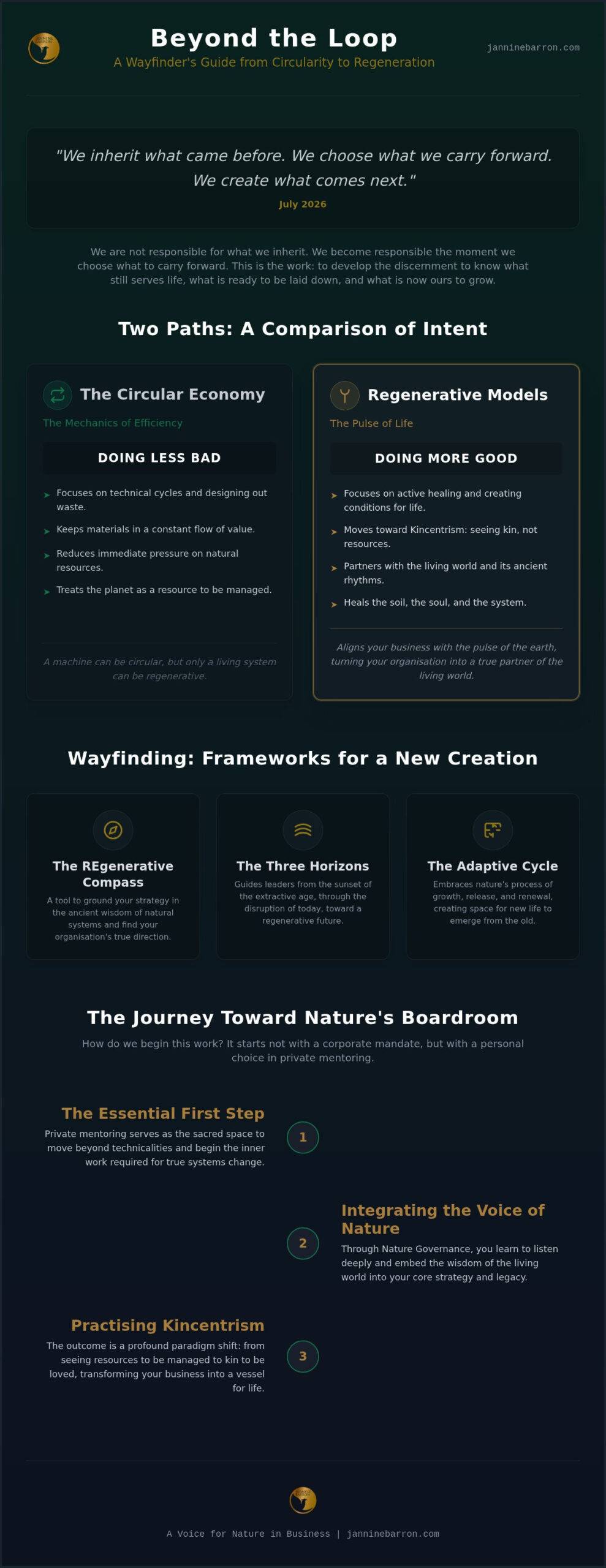
Why does a perfectly closed loop sometimes feel hollow? It is because efficiency is not the same as aliveness. A machine can be circular, but only a living system can be regenerative. While circularity focuses on technical cycles, Regenerative economics invites us to align our business pulse with the ancient rhythms of the earth. We must question if our sustainable loops are still serving an extractive core. If we recycle materials but continue to deplete the spirit of our people and the biodiversity of our land, have we truly changed?
True transformation requires us to move beyond the loop. We become responsible the moment we choose what to carry forward from our inheritance. This discernment is the first step in Nature’s Boardroom, where we learn to listen to the Voice of Nature. Regeneration is not about maintaining the status quo through better recycling; it is about active healing. It is about creating the conditions for more life to thrive through every transaction we make. We are not just managers of a system; we are the wayfinders of a new creation.
The Pulse of Regeneration: How It Differs from Circular Models
Business is not a machine. It is a living entity existing within a vast, interconnected forest of commerce. While the previous section explored circularity as a structural bridge, we must now look deeper into the spirit of our operations. Understanding the difference between the circular economy vs regenerative models is about shifting your gaze from the plumbing to the pulse. Regeneration is the act of bringing more life to every interaction. It is a move from sustainability, which seeks to maintain a precarious status quo, to active healing and evolution.
Circularity vs Regeneration: A Comparison of Intent
The core of this shift lies in how we view the world. Standard circular economy principles are masterful at keeping technical materials in use and designing out waste. This is essential for resource management. Yet, regeneration asks us to move toward Kincentrism. Instead of seeing resources, we see kin. We begin to treat our supply chains with the same care we would a garden. When we evaluate the circular economy vs regenerative intent, we see that circularity is about doing less bad. Regeneration is about doing more good by healing the soil, the soul, and the system. This requires an understanding of The Adaptive Cycle. In nature, growth is followed by release. To create space for new life, we must be willing to let go of what no longer serves the whole. It’s a process of pruning the old to feed the new.
The Three Horizons Framework for Wayfinders
How do we navigate this transition? I often use The Three Horizons Framework to guide leaders through this forest. Horizon One represents the sunset of the extractive age, where even purely circular models can sometimes feel like they’re just slowing down the inevitable. Horizon Two is the disruptive bridge. This is where we innovate for life, testing new ways of being that honour the Voice of Nature. Finally, Horizon Three is the regenerative future that is already trying to be born through our choices today, anchored in the wisdom of Nature Governance.
This journey of discernment is at the heart of my private mentoring, where we use the REgenerative Compass to find our way. We must remember the wisdom I shared in July 2026: “We inherit what came before. We choose what we carry forward. We create what comes next.” By choosing to carry forward only that which nourishes life, we begin to build a legacy that matters. Are you ready to stop managing depletion and start cultivating aliveness?
Inheriting the Past and Choosing the Future of Business
We are not responsible for what we inherit. This is the first liberation for any leader standing at the threshold of change. You did not design the extractive systems that dominate our world, nor did you write the original scripts of corporate governance that prioritise profit over the pulse of the planet. We find ourselves living in structures built by those who came before us. However, we become responsible the moment we choose what to carry forward. As we weigh the circular economy vs regenerative path, we are essentially deciding which parts of our inheritance still serve life and which are ready to be laid down in the compost of history.
In July 2026, I shared a truth that has become the heartbeat of my work: “We inherit what came before. We choose what we carry forward. We create what comes next.” This is the work of the wayfinder. It requires a deep, quiet discernment. It is about looking at our businesses not as machines to be fixed, but as legacies to be tended. While the US EPA on Circular Economy provides a clear baseline for keeping materials in use, the regenerative journey asks us to go further. It asks us to heal the very stories that allow extraction to exist in the first place.
The Past Lives on in Our Stories
What ghosts are haunting your boardroom? Ancient patterns of extraction often hide in the fine print of our contracts and the rhythm of our supply chains. These stories tell us that nature is a resource and that growth must be linear. To move from circular economy vs regenerative thinking, we must have the courage to identify these ghosts. We must ask if our current models are merely recycling old, tired ideas of dominance. True leadership in 2026 is the bravery to stop carrying forward what no longer serves the living world. It is the choice to let certain traditions die so that something more beautiful can be born.
Creating What Comes Next Through Discernment
How do we decide what stays and what goes? Whether you are leading an organisation in the historic centres of London or the vibrant landscapes of Sydney, the process remains the same. It begins with private mentoring to unlearn the habits of the extractive age. We use the Voice of Nature to guide our strategic decisions, ensuring that our legacy is defined by what we choose to grow now. By engaging in Nature’s Boardroom, we find the clarity to see which innovations are truly life affirming. Your role is to be the bridge between what was and what could be. What will you choose to carry into the next era?
Practising Kincentrism: From Resource Management to Life Alignment
What happens to your strategy when you stop viewing the world as a warehouse of materials and start seeing it as a family of relations? This is the core of Kincentrism. It is a profound shift in perception that moves us from the cold mechanics of resource management into the warm reality of life alignment. While the debate of circular economy vs regenerative models often stays on the surface of material flows, Kincentrism takes us to the root. It asks us to recognise our deep relationship with all living beings. When we partner with nature instead of trying to manage it, we stop being extractors and become creators of aliveness. We begin to understand that our organisations are not separate from the earth, but are breathing parts of a living whole.
The Voice of Nature in the Boardroom
Nature Governance is not a metaphor. It is a practical framework for leadership that places the living world at the centre of every decision. By bringing the Voice of Nature into your boardroom, you allow the wisdom of ancient evolution to inform your strategic table. This is where biomimicry becomes more than just a design tool; it becomes a way of structuring teams and life centric products. Traditional business coaching, such as the support offered by SA Business Coaching for business owners in South Australia, often focuses on the technicalities of efficiency, but nature aligned mentoring focuses on the essence of existence. It is about developing the discernment to know how your organisation can truly serve the whole. How would your next quarterly plan change if the forest itself had a vote?
Kincentrism transforms how we see our supply chains. Instead of viewing a supplier in the UK or a landscape in Australia as a mere link in a chain, we see them as kin. We recognise that their health is our health. This shift builds a level of brand trust and long term resilience that a purely circular model cannot reach. When you treat ecosystems as family, you naturally move toward a circular economy vs regenerative practice that heals as it grows. You are no longer just closing loops; you are nourishing the very soil that feeds your industry. This is the path to true business aliveness, where your success is measured by the vitality of the entire system you inhabit. If you are ready to move your leadership into this deeper alignment, I invite you to explore Nature’s Boardroom to begin your transformation.
Nature’s Boardroom: Your Journey Toward Regenerative Leadership
Transitioning from the technical loops of circularity to the heartbeat of regeneration is not a task for a spreadsheet. It is a journey of the soul. Why is private mentoring the essential first step for the regenerative wayfinder? It is because the leader must first clear the internal noise to truly hear the Voice of Nature. To support this mental shift, Feed Your Brain provides neuroscience-based consulting designed to help leaders and teams overcome resistance to change. While the debate over the circular economy vs regenerative models continues in corporate seminars, the true shift happens when a leader stands in a forest and realises they are part of the very system they seek to heal. This inner alignment is the foundation of everything that follows.
Nature’s Boardroom experiences are designed to unlock this fresh strategic thinking by removing the walls that separate us from life. By stepping into the ancient woodlands of Wiltshire or the surprising green spaces of London, we move beyond human centric silos and practice Nature Governance. These immersions are not retreats in the traditional sense; they are deep dives into business aliveness. They provide the quietude necessary to use the REgenerative Compass effectively, allowing you to see your organisation through the eyes of the living world.
Corporate hustle culture often leaves even the most visionary leaders feeling exhausted and disconnected. Nature based immersions offer a rhythmic pause to break through that noise. Forest therapy plays a vital role here, not just for individual wellbeing, but for restoring the discernment needed for complex systems change. Somerset and London are becoming vital hubs for this work, where leaders gather to unlearn the extractive patterns they inherited. In these spaces, we don’t just talk about sustainability; we feel the pulse of creation and allow it to reshape our vision for the future.
Stepping Into Your Responsibility
We inherit what came before. We choose what we carry forward. We create what comes next. This signature truth, which I first shared in July 2026, reminds us that your transition can begin this very moment. Whether you are currently operating within an extractive model or a circular one, the invitation is to move toward the life affirming depth of regeneration. You are not responsible for the past, but you are responsible for the legacy you choose to grow from this moment. How will you decide what still serves life and what is ready to be laid down?
For those ready for a sustained metamorphosis, The Growth Experience offers a nine month incubator to lead like nature. You do not have to walk this path alone. There is a community of purpose driven founders waiting to welcome you into a new way of being. Are you ready to take the first step and Explore our regenerative programmes and mentoring to see where the path leads? The forest is ready to speak; the only question is whether you are ready to listen.
Step Into Your Living Legacy
The transition from a linear past to a regenerative future is the most significant work a leader can undertake. We have explored why the circular economy vs regenerative path represents a shift from technical efficiency to true systemic healing. By embracing Kincentrism and integrating the Voice of Nature into your governance, you move beyond the limitations of being less bad. You begin to create conditions where life can thrive through your business operations. Remember that we are not responsible for what we inherit, but we become responsible the moment we choose what to carry forward.
Your journey as a wayfinder is supported by a legacy of ethical leadership dating back to the 1990s. Whether through the REgenerative Compass framework or immersive Nature’s Boardroom experiences in Wiltshire and London, the path to aliveness is clear. It is time to move your strategy from the boardroom to the forest floor. I invite you to Begin your regenerative transition with private mentoring today. Together, we will grow a legacy that honours the ancient rhythms of our planet and serves the generations yet to come. The world is waiting for your choice.
Frequently Asked Questions
What is the difference between circular and regenerative business models?
Circular models focus on technical loops to design out waste; however, regenerative models focus on biological cycles to heal systems. The circular economy vs regenerative distinction is one of intent. Circularity seeks to be less bad by maintaining materials. Regeneration seeks to be truly good by creating more life in every transaction. It is the difference between fixing a machine and tending a garden.
Can a circular economy also be regenerative?
Yes, circularity can serve as a structural bridge toward a regenerative future. While the circular economy vs regenerative debate often separates the two, they can work in harmony. Circularity provides the mechanics for keeping materials in flow, while regeneration provides the soul and the life affirming purpose. When circular principles are applied with the intent of active healing and biodiversity restoration, they align with the pulse of the living world.
How do I move from sustainability to regeneration in my leadership?
Moving from sustainability to regeneration requires a shift from maintaining the status quo to active creation. It begins with developing the discernment to know what still serves life and what is ready to be laid down. You must recognise that we are not responsible for what we inherit, but we become responsible the moment we choose what to carry forward. This is the wayfinder’s path to business aliveness in 2026.
What is Kincentrism and why does it matter for my business?
Kincentrism is the recognition of our deep relationship with all living beings as our kin. For your business, it matters because it shifts the paradigm from managing nature as a resource to partnering with nature as a family. This creates long term resilience and builds profound brand trust. When you see your supply chain as a community of life, your strategic choices naturally align with the ancient wisdom of the earth.
What are the Three Horizons in the context of regenerative strategy?
The Three Horizons Framework helps wayfinders navigate systemic change. Horizon One is the sunset of extractive and purely circular models. Horizon Two is the disruptive bridge where we innovate for life. Horizon Three is the regenerative future that is already trying to be born through our choices. By using this framework, leaders can manage the decline of old patterns while nurturing the growth of new, life affirming systems.
How does Nature Governance work in a modern corporate setting?
Nature Governance works by giving the living world a seat at the strategic table. In a modern corporate setting, this involves using the Voice of Nature to guide decisions and ensuring that governance structures protect the vitality of all kin. It moves beyond human centric design to life centric creation. By adopting this framework, organisations in London or Sydney can align their operations with the rhythms of the natural boardroom.
Why is private mentoring better than traditional coaching for this transition?
Private mentoring is the essential first step because it focuses on the inner work of the leader. Traditional coaching often prioritises clinical efficiency and profit targets. In contrast, a regenerative business mentor acts as a wayfinder, helping you navigate the REgenerative Compass and the Adaptive Cycle. This personal guidance allows you to unlearn extractive habits and develop the spiritual connection necessary to lead with love and technical expertise.
What is the Voice of Nature and how do I listen to it?
The Voice of Nature is the inherent wisdom of the living world that guides us toward aliveness. You listen to it by quieting the corporate noise and engaging in Nature’s Boardroom experiences. Through forest therapy and deep immersion, you learn to interpret the ancient patterns of the earth. This practice allows you to align your organisation with the rhythms of nature, ensuring your legacy is one that truly nourishes the whole.