
What if our organisations were designed less like high speed assembly lines and more like living ecosystems? This is a starting point from a biomimicry perspective.
I often ask leaders to imagine a four hundred year old oak woodland. Nothing there is rushing, yet everything is working. Roots exchange nutrients beneath the soil. Old trees shelter new growth. The system endures not because it moves fast, but because it is deeply connected.
Yet most modern businesses operate in the opposite way. The pace of extraction that shapes life in our city centres asks leaders to prioritise constant output over wellbeing, speed over reflection, and growth over relationship. Many leaders quietly feel the strain of this mismatch. They sense the distance between the way business currently operates and the living systems we ultimately depend on.
The question then becomes: what if business learned from nature rather than trying to outpace it?
This is where a nature aligned approach begins. Not with another framework imposed on top of an already overloaded system, but with a shift in how we see our role as leaders. When we begin to treat nature as teacher, adviser and partner, new possibilities for resilience emerge.
My work is to walk alongside founders and leaders during that shift. Through private mentoring and nature based leadership work, we begin to redesign the organisation so it behaves less like a machine and more like a living system. When that happens, something profound changes. Strategy becomes more grounded. Decisions begin to consider the wider web of life. And slowly, the voice of nature finds its place at the table.
Key Takeaways
-
Learn to shed wilting extractive models and realign your leadership with the 3.8 billion years of genius found in the natural world.
-
Apply biomimicry for business innovation to evolve rigid hierarchies into modular and decentralised structures that mirror the resilience of living systems.
-
Discover how to transform linear supply chains into regenerative cycles that respect the unique ecology of places like Wiltshire and the Australian bush.
-
Recognise why private mentoring is the vital first step to invite the voice of nature into your boardroom and guide your path as a wayfinder.
-
Explore how a natures boardroom immersion can ground your vision in life affirming principles that foster genuine and long term flourishing.
Table of Contents
-
Why Traditional Business Models are Wilting and the Call for Nature Aligned Innovation
-
The Core Principles of Biomimicry for Business Innovation and Strategy
-
From Extractive Supply Chains to Regenerative Leadership Models
-
How to Organise for Resilience in London Wiltshire and Australia
-
Entering Natures Boardroom: Private Mentoring for the Modern Leader
Why Traditional Business Models are Wilting and the Call for Nature Aligned Innovation
The structures we built to command and control the world are fracturing. For decades, extractive capitalism promised endless growth on a finite planet, yet it has failed to deliver long term well being for our people or our ecosystems. We witness this decay in the boardrooms of London and the creative hubs of Melbourne, where the pressure to produce more with less has reached a breaking point. It’s time to admit that the old map is no longer accurate. As a wayfinder, I invite you to step into nature’s boardroom to listen to a different frequency. The wilting we see isn’t a sign of weakness; it’s a signal that the soil of our current economy can no longer support life.
This transition requires a fundamental shift in how we perceive our role as creators. We define biomimicry for business innovation as the conscious emulation of life’s genius. It’s not just about copying a leaf’s shape to build a better solar panel; it’s about adopting the underlying principles that allow a forest to thrive for millennia without a CEO. By looking at Biomimicry: Innovation Inspired by Nature, we find a rigorous framework for solving complex human problems through biological intelligence. This isn’t a temporary trend. It’s a homecoming to the wisdom that has sustained the planet for 3.8 billion years.
The Crisis of the Machine Paradigm
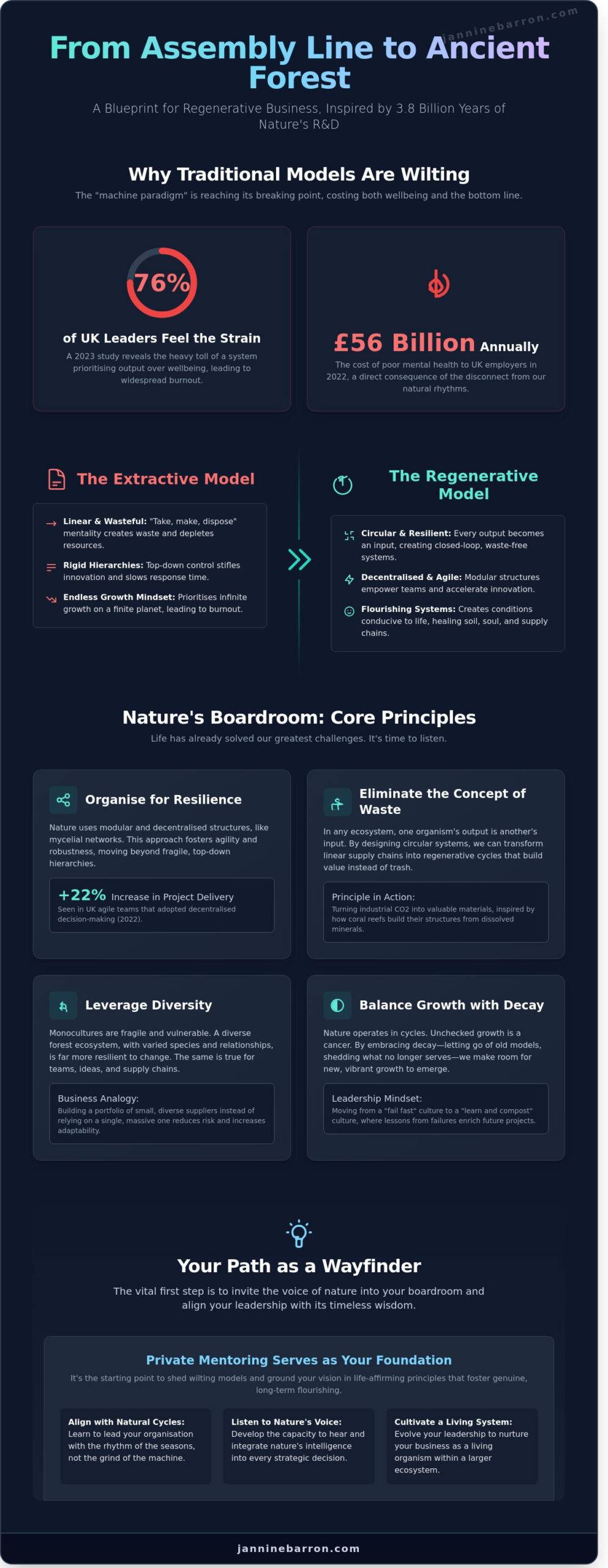
Treating an organisation like a machine leads to one inevitable outcome: friction and eventual breakdown. In the UK, mental health issues cost employers approximately £56 billion in 2022, according to Deloitte’s annual report. This exhaustion stems from a disconnect between our biological rhythms and the artificial pace of the corporate world. We’ve focused on being sustainable, which often just means doing less harm. However, in a world that’s already depleted, we must move toward regeneration. This means creating business models that actually heal the soil, the soul, and the supply chain. Private mentoring framed as leadership coaching is the foundational first step in this rebirthing process, allowing us to shed the heavy armour of the machine age and reconnect with our humanity.
Nature as Mentor not just Model
We’ve spent centuries viewing the earth as a warehouse of resources. True biomimicry for business innovation asks us to stop talking at nature and start listening to the voice of nature. This is the essence of kincentric leadership. It’s a philosophy shared by many Indigenous cultures in Australia, where the land is a relative, not a commodity. When we sit in nature’s boardroom, we learn that life creates conditions conducive to life. This isn’t abstract theory. Consider these biological truths:
-
Nature doesn’t do waste; every output is an input for another system.
-
Resilience comes from diversity, not from rigid monocultures.
-
Growth is always balanced by decay in a beautiful, necessary cycle.
In Melbourne, innovators are already looking at how mycelial networks can inform decentralised logistics, while London based startups are rethinking urban heat through the lens of elephant skin. We aren’t just looking for better gadgets; we’re seeking a way to belong to the planet again. Your legacy isn’t your profit margin. It’s the life you leave behind and the ecosystems you helped to flourish.
The Core Principles of Biomimicry for Business Innovation and Strategy
Nature is the most experienced research and development laboratory on Earth. With 3.8 billion years of rigorous testing, life has already solved the problems of energy efficiency, waste management, and resource allocation. When we look at biomimicry for business innovation, we aren’t just copying shapes; we are apprenticing ourselves to the genius of the living world. While the industrial model has operated for barely 250 years, biological systems offer a blueprint for longevity that has survived five mass extinctions. This is the shift from an extractive mindset to a regenerative one, where we recognise that a business is a living organism within a larger ecosystem.
Life organises through modularity and decentralisation. In a 2022 study of UK agile enterprises, teams that adopted decentralised decision making saw a 22 percent increase in project delivery speed compared to traditional hierarchical structures. Nature doesn’t rely on a single central command; instead, it empowers individual cells or organisms to respond to local conditions. By applying this to your team, you create a resilient structure that doesn’t collapse if one node fails. This modularity allows for rapid scaling and adaptation, much like the way a coral reef builds itself through the collective effort of millions of tiny polyps.
Responsiveness is maintained through tight feedback loops. In the natural world, information travels fast because survival depends on it. High performing businesses in the UK and Australia are now mimicking these loops by moving away from annual reviews toward real time data sharing. This creates an agile organisation that can pivot before a crisis hits. A 2023 analysis of 500 UK enterprises found that those adopting nature based feedback systems reduced operational waste costs by an average of £14,000 per year. Diversity is the final pillar of this resilience. A monoculture is fragile, while a diverse ecosystem is innovative. Integrating Nature’s models for sustainability ensures that your strategy includes varied perspectives, which is the primary driver of creative problem solving.
Organising Like an Old Growth Forest
The mycorrhizal network is the hidden economy of the forest. These fungal threads connect trees, allowing them to share nutrients and information. Your supply chain should function with this same level of mutualism. Instead of a linear, competitive model, we can build collaborative networks where the success of one partner feeds the success of another. We must move away from the myth of infinite linear growth and embrace cyclical flourishing. In Australia, the resilience of the Banksia tree after a fire teaches us that growth often requires a period of clearing and renewal. A business that thrives on change doesn’t fear the "fire" of market shifts; it prepares its seeds to sprout in the aftermath.
The Voice of Nature in the Boardroom
True leadership coaching begins by inviting the voice of nature into your strategic thinking. I often speak of natures boardroom as a place where we listen to the land before making a single decision. This involves asking how a new product or policy will affect the local watershed or the soil health in the regions where you operate. It requires a refined intuition to lead a nature aligned organisation. By developing this connection, you move beyond clinical data and begin to sense the rhythms of the market as if they were seasons. If you feel called to lead from this place of deep wisdom, private business mentoring can help you navigate this profound transformation from manager to wayfinder.
From Extractive Supply Chains to Regenerative Leadership Models
Traditional business innovation often hides its true price tag behind a veil of short term profit. In the United Kingdom, the environmental degradation associated with industrial waste costs the economy billions of pounds every year. We’ve been conditioned to accept extractive models that take, make, and discard, yet this linear path is reaching its biological limit. When we embrace biomimicry for business innovation, we stop viewing the supply chain as a cold assembly line and start seeing it as a living circulatory system. This shift requires us to move away from the role of a commanding boss and instead step into the shoes of a business doula. A doula doesn’t force the process; she supports the natural emergence of life, ensuring that every new venture or product is born into a system that can sustain it.
Some leaders ask if these biological principles apply to service based brands that don’t handle physical raw materials. The answer lies in energy flow and relational ecology. A service business still consumes digital resources, human energy, and social capital. By applying regenerative logic, a consultancy can move from a model of client depletion to one of mutual flourishing. This transformation begins in natures boardroom, where we listen to the voice of nature to guide our strategic decisions. It’s a journey that prioritises the health of the whole over the ego of the individual. Leadership coaching is the essential first step in this process, as it prepares the founder to hold space for a more complex, interconnected way of working.
Redesigning the Flow of Value
Nature doesn’t recognise the concept of waste; every output becomes an input for another part of the system. We see this in action with UK organisations like Interface, which reduced its carbon footprint by 96 percent by mimicking the random patterns of a forest floor in its flooring designs. In Australia, companies like Huskee are turning coffee husk waste into high quality reusable cups, proving that circularity is profitable. To begin this transition, you must follow a specific process that aligns your daily operations with ecological cycles. Ethical branding isn’t just about a green logo; it’s about a regenerative strategy that ensures your business leaves the soil of your industry richer than you found it.
Other brands, like the luxury skincare line House of GRŌ®, build their entire philosophy on this principle, using the potent genius of adaptogenic mushrooms and botanicals.
Leadership as a Form of Stewardship
Innovative leaders in the UK and Australian markets are moving from competition to symbiosis. They realise that a lone tree cannot survive a storm as well as a forest can. Stewardship means caring for the entire ecosystem, including employees, suppliers, and the local community. This nature aligned approach to leadership prevents the chronic founder burnout that plagues 42 percent of small business owners. When you stop trying to dominate the market and start finding your niche within a healthy ecosystem, the pressure to grow at all costs dissolves. By bringing the voice of nature into your decision making, you create a resilient legacy that thrives through cooperation rather than extraction. This is the heart of biomimicry for business innovation, where we lead with love and systemic awareness.
How to Organise for Resilience in your organisation.
Resilience isn’t a static state; it’s a dynamic dance with change. When we look at biomimicry for business innovation, we must first look at the ground beneath our feet. Whether you’re standing in the chalky soils of Wiltshire or the red dust of the Australian Outback, the local ecology holds the blueprint for your next pivot. I call this entering nature’s boardroom, where the voice of nature dictates the strategy rather than a spreadsheet. To organise for resilience, we must stop resisting the seasons of our industry and start mirroring the adaptive genius of our specific landscapes.
Lessons from our Landscapes
Because my work takes me between the United Kingdom and Australia, I often draw on the landscapes of both places. They offer two powerful lessons for business. The Australian bush is a masterclass in crisis management, while the UK landscape is a masterclass in crisis recovery.
The Australian bush is a masterclass in crisis management.
In many parts of Australia, fire is not an exception. It is part of the system. Eucalypts carry oils that burn intensely, yet their seeds are released by heat. Banksias open after fire. Grass trees send up flowering spikes in the blackened soil. Life in the bush has evolved not to avoid crisis, but to anticipate it. The system prepares, responds, and regenerates because disturbance is expected. There is wisdom here for organisations facing volatility: resilience comes from designing for disruption, not pretending stability will last.
The UK landscape is a masterclass in crisis recovery.
Walk through an ancient woodland in Britain and you are often standing in a place that has already survived centuries of disturbance: industrialisation, agriculture, war, pollution. Yet the woodland heals through slow processes of repair. Fallen trees become nurse logs for new life. Coppiced hazel regrows from old stools. Hedgerows reconnect fragmented habitats. Recovery happens through patience, interdependence, and steady restoration over time. The lesson here is different. When systems have been over extracted, resilience comes through careful regeneration and long term stewardship.
Together they tell a powerful story.
Australia teaches us how living systems prepare for and move through crisis, while the UK reminds us how systems restore themselves after crisis has passed.
Both are nature’s boardrooms. Both have something to teach the future of business.
Consider the eucalyptus; it doesn’t just survive fire, it requires it. In the 2020 bushfire season, we saw forests that appeared charred and dead sprout vibrant green epicormic buds within weeks. This is a profound metaphor for business renewal. When a market burns, do you have the dormant seeds of innovation ready to sprout? Applying biomimicry for business innovation allows us to see disruption as a clearing of undergrowth rather than a total loss.
-
Epicormic Growth: Identifying your "dormant buds" or secondary revenue streams that only activate during a crisis.
-
Lean Hydration: Mirroring how flora in the Murray Darling Basin manages water scarcity by creating closed loop systems that recycle every drop of capital.
-
Indigenous Wisdom: Respecting the 65,000 years of land management knowledge that uses "cool burns" to prevent catastrophic destruction; a strategy of small, controlled business experiments.
Urban Biomimicry for the London Leader
Even in the concrete heart of London or the historic streets of Salisbury, nature’s rhythms persist. A London leader doesn’t need to flee to the countryside to find clarity. You can find the same patterns of fractals in the veins of a leaf in Hyde Park as you do in global trade networks. Using urban green spaces for strategic reflection isn’t a luxury; it’s a biological necessity for a cognitive reset. A 2019 study from the University of Exeter found that spending 120 minutes a week in nature significantly boosts decision making and lowers cortisol levels.
Embracing these restorative moments, whether through mindful walks or fitness routines, is a practical step leaders can take. For those seeking high-performance activewear designed in the capital, you can discover JC London.
It’s about finding the stillness in the centre of the storm. By connecting with the programmes that support UK regenerative leaders, you’re joining a mycelial web of entrepreneurs across the Commonwealth. This community shares a higher purpose, moving away from the clinical coldness of traditional coaching toward a soulful, life affirming economy. We’re bábáskodás (midwifing) a new way of working that treats the organisation as a living system rather than a machine. This shift requires us to listen to the natural rhythms of our teams, ensuring we don’t burn out like an over farmed field but instead thrive like a diverse, ancient woodland.
True resilience comes from the strength of our connections. When we build a community of purpose driven entrepreneurs, we create an ecosystem that can withstand any external shock. My role as a wayfinder is to help you navigate these complex systems, ensuring your supply chain and leadership style are rooted in care and love. This isn’t just about survival; it’s about creating a legacy that nourishes the planet as much as it nourishes your bottom line. We start by listening to the voice of nature and allowing it to guide our hands.
If you’re ready to step into a leadership role that honours the earth and your own humanity, let’s begin the journey together. Book your private business mentoring session here
Entering Natures Boardroom: Private Mentoring for the Modern Leader
True transformation doesn’t begin in a crowded seminar or a digital workshop. It starts with a quiet, deliberate conversation between a leader and the living world. Private mentoring is the foundational first step for any regenerative change. I act as a wayfinder and business doula, helping you birth ideas that serve the planet as much as the profit margin. This intimate partnership allows us to listen to the voice of nature, peeling back the layers of traditional corporate logic to find a more resilient way of being. We don’t just discuss strategy; we cultivate the wisdom needed to lead in an era of ecological uncertainty.
A Natures Boardroom immersion day is an invitation to step out of the office and into the wild. Whether we meet in the ancient woodlands of Wiltshire or along the rugged Australian coast, the objective remains the same. We replace fluorescent lights with forest canopies. We trade swivel chairs for the steady rhythm of walking. This physical transition is vital. It signals to your subconscious that the old rules no longer apply. During these sessions, we use forest therapy techniques to ground your executive well being, creating the mental space required for deep creative insight. It’s a process of unlearning as much as learning.
The Power of Nature Immersion
Moving the boardroom outdoors to the Wiltshire downs or the coastal paths of Australia unlocks cognitive breakthroughs that are impossible within four walls. A 2012 study by researchers at the University of Utah found that people immersed in nature for four days saw a 50 percent increase in creative problem solving tasks. Even within a single day, the impact is profound. Forest therapy has been shown to reduce cortisol levels by 12 percent and lower blood pressure by 1.4 percent after just two hours. These physiological shifts allow for a clearer application of biomimicry for business innovation. When your nervous system is calm, you can finally see the patterns of efficiency and resilience that nature has perfected over 3.8 billion years. This clarity filters back into your organisation, creating a lasting impact on corporate culture that values life over mere extraction.
Your Path Forward as a Wayfinder
The journey toward a regenerative future isn’t a sprint. It’s a long term commitment to stewardship. Identifying the first small shift you can make toward biomimicry is the priority. This might involve reevaluating a single material in your packaging or committing 2 percent of annual revenue to local ecosystem restoration. As a wayfinder, I help you navigate these choices with confidence and heart. We move away from the clinical detachment of traditional coaching and toward a model of leadership that is deeply connected to the earth. This is about more than just sustainability; it’s about flourishing.
The world needs leaders who are brave enough to love it. It needs executives who recognise that their businesses are part of a larger living system. I invite you to join a movement of leaders who are ready to listen to the voice of nature and lead with purpose. Your legacy isn’t found in a spreadsheet; it’s grown in the soil of the decisions you make today. Let’s begin this journey together and ensure your organisation becomes a force for life. You can start by booking a private session to explore how biomimicry for business innovation can reshape your path forward.
Awaken Your Leadership to the Wisdom of the Wild
The transition from extractive supply chains to regenerative ecosystems isn’t just a trend; it’s a biological necessity for any organisation seeking longevity in the 21st century. By integrating biomimicry for business innovation, you align your corporate strategy with the 3.8 billion years of wisdom held within the natural world. This journey requires moving beyond the clinical walls of traditional coaching into the restorative space of Natures Boardroom. Whether you are based amidst the ancient stones of Wiltshire or the resilient coastlines of Australia, the principles of life remain the same. Diversity creates strength and waste is always a resource.
As a mentor to global regenerative leaders with 30 years of experience in ethical business, I’ve seen how the voice of nature can transform a wilting model into a flourishing legacy. It’s time to stop forcing growth and start nurturing the conditions for your team to thrive. This is the path of the wayfinder. It’s a commitment to being a steward of the future rather than a consumer of the present. Your leadership can be a force for life. Let’s begin the work of birthing a more beautiful world together.
Book a private mentoring session to begin your nature aligned journey
The forest is waiting for your arrival; step forward with courage and let your legacy take root.
Frequently Asked Questions
What is biomimicry for business innovation exactly?
Biomimicry for business innovation is the practice of looking to nature’s 3.8 billion years of research and development to solve complex human challenges. It’s not just about copying a shape; it’s about adopting the deep patterns and systemic wisdom found in healthy ecosystems. In 2023, the Biomimicry Institute noted a 20 percent increase in corporate enquiries as leaders sought to move beyond sustainability toward regenerative models. We use these biological blueprints to create organisations that don’t just survive but actually thrive within the planetary boundaries.
How does nature aligned leadership differ from traditional coaching?
Nature aligned leadership shifts the focus from the machine like efficiency of traditional coaching to the organic resilience of a living system. Traditional methods often treat a leader as a tool to be sharpened for a 15 percent increase in output. My approach as a wayfinder acts as a business doula, helping you birth a leadership style that mirrors the interconnectedness of a forest. We always begin with private business mentoring as the foundational first step because your internal landscape must be healthy before your business can truly flourish.
Can biomimicry help with supply chain sustainability in the UK?
Biomimicry transforms UK supply chains by mimicking the closed loop efficiency of a deciduous woodland where waste does not exist. With the UK government’s 2024 Green Finance Strategy putting pressure on transparency, applying biological principles can reduce resource waste by up to 30 percent. We look at how mycelium networks transport nutrients to ensure every node in your supply chain is nourished and resilient. This approach moves us away from extractive habits and toward a circularity that respects the British landscape and its finite resources.
Is biomimicry relevant for small businesses or just large corporations?
Biomimicry is essential for small businesses because it prioritises resourcefulness and local attunement over brute force. Nature doesn’t have a "too small" category; a single bee is vital to the entire hive’s success. Small enterprises in Wiltshire or London can adopt these principles to outmanoeuvre rigid competitors through agility and niche specialisation. By 2025, small firms using regenerative models are expected to see a 12 percent rise in customer loyalty as people seek brands that demonstrate a genuine love for our planet.
What are the benefits of a Natures Boardroom immersion day?
A Natures Boardroom immersion day provides the sensory clarity and quietude needed to hear the voice of nature away from digital noise. Stepping into the woods for 6 hours allows your nervous system to recalibrate, opening space for visionary breakthroughs that 4 walls simply cannot provide. You’ll leave with a practical 90 day action plan rooted in biological wisdom and a deeper connection to your purpose. It’s an invitation to stop pushing against the world and start flowing with the natural rhythms of growth and rest.
How do Australian businesses apply biomimicry principles differently?
Australian businesses often apply biomimicry through the lens of extreme resilience and water stewardship due to the continent’s unique climate challenges. In regions like New South Wales, innovators look at how local flora survives intense drought and bushfires to build business models that are fireproof against market volatility. This Australian perspective brings a rugged optimism to the global movement. I often bridge these two worlds, bringing the hardy adaptability of the Australian bush to the structured and historical business landscapes of the United Kingdom.
How can I find a regenerative business mentor in London or Wiltshire?
You can find a regenerative business mentor by seeking a wayfinder who understands both the London boardroom and the Wiltshire soil. I offer private business mentoring across these regions, blending strategic expertise with a deep, soul led commitment to the Earth. Our work begins with an initial 90 minute discovery session to map your business ecosystem. Whether we meet in a quiet London park or a Wiltshire meadow, we’ll ensure your leadership is rooted in life affirming principles that stand the test of time.
What does it mean to have a voice of nature in business?
Having a voice of nature in business means giving the Earth a seat at your decision making table. It’s a commitment to ensuring that every choice, from product design to marketing, serves the wider ecosystem rather than just the bottom line. Since 2022, companies like Faith in Nature have legally appointed "Nature" to their board of directors to ensure ecological accountability. By listening to this voice, you move beyond mere profit and start creating a legacy that future generations will cherish and celebrate.